Managed Detection and Response (MDR) Market

Managed Detection and Response (MDR) Market by Offering (MDR-Integrated Platforms [XDR, EDR, SIEM], MDR Services [Fully-Managed, Co-Managed), Deployment Mode (Cloud-based, On-premises, Hybrid), Organization Size, Vertical - Global Forecast to 2031




OVERVIEW

Source: Secondary Research, Interviews with Experts, MarketsandMarkets Analysis
The managed detection and response (MDR) market is projected to reach USD 17.64 billion by 2031 from USD 6.22 billion in 2026, at a CAGR of 23.2% from 2026 to 2031. The rise in the threat of business email compromise, ransomware, and crypto-jacking attacks is creating demand for MDR services. On the other hand, a shortage of security professionals and the increasing number of alerts triggered by different security systems and tools are making it hard for in-house security teams to manage the rising threat of cyber attacks. MDR services are helping organizations to address the challenges mentioned above by offering 24x7 threat hunting and response services by leveraging the use of advanced tools and technologies. This is helping organizations to improve the overall effectiveness of threat detection and response.
Market Size and Forecast:
- 2025 Market Size: USD 5.05 Billion
- 2026 Projected Market Size: USD 6.22 Billion
- 2031 Forecasted Market Size: USD 17.64 Billion
- Growth Rate (2026-2031): CAGR of 23.2%
- Forecast period: 2020–2031
- MDR Integrated Platforms segment to dominate market CAGR of 25.3%.
Key Market Trends and Insights
- Future Outlook: AI-driven automation, proactive threat hunting, and expanded cloud security.
-
Growth Factors: Escalating cyber threats, strict compliance mandates, and severe talent shortages.
- Growth Trends: AI-driven orchestration, continuous posture management, and specialized IoT security.
- Emerging Opportunities: Integrating AI for automated response workflows and protecting cloud infrastructures.
KEY TAKEAWAYS
-
BY REGIONNorth America is estimated to account for the highest share of 41.2% of the MDR market in 2026.
-
BY OFFERINGBy offering, the MDR services segment is expected to dominate the market in 2026.
-
BY MDR-INTEGRATED PLATFORMSBy MDR-Integrated Platforms, the Integration to XDR Platform segment is projected to register the highest CAGR of 27.7% during the forecast period.
-
BY MDR SERVICESBy MDR Services, the fully-managed services segment is estimated to account for the largest market size during the forecast period.
-
BY DEPLOYMENT MODEBy deployment mode, the hybrid-MDR segment is expected to register the highest CAGR of 26.2% during the forecast period.
-
BY ORGANIZATION SIZEBy organization size, the SMEs segment is projected to register the highest CAGR during the forecast period.
-
BY VERTICALBy vertical, the healthcare & life sciences segment will grow at the highest CAGR of 26.6% during the forecast period.
-
COMPETITIVE LANDSCAPE - KEY PLAYERSKey players in the MDR market include CrowdStrike, Rapid7, and Arctic Wolf, who are providing enhanced threat detection response and prevention services through AI-powered analytics, cloud-based delivery and integrated XDR capabilities. They offer services for continuous monitoring, threat hunting, and incident response to help enterprises enhance security operations across endpoints, the cloud, and networks.
-
COMPETITIVE LANDSCAPE - STARTUPS/SMEsThe new entrants in the MDR market include Cynet, Deepwatch, Critical Start, and others. They specialize in providing agile, cloud-based MDR services with a particular emphasis on SOC-as-a-Service, threat visibility, and response automation, targeting enterprises looking for scalable, cost-efficient, and outcome-based cybersecurity operation support.
Through MDR, companies are able to respond to increased cyber threats efficiently by filtering out false positive and noise using context and threat intelligence. This allows them to focus on what really matters, which is important because cybersecurity requires constant monitoring and vigilance. In addition, MDR services provide high scalability of SOC and responses, which helps companies improve their overall security posture in the continuously evolving IT landscape.
TRENDS & DISRUPTIONS IMPACTING CUSTOMERS' CUSTOMERS
The MDR market is moving beyond traditional MSSP-driven monitoring and reactive incident response with AI-driven, cloud-native, and XDR-integrated security operations. Revenue growth is being driven by proactive threat hunting, automated response orchestration, and platform-driven delivery. In various sectors such as IT & telecommunications, energy & utilities, and retail & e-commerce, organizations are focused on continuous visibility, protection of distributed environments, and real-time detection of emerging threats. This is enabling better operational resilience, cyber risk reduction, and customer trust within digital environments.

Source: Secondary Research, Interviews with Experts, MarketsandMarkets Analysis
MARKET DYNAMICS

Level
-
Need for 24/7 security monitoring and rapid incident response

-
Cost efficiency compared to building in-house SOCS


Level
-
Complexity of managing multi-vendor security environments

-
False positives hinder effectiveness of MDR services


Level
-
Increasing adoption of cloud and multi-cloud environments

-
Increasing demand for integrated extended detection and response (XDR)


Level
-
Managing large volumes of security alerts and data

-
Difficulty in detecting sophisticated and evolving cyber threats

Source: Secondary Research, Interviews with Experts, MarketsandMarkets Analysis
Driver: Need for 24/7 security monitoring and rapid incident response
Continuous monitoring of security is essential for businesses today due to the ever-increasing number of threats and the evolving nature of cyberattacks. Cybercriminals are constantly looking for new ways to take advantage of the vulnerabilities in an organization's system and often exploit these vulnerabilities within minutes. This requires real-time threat detection and response. MDR provides continuous security monitoring, threat detection, and rapid response to events (which reduces dwell time and impact), helping to maintain business continuity in a constantly changing threat landscape.
Restraint: Complexity of managing multi-vendor security environments
In organizations, several types of security products from various vendors may be utilized, making it difficult to gain comprehensive visibility and improve efficiency. The integration of all these systems is not always easy and may require considerable effort and knowledge. Such complexity leads to duplicate alerts, lack of consistent policies, and long response times. Consequently, managing multi-vendor systems becomes an issue, making MDR implementation harder.
Opportunity: Increasing adoption of cloud and multi-cloud environments
Increasing adoption of cloud and multi-cloud computing environments is presenting major growth opportunities for MDR services. In these environments, where the workload is distributed across several cloud computing systems, there are more potential attack surfaces, and hence the need for integrated security measures arises. This is why cloud-native MDR solutions will see increasing adoption going forward.
Challenge: Managing large volumes of security alerts and data
Security teams become inundated by the sheer number of alerts generated by different systems and tools. It becomes even harder for them to distinguish which alerts are real and which are not, leading to alert fatigue and delayed responses. This is where the role of the MDR provider comes in, since they should be able to utilize intelligent solutions to manage such problems.
MANAGED DETECTION AND RESPONSE (MDR) MARKET: COMMERCIAL USE CASES ACROSS INDUSTRIES
| COMPANY | USE CASE DESCRIPTION | BENEFITS |
|---|---|---|
 |
A US-based insurance and annuity firm adopted eSentire’s MDR services to address visibility and configuration challenges across its multi-cloud environment and enable centralized threat monitoring. | Achieved unified security visibility, strengthened protection against misconfigurations and cyber threats, reduced operational complexity, and improved resilience of cloud-based financial services |
 |
A Canadian financial services organization deployed Arctic Wolf’s MDR service to proactively detect and respond to business email compromise (BEC) risks and other real-time cyber threats. | Enabled faster threat detection and response, reduced risk of financial losses and data breaches, and enhanced continuous security monitoring across critical financial systems |
|
|
A global investment firm adopted MDR services from eSentire to overcome alert fatigue, limited SOC coverage, and challenges associated with remote workforce security and cloud migration. | Reduced security workload for internal teams, gained continuous global threat monitoring support, improved breach detection capability, and strengthened overall cybersecurity posture |
Logos and trademarks shown above are the property of their respective owners. Their use here is for informational and illustrative purposes only.
MARKET ECOSYSTEM
MDR ecosystem includes technology companies, service providers, and other security stakeholders that provide continuous threat monitoring and response services. It operates around the MDR integrated platforms and MDR services. MDR platform vendors offer integrated solutions with EDR, XDR, and SIEM, and MDR service providers and MSSPs deliver 24/7 monitoring, threat hunting, and incident response services. Increasing compliance requirements and digital transformation initiatives are driving its adoption and reinforcing its importance in cybersecurity strategies.

Logos and trademarks shown above are the property of their respective owners. Their use here is for informational and illustrative purposes only.
MARKET SEGMENTS

Source: Secondary Research, Interviews with Experts, MarketsandMarkets Analysis
MDR Market, by Offering
The MDR services segment leads the MDR market due to increasing demand for outsourced cybersecurity expertise and for threat monitoring all around the clock. Many organizations rely on service providers to detect suspicious activities and respond accordingly. Such an approach can be beneficial for organizations, especially when there is a need to address a skills shortage issue.
MDR Market, by MDR-Integrated Platforms
EDR integration leads the MDR-integrated platforms segment in the MDR market, as endpoint security is a key component of threat detection. EDR platforms offer insights on endpoint activities, facilitating quick detection of threats. Integration with MDR services improves real-time monitoring, investigation, and response. Growing endpoint attacks spur the demand for EDR-integrated MDR solutions.
MDR Market, by MDR Services
The fully-managed MDR services segment accounts for the largest share of the overall market, as companies prefer to have all their security operations outsourced to third-party professionals. The main advantage of such services is that companies get all the necessary protection and do not have to possess any knowledge about security measures. The use of such services is particularly beneficial for those organizations that lack any security experience.
MDR Market, by Deployment Mode
Cloud-based MDR has the largest market share due to the rapid adoption of cloud computing and SaaS applications. Such solutions provide scalability and centralized visibility across distributed environments. Additionally, the organizations benefit from reduced infrastructure costs and real-time threat detection. As more workloads move into the cloud, demand grows.
MDR Market, by Organization Size
Large enterprises are at the forefront of MDR adoption, primarily because of their complex IT infrastructure and high data volumes. In addition, these organizations are more susceptible to sophisticated cyber attacks. Based on IBM X-Force Threat Intelligence Index, in March 2025, large enterprises remained at the forefront of attacks by advanced persistent threats and ransomware attacks. In September 2024, based on the Rapid7 2024 Attack Surface Intelligence Report, organizations are adopting MDR solutions to address their attack surface and global infrastructure through their expanded digital footprint.
MDR Market, by Vertical
The healthcare and life sciences vertical dominates the MDR market owing to the sensitive nature of patient information and the rising number of cyberattacks on the industry. There are many instances where healthcare organizations have experienced ransomware and data breaches. MDR services provide continual monitoring, regulatory compliance, and rapid incident response. They enable healthcare organizations to securely transform their operations digitally while protecting their critical operations
REGION
Asia Pacific to be fastest-growing region in global MDR market during forecast period
The Asia Pacific market for MDR services is growing at the fastest rate due to rapid digital transformation, growing demand for cloud computing, and increasing security threats in emerging markets. According to the IBM X-Force Threat Intelligence Index, in March 2025, there was a notable increase in ransomware and phishing attacks in the Asia Pacific region. According to the Palo Alto Networks Unit 42 Threat Report, in July 2024, the Asia Pacific region witnessed a rise in attacks exploiting cloud and identity vulnerabilities, thus creating a need for MDR services to strengthen threat detection and response.

MANAGED DETECTION AND RESPONSE (MDR) MARKET: COMPANY EVALUATION MATRIX
CrowdStrike (Key Player) occupies the most dominant position in the MDR market when it comes to the provision of Falcon solutions that offer intelligent integrated threat detection, threat intelligence, and response solutions utilizing artificial intelligence technology. On the other hand, Lumifi Cyber (Emerging Leader) is establishing itself in the MDR market through service-based and automated MDR solutions.

Source: Secondary Research, Interviews with Experts, MarketsandMarkets Analysis
KEY MARKET PLAYERS
- CrowdStrike
- Rapid7
- Sophos
- Arctic Wolf
- Red Canary
- Palo Alto Networks
- Kudelski Security
- eSentire - Past client
- Proficio - Past client
- Seceon
- SentinelOne
- Expel
- Levelblue
- Bitdefender
MARKET SCOPE
| REPORT METRIC | DETAILS |
|---|---|
| Market Size in 2025 (Value) | USD 5.05 Billion |
| Market Forecast in 2026 (Value) | USD 6.22 Billion |
| Market Forecast in 2031 (Value) | USD 17.64 Billion |
| Growth Rate | CAGR of 23.2% from 2026-2031 |
| Years Considered | 2020-2031 |
| Base Year | 2025 |
| Forecast Period | 2026-2031 |
| Units Considered | Value (USD Billion) |
| Report Coverage | Revenue forecast, company ranking, competitive landscape, growth factors, and trends |
| Segments Covered | Offerings (MDR-integrated platforms (Integration to XDR platform, Integration to EDR platform, Integration to SIEM platform)), MDR Services (fully-managed services, co-managed services)), deployment mode (cloud-based MDR, on-premises MDR, hybrid MDR), organization size (large enterprises & SMEs), vertical (BFSI, healthcare & life sciences, IT & telecommunications, government & defense, retail & e-commerce, manufacturing, energy & utilities, media & entertainment, transportation & logistics, travel & hospitality, other verticals) |
| Regions Covered | North America, Europe, Asia Pacific, Middle East & Africa, Latin America |
WHAT IS IN IT FOR YOU: MANAGED DETECTION AND RESPONSE (MDR) MARKET REPORT CONTENT GUIDE

DELIVERED CUSTOMIZATIONS
We have successfully delivered the following deep-dive customizations:
| CLIENT REQUEST | CUSTOMIZATION DELIVERED | VALUE ADDS |
|---|---|---|
| Leading Solution Provider (US) | Product Analysis: MDR Matrix providing an in-depth comparison of leading vendors’ offerings, including 24/7 threat detection, proactive threat hunting, incident investigation, automated response orchestration, XDR integration, threat intelligence, and SOC-as-a-Service capabilities; These platforms deliver unified visibility across endpoint, network, cloud, and identity environments, along with analytics, reporting, and flexible deployment models across cloud, hybrid, and on-premises infrastructures. | Stronger understanding of competitive positioning in the MDR market, service depth across detection and response workflows, automation maturity, AI-driven analytics capabilities, and platform integration strengths – supporting strategic investments, vendor selection, and long-term cyber resilience strategies |
| Leading Service Provider (EU) | Company Information: Detailed profiling and evaluation of additional MDR vendors and service providers (up to 5), covering managed threat detection, incident response capabilities, SOC delivery models, threat intelligence integration, automation maturity, global SOC presence, compliance support, and strategic partnerships across industries | Comprehensive perspective of the evolving MDR landscape, highlighting increasing adoption of AI-driven security operations, convergence of XDR and SOC platforms, growing reliance on outsourced detection and response services, and vendor differentiation through automation, proactive threat hunting, and continuous security operations capabilities |
RECENT DEVELOPMENTS
- March 2026 : CrowdStrike introduced its Agentic MDR solution under the Falcon platform, leveraging AI-powered agents to automate threat investigation and response workflows, enabling machine-speed detection and response while improving SOC efficiency and accuracy in handling large-scale cyber threats
- December 2025 : CrowdStrike partnered with Kroll to enhance global MDR services, migrating over 500,000 endpoints to the Falcon Complete platform to deliver AI-driven detection, investigation, and response capabilities, improving cyber resilience and reducing response times across enterprise environments.
- April 2025 : Rapid7 launched MDR for Enterprise, a fully managed and customizable MDR service designed for complex, distributed environments, integrating endpoint, network, cloud, and identity telemetry with tailored detection engineering and 24/7 SOC support.
- September 2024 : Rapid7 expanded its MDR capabilities with MDR for the Extended Ecosystem, enabling integration of third-party security tools such as endpoint, cloud, and identity platforms to provide broader visibility and improved threat detection across complex IT environments.
Table of Contents
 Exclusive indicates content/data unique to MarketsandMarkets and not available with any competitors.
Methodology
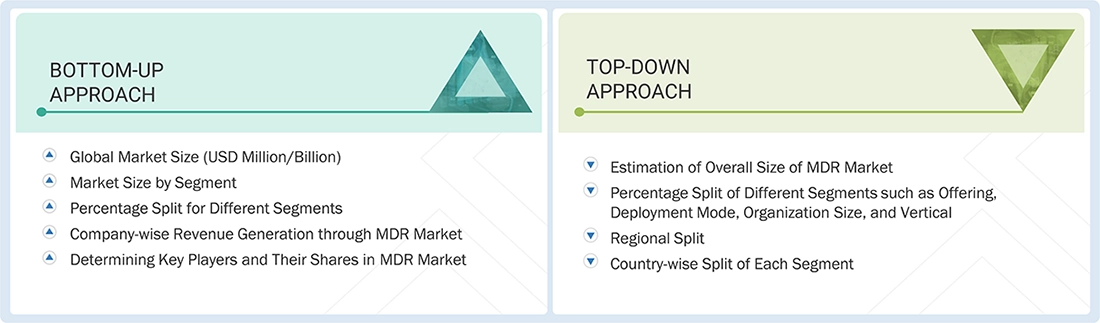
Secondary research was conducted to collect information useful for this technical, market-oriented, and commercial study of the MDR market. The next step involved validating these findings, assumptions, and sizing with industry experts across the value chain using primary research. Different approaches, including top-down and bottom-up methods, were employed to estimate the total market size. After that, the market breakup and data triangulation procedures were used to estimate the market size of the segments and subsegments of the MDR market.
Secondary Research
During the secondary research process, various secondary sources were consulted to identify and collect information relevant to the study. The secondary sources included annual reports, press releases, investor presentations of MDR vendors, forums, certified publications, and whitepapers. The secondary research was mainly used to obtain key information about the industry's supply chain, the total pool of key players, market classification and segmentation according to industry trends to the bottom-most level, regional markets, and key developments from both market- and technology-oriented perspectives, all of which were further validated by primary sources.
Primary Research
In the primary research process, various primary sources from both the supply and demand sides were interviewed to obtain qualitative and quantitative information for this report. The primary sources from the supply side included various industry experts, including chief executive officers (CEOs), vice presidents (VPs), marketing directors, technology and innovation directors, and related key executives from various key companies and organizations operating in the MDR market.
In the market engineering process, top-down and bottom-up approaches were extensively used, along with several data triangulation methods, to perform market estimation and forecasting for the overall market segments and subsegments listed in this report. Extensive qualitative and quantitative analysis was performed on the complete market engineering process to list key information/insights throughout the report.
After the complete market engineering process (including calculations for market statistics, market breakups, market size estimations, market forecasts, and data triangulation), extensive primary research was conducted to gather information and verify & validate the critical numbers arrived at. The primary research was also conducted to identify the segmentation types, industry trends, competitive landscape of MDR market players, and key market dynamics, such as drivers, restraints, opportunities, challenges, and key strategies.
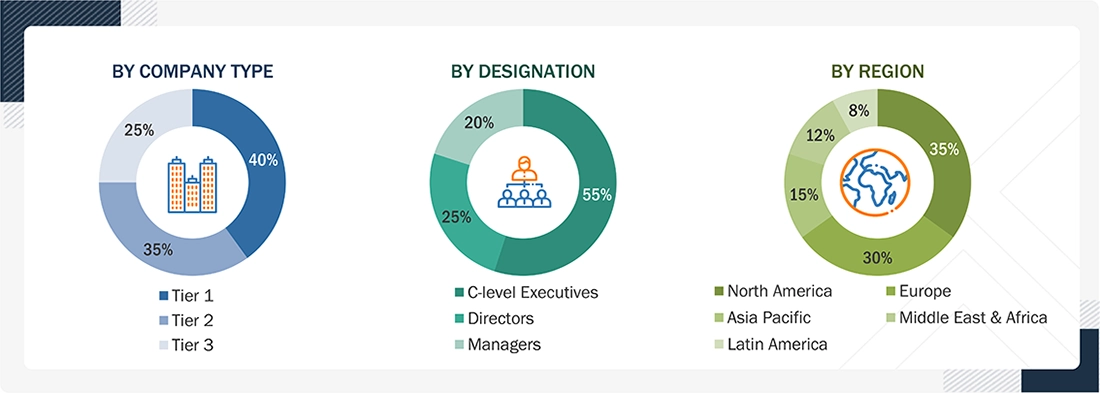
Note: Tier 1 companies receive revenues higher than USD 10 billion; Tier 2 companies' revenues range between USD 1 and 10 billion; and Tier 3 companies' revenues range between USD 500 million and USD 1 billion. Other designations include sales, marketing, and product managers.
To know about the assumptions considered for the study, download the pdf brochure
Market Size Estimation
Top-down and bottom-up approaches were employed to estimate and validate the size of the MDR market, as well as the size of various dependent sub-segments within the overall MDR market. The research methodology used to estimate the market size includes the following details: critical players in the market were identified through secondary research, and their market shares in the respective regions were determined through primary and secondary research. This entire procedure involved studying the annual and financial reports of the top market players, and extensive interviews were conducted with key industry leaders, including CEOs, VPs, directors, and marketing executives, to gather valuable insights.
All percentage splits and breakdowns were determined using secondary sources and verified through primary sources. All possible parameters that affect the market covered in this research study were accounted for, viewed in extensive detail, verified through primary research, and analyzed to get the final quantitative and qualitative data. This data was consolidated and added to detailed inputs and analysis from MarketsandMarkets.
Data Triangulation
The market was split into several segments and subsegments after arriving at the overall market size using the market size estimation processes explained above. The data triangulation and market breakup procedures were employed, wherever applicable, to complete the overall market engineering process and arrive at the exact statistics of each market segment and subsegment. The data was triangulated by studying various factors and trends from both the demand and supply sides.
Market Definition
MarketsandMarkets defined MDR as "The managed detection and response (MDR) market comprises revenues generated from subscription-based services and platform-integrated offerings that provide continuous threat detection, investigation, and active response through human-led security operations, leveraging advanced security technologies such as XDR, EDR, and SIEM."
Key Stakeholders
- MDR Service Providers
- Managed Security Service Providers (MSSPs)
- Extended Detection & Response (XDR) Platform Providers
- Endpoint Detection & Response (EDR) Vendors
- Security Information & Event Management (SIEM) Providers
- Cloud Security Providers
- Identity & Access Management (IAM) Providers
- Threat Intelligence Providers
- Security Operations Center (SOC) Teams
- Incident Response & Digital Forensics Providers
- Cybersecurity Consultants & System Integrators
- Enterprises (SMEs & Large Organizations)
- Government & Public Sector Organizations
- Critical Infrastructure Operators
- Regulators & Compliance Authorities
- Cloud Service Providers
- System integrators
- Data Protection & Privacy Authorities
- Cybersecurity Training & Awareness Providers
Report Objectives
- To describe and forecast the MDR market by offering, deployment mode, organization size, vertical, and region from 2026 to 2031, and analyze the various macroeconomic and microeconomic factors that affect market growth
- To forecast the market size of five major regions: North America, Europe, Asia Pacific, the Middle East & Africa, and Latin America
- To analyze the subsegments of the market concerning individual growth trends, prospects, and contributions to the overall market
- To provide detailed information related to the primary factors (drivers, restraints, opportunities, and challenges) influencing the growth of the MDR market
- To analyze opportunities in the market for stakeholders by identifying high-growth segments of the MDR market.
- To profile the key players of the MDR market and comprehensively analyze their market size and core competencies
- Track and analyze competitive developments, such as new product launches, mergers & acquisitions, partnerships, agreements, and collaborations in the global MDR market
Available customizations:
With the given market data, MarketsandMarkets offers customizations based on company-specific needs. The following customization options are available for the report:
GEOGRAPHIC ANALYSIS
- Further breakup of the Asia Pacific market into countries contributing to the rest of the regional market size.
- Further breakup of the North American market into countries contributing to the rest of the regional market size.
- Further breakup of the Latin American market into countries contributing to the rest of the regional market size
- Further breakup of the Middle East & African market into countries contributing to the rest of the regional market size
- Further breakup of the European market into countries contributes to the rest of the regional market size
Company information
- Detailed analysis and profiling of additional market players (up to 5)
Key Questions Addressed by the Report
What is the projected growth of the Managed Detection and Response (MDR) Market?
The Managed Detection and Response (MDR) Market is projected to grow from USD 6.22 billion in 2026 to USD 17.64 billion by 2031, at a CAGR of 23.2%.
What factors are driving the Managed Detection and Response Market?
The market is driven by rising ransomware, business email compromise, crypto-jacking attacks, cybersecurity talent shortages, and demand for 24/7 threat detection and response services.
Why are organizations investing in Managed Detection and Response solutions?
Organizations invest in MDR to strengthen cyber resilience through continuous monitoring, proactive threat hunting, faster incident response, and reduced operational burden.
Which deployment model is gaining traction in the Managed Detection and Response Market?
Cloud-based MDR deployment is gaining strong adoption as enterprises seek scalable, flexible, and remotely managed cybersecurity services.
Who are the leading players in the Managed Detection and Response Market?
The report profiles leading MDR vendors offering integrated threat detection, incident response, and managed security services across global enterprise markets.


Personalize This Research
- Triangulate with your Own Data
- Get Data as per your Format and Definition
- Gain a Deeper Dive on a Specific Application, Geography, Customer or Competitor
- Any level of Personalization
Let Us Help You
- What are the Known and Unknown Adjacencies Impacting the Managed Detection and Response (MDR) Market
- What will your New Revenue Sources be?
- Who will be your Top Customer; what will make them switch?
- Defend your Market Share or Win Competitors
- Get a Scorecard for Target Partners

Custom Market Research Services
We Will Customise The Research For You, In Case The Report Listed Above Does Not Meet With Your Requirements
Get 10% Free CustomisationTESTIMONIALS
- US Managed Detection and Response (MDR) Market
- Canada Managed Detection and Response (MDR) Market
- UK Managed Detection and Response (MDR) Market
- Germany Managed Detection and Response (MDR) Market
- France Managed Detection and Response (MDR) Market
- Italy Managed Detection and Response (MDR) Market
- China Managed Detection and Response (MDR) Market
- Japan Managed Detection and Response (MDR) Market
- India Managed Detection and Response (MDR) Market
- UAE Managed Detection and Response (MDR) Market
- South Africa Managed Detection and Response (MDR) Market
- Brazil Managed Detection and Response (MDR) Market
- Mexico Managed Detection and Response (MDR) Market
- Rest Of Europe Managed Detection and Response (MDR) Market
- Rest Of Asia Pacific Managed Detection and Response (MDR) Market





Growth opportunities and latent adjacency in Managed Detection and Response (MDR) Market