



ebike Market Size, Share & Analysis
Report Code
AT 6958
Published in
Apr, 2026, By MarketsandMarkets™
ebike Market by Class (Class I, II, & III), Battery (Li-ion, Li-ion Polymer, Lead Acid), Motor (Mid, Hub), Mode (Throttle, Pedal Assist), Usage (Mountain/Trekking, City/Urban, Cargo), Speed, Battery Capacity, Component, Region - Global Forecast to 2035

USD 74.98 BN
MARKET SIZE, 2035

CAGR 5.5%
(2026-2035)

560
REPORT PAGES

550
MARKET TABLES
OVERVIEW
Source: Secondary Research, Interviews with Experts, MarketsandMarkets Analysis
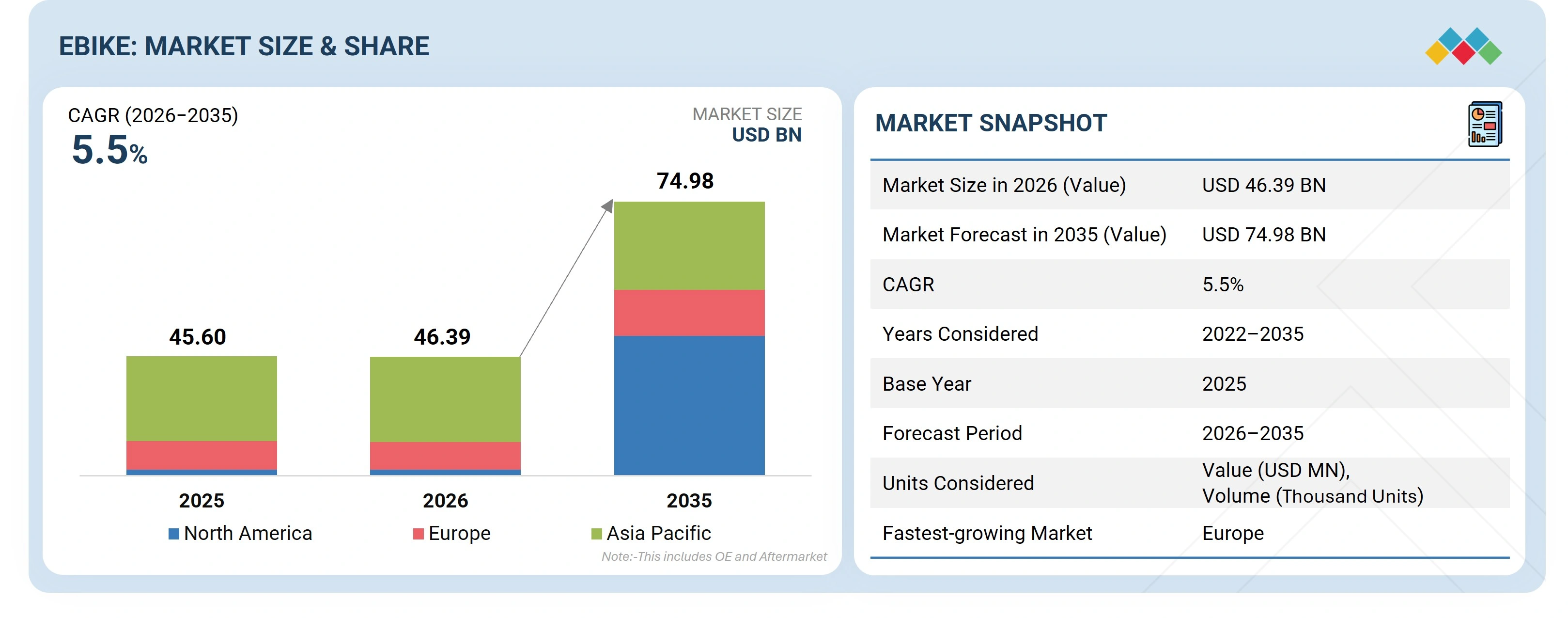
The global ebike market is projected to grow from USD 46.39 billion in 2026 to USD 74.98 billion by 2035, with a CAGR of 5.5%. The global ebike market is gradually growing; however, there is a slight decline in Europe and North America. In Europe, the ebike market has remained down since 2024 due to excessive inventories, heavy discounting, and weak consumer demand, a trend that has continued into 2026. The North American ebike market is also still contracting, owing to tariff pressures, high retail prices, and demand normalization post-COVID. Companies such as Rad Power Bikes are facing financial and operational challenges, indicating the market has not yet stabilized. In contrast, Asia Oceania continues to lead the global market by volume, led by China, where daily commuting demand and domestic manufacturers are maintaining steady sales momentum. Overall, the market is not trending upward in the short term, as it is sluggish in Europe and North America and is expected to see a market correction starting in mid-2027. Alternatively, the Asia Pacific market is stable, making the current global trend imbalanced and demand-constrained rather than growth-driven.
ebike Market Size and Forecast:
- Market Size Value in 2025: USD 45.60 Billion
- Market Size Value in 2026: USD 46.39 Billion
- Revenue Forecast in 2035: USD 74.98 Billion
- Growth Rate: CAGR of 5.5% from 2026 to 2035
- Data available from 2019 to 2030
-
Cargo E-Bike Market
- Market size USD 4.10 billion in 2025
- Market forecast USD 8.97 billion in 2032
- Market Growing at a CAGR of 11.8%
Key Market Trends and Insights
- Market Growth: Growth is supported by strong demand in Asia Pacific, particularly China, despite short-term market challenges in Europe and North America.
-
IoT Impact: Thermal management systems and lightweight materials are enhancing off-highway equipment performance.
- Growing Trends: The market is shifting toward high-performance, connected ebikes with smart features, integrated batteries, and AI-enabled technologies.
- Growth Opportunities: Opportunities are emerging from the growing adoption of connected ebikes with GPS tracking, app integration, and real-time diagnostics.
KEY TAKEAWAYS
-
BY REGIONAsia Pacific holds the largest market for ebikes, with a share >70% in terms of value.
-
BY SPEEDThe 25-45 km/h speed segment is will be the fastest-growing, at a CAGR of more than 11%, in terms of value.
-
BY USAGECity/urban ebikes hold the largest market share of >55%, in terms of value.
-
BY CLASSClass III ebikes is the fastest-growing ebike segment in terms of value.
-
By COMPONENTThe battery segment holds the major market share of all components in terms of value.
-
BY BATTERY TYPELithium-ion-phosphate is projected to be the fastest-growing ebike battery segment.
-
BY MODEPedal assist ebikes hold the largest market share in terms of value.
-
BY BATTERY CAPACITYebikes with >650W battery capacity will be the fastest-growing segment in terms of value.
-
BY OWNERSHIPPersonal mobility is the largest application of ebikes, in terms of value.
-
BY MOTOR WEIGHTebikes with >2.4 Kg is projected to be the fastest-growing segment, in terms of value.
-
BY MOTOR TYPEMid-motor ebikes hold the largest market share in terms of value.
-
BY MOTOR POWER (Nm)>70 Nm motor ebikes is projected to be the fastest-growing segment in terms of value.
-
BY MOTOR POWER (Watt)>500-600W is the projected to be the fastest-growing segment in terms of value.
-
BY BATTERY INTEGRATIONThe integrated battery segment holds the largest market share in terms of value.
-
COMPETITIVE LANDSCAPE - KEY PLAYERSAccell Group, Giant Manufacturing Co., Ltd., Yadea Group Holdings, Ltd., Yamaha Motor Company, and Pon Bicycles B.V. are the star players in the ebike market, as they are focused on innovation; investments in R&D as well as new and existing manufacturing plants; and offer discounts on ebikes.
-
COMPETITIVE LANDSCAPE - STARTUPSLectric eBikes, Voltbikes, Aventon, and Super 73 are startups driving the market with new technological innovations, new subscription and leasing models, attracting investment, and accelerating market growth.
The global ebike market is in a post-boom normalization phase, with near-term weakness in Europe and North America driven by excess inventory, discounting, and demand correction rather than structural decline. Growth is shifting from discretionary purchases to utility-led use cases such as commuting and last-mile delivery, with cargo ebikes gaining traction.
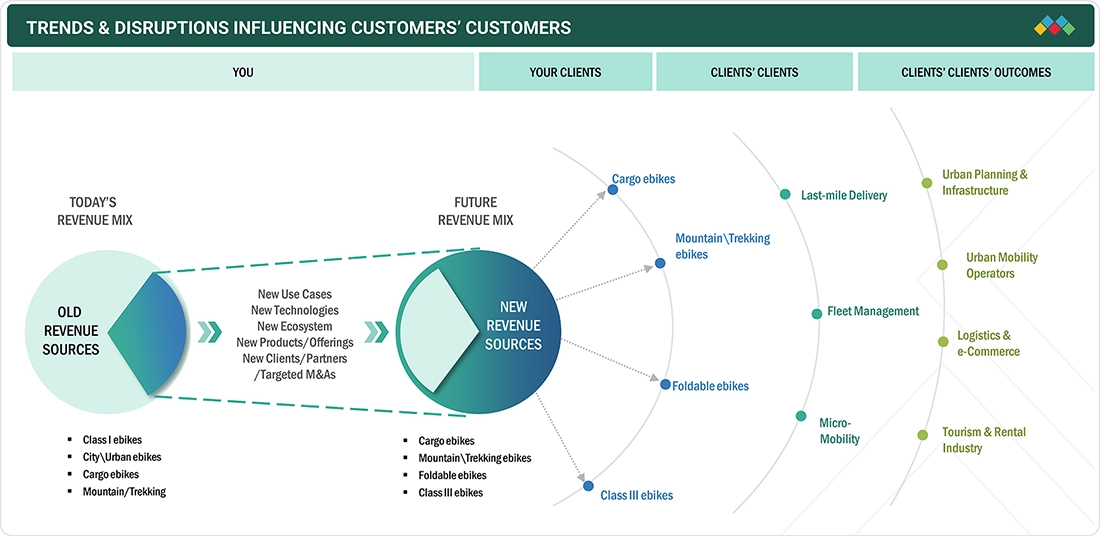
TRENDS & DISRUPTIONS IMPACTING CUSTOMERS' CUSTOMERS
The most disruptive trends in the ebike market (2025–2026) are shifting the industry from pure growth to technology, safety, and system-level transformation. A key disruption is the shift toward high-performance yet compact systems, with new motors delivering over 100 Nm of torque and lighter, integrated battery designs that make ebikes resemble traditional bicycles. Another major shift is smart and connected ebikes, with AI-based features, automatic gear shifting, and app-enabled diagnostics becoming standard, reflecting convergence with consumer electronics.
Source: Secondary Research, Interviews with Experts, MarketsandMarkets Analysis
MARKET DYNAMICS

Drivers
Impact
Level
Level
-
Government support to increase ebike sales for CO2 emission reduction

-
Growing popularity of electric mountain and cargo bikes


RESTRAINTS
Impact
Level
Level
-
Limited charging infrastructure for ebikes

-
Varied government regulations and lack of proper infrastructure


OPPORTUNITIES
Impact
Level
Level
-
Trend of connected ebikes

-
Development of lightweight electrical energy storage systems


CHALLENGES
Impact
Level
Level
-
High price of ebikes

-
Importing to European Union and US from China

Source: Secondary Research, Interviews with Experts, MarketsandMarkets Analysis
Driver: Government support to increase ebike sales for CO2 emission reduction
Governments around the world are supporting ebikes because they help reduce CO2 emissions and transportation pollution. To encourage people to switch from cars to ebikes, European governments are offering subsidies and discounts on purchases, along with building better cycling infrastructure, such as dedicated bike lanes. In the US, proposals and state-level programs promote ebike adoption as part of clean transportation strategies, and in Asia (especially China and India), policies focus on electrifying two-wheelers to cut urban air pollution.
Restraint: Limited charging infrastructure for ebikes
Most personal ebikes are charged at home, and limited public and workplace charging still constrains expansion beyond short, predictable commutes, particularly for delivery, shared mobility, and long-distance urban riders, reducing overall utilization rates and fleet scalability. At the same time, structural cost pressures persist: OEMs are equipping ebikes with higher-spec battery packs (larger capacity, integrated designs, advanced BMS), increasing the bill of materials, while post-pandemic consumers remain price-sensitive and anchored to lower historical price points. This creates a price-value mismatch, compressing OEM margins, limiting pricing power, and slowing the transition toward premium, high-performance models, thereby moderating overall market growth.
Opportunity: Trend of connected ebikes
A major opportunity in the ebike market is the rapid adoption of connected features, which are transforming ebikes into smart mobility devices. Modern ebikes increasingly include GPS tracking, mobile app integration, anti-theft systems, real-time diagnostics, and route optimization, enhancing both, user convenience and safety. These features are especially valuable for urban commuters and fleet operators (such as delivery services), enabling better vehicle monitoring, predictive maintenance, and efficient operations.
Challenge: Importing to European Union and US from China
Importing ebikes from China into the EU and the US is increasingly challenged by regulatory fragmentation across power limits, speed thresholds, classification systems, and safety/battery standards, which compels manufacturers to develop multiple SKU variants (e.g., 25 km/h, 250W-compliant models for the EU versus Class 1/2/3 configurations in the US with different throttle and speed allowances). This multi-SKU requirement limits scale efficiencies in production and sourcing, increases inventory complexity, and extends time-to-market due to repeated testing, certification (such as CE marking, UL standards), and homologation processes. At the same time, tightening battery safety regulations and import scrutiny increase compliance costs, documentation burdens, and risk of shipment delays, collectively squeezing margins and making cross-border expansion less economically attractive for OEMs.
E-BIKE MARKET SIZE, SHARE & ANALYSIS: COMMERCIAL USE CASES ACROSS INDUSTRIES
| COMPANY | USE CASE DESCRIPTION | BENEFITS |
|---|---|---|
 |
Focuses on a wide range of premium ebikes including urban commuting, mountain (e-MTB), and performance cycling, supported by a strong global retail and manufacturing network | Offers high-quality engineering, global availability, and advanced motor integration (often with Yamaha systems), making it suitable for everyday commuters as well as professional riders |
 |
Specializes in urban mobility, cargo ebikes, and niche applications (like logistics and adventure cycling), with strong presence across Europe and partnerships with public/private sectors | Provides diverse product portfolio and strong European distribution, enabling efficient last-mile delivery solutions and sustainable urban transport adoption |
 |
Targets mass-market urban commuting and affordable e-mobility, with strong focus on high-volume production and expansion into global markets | Delivers cost-effective ebikes with smart features (GPS, digital display, battery tech) and large-scale production, making them accessible for emerging markets |
 |
Primarily provides ebike drive systems (motors, batteries, displays) and collaborates with OEMs to power high-performance and premium ebikes | Enables high-performance, reliable powertrain solutions (e.g., 85 Nm motors), supporting innovation and performance across multiple ebike brands globally |
Logos and trademarks shown above are the property of their respective owners. Their use here is for informational and illustrative purposes only.
MARKET ECOSYSTEM
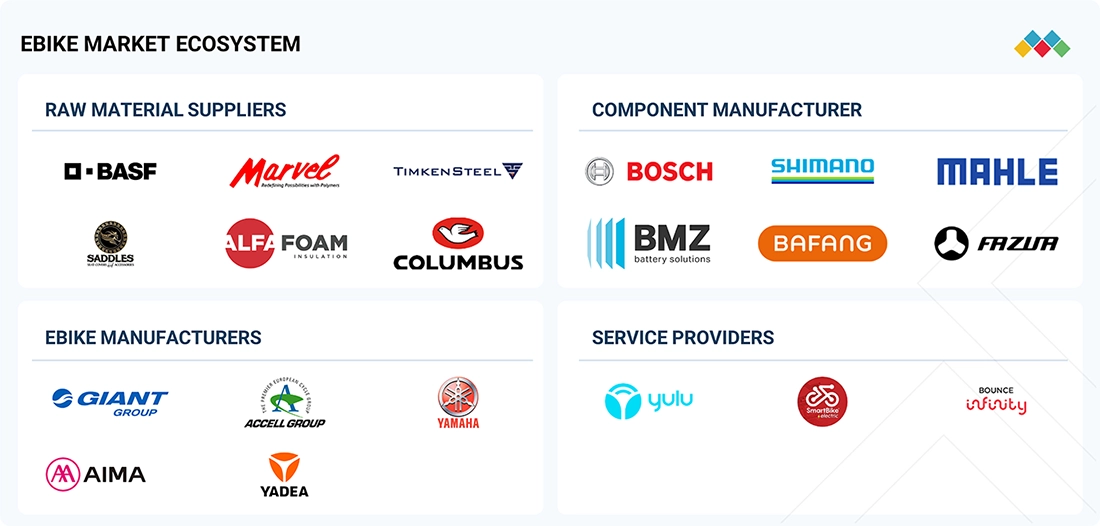
The ecosystem highlights various ebike market players, including raw material suppliers, ebike component manufacturers, ebike manufacturers, and end users. The leading players in the market are Giant Bicycles (Taiwan), Yadea Technology Group Co., Ltd. (China), Yamaha Motor Co., Ltd. (Japan), Pon.Bike (Netherlands), and Accell group N.V. (Netherlands), among others, which offer advanced ebikes with a strong distribution network worldwide.
Logos and trademarks shown above are the property of their respective owners. Their use here is for informational and illustrative purposes only.
MARKET SEGMENTS
Source: Secondary Research, Interviews with Experts, MarketsandMarkets Analysis
ebike Market, By Usage
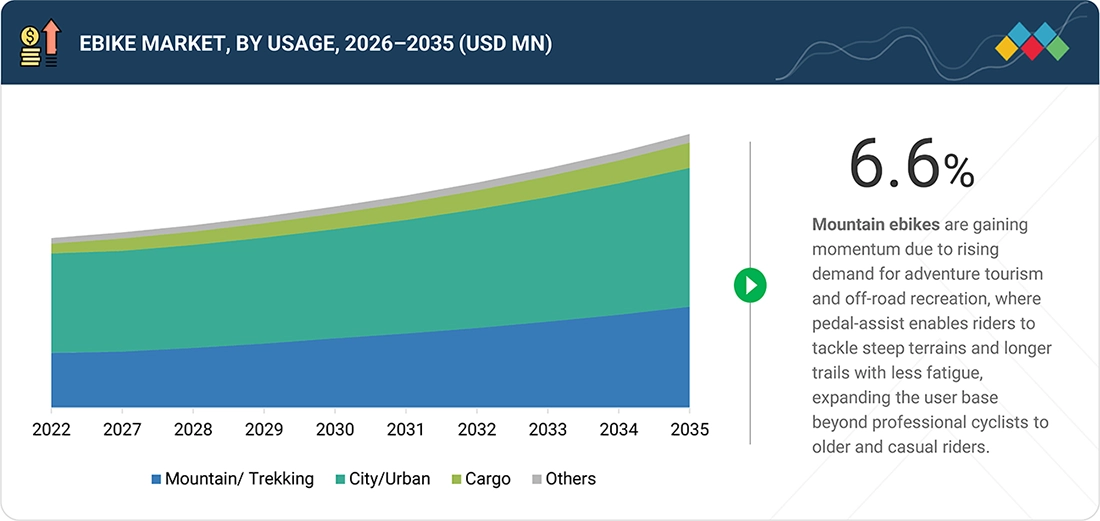
City/urban ebikes dominate the segment, with differences at the regional level. In Asia–Oceania, especially China and Southeast Asia, urban ebikes are growing strongly because they are the primary low-cost daily transport. Around 25% of urban users prefer them for affordability and convenience, and the region contributes over 75% of global demand. In Europe, the market is mature but still strong in cities, where around 38% of commuters use ebikes for short trips, supported by strict emission policies and dense cycling infrastructure, though growth is stabilizing due to market saturation. In North America, demand for mountain/trekking ebikes is higher due to increased outdoor activities. Moreover, demand for cargo ebikes has increased, as they are used in last-mile delivery.
ebike Market, By Class
Class III is the fastest-growing segment in the ebike market. In Asia Oceania, Class I ebikes dominate, as lower-speed, throttle-assisted models are widely used for daily commuting because of affordability and relaxed regulations. In Europe, Class I (pedal-assist, ≤25 km/h) is the most common, driven by strict regulatory frameworks that limit speed and throttle use, making it the standard for urban mobility. In contrast, North America shows growing demand for Class II and Class III ebikes, with Class III (up to ~45 km/h) gaining traction for longer commutes and suburban travel, supported by more flexible regulations and rising interest in high-speed urban mobility.
ebike Market, By Mode
Pedal-assist mode holds the dominant market share and will continue to for the foreseeable future. The shift from throttle-assisted to pedal-assist ebikes is driven by changing consumer preferences and regulatory influence. Pedal-assist models are gaining popularity because they offer a more natural riding experience, better battery efficiency, and improved range, making them suitable for daily commuting and fitness-oriented users. In contrast, throttle-assisted ebikes, while convenient, tend to consume more battery power and face stricter regulations in many markets, limiting their growth.
ebike Market, By Ownership
Personal ownership of e-bikes will dominate the market through the forecast period. Because personal e-bikes are used mostly for daily commuting and recreational purposes, commercial adoption is growing rapidly, especially in last-mile delivery, ride sharing, and rental services. Businesses prefer fleet deployment because e-bikes offer lower operating costs, higher efficiency in urban areas, and easier maintenance compared to fuel-based vehicles. At the same time, digital fleet management tools (tracking, diagnostics, battery monitoring) are making large-scale operations more efficient.
REGION
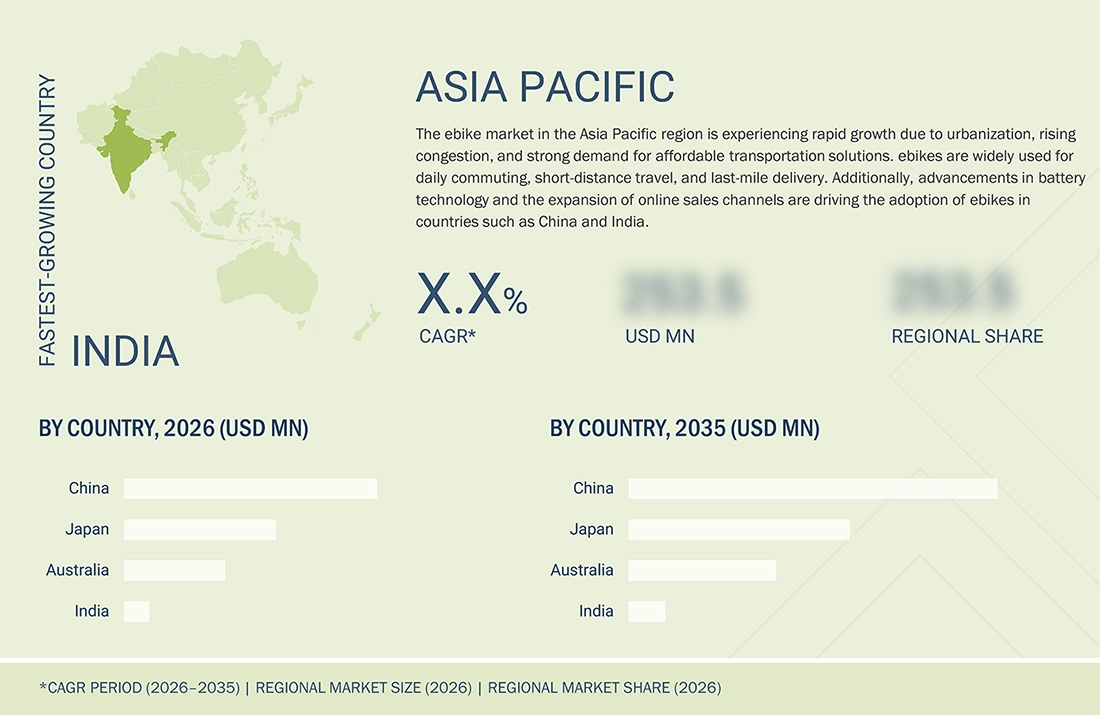
Asia Pacific is likely to be the largest ebike market globally, throughout the forecast period.
Asia Pacific leads the ebike market largely because ebikes are deeply integrated into daily transportation systems across the region, especially in countries such as China, where they serve as a primary mode of low-cost mobility rather than a lifestyle product. The region benefits from large-scale local manufacturing and supply chains, which significantly reduce costs and make ebikes more affordable to a wider population. In addition, high urban population density, traffic congestion, and rising fuel prices push consumers toward efficient two-wheel solutions. Governments also support electrification to reduce urban pollution, further boosting adoption. According to the International Energy Agency, the widespread use of electric two-wheelers in Asia plays a crucial role in lowering transport emissions, which is why the region continues to dominate global ebike demand.
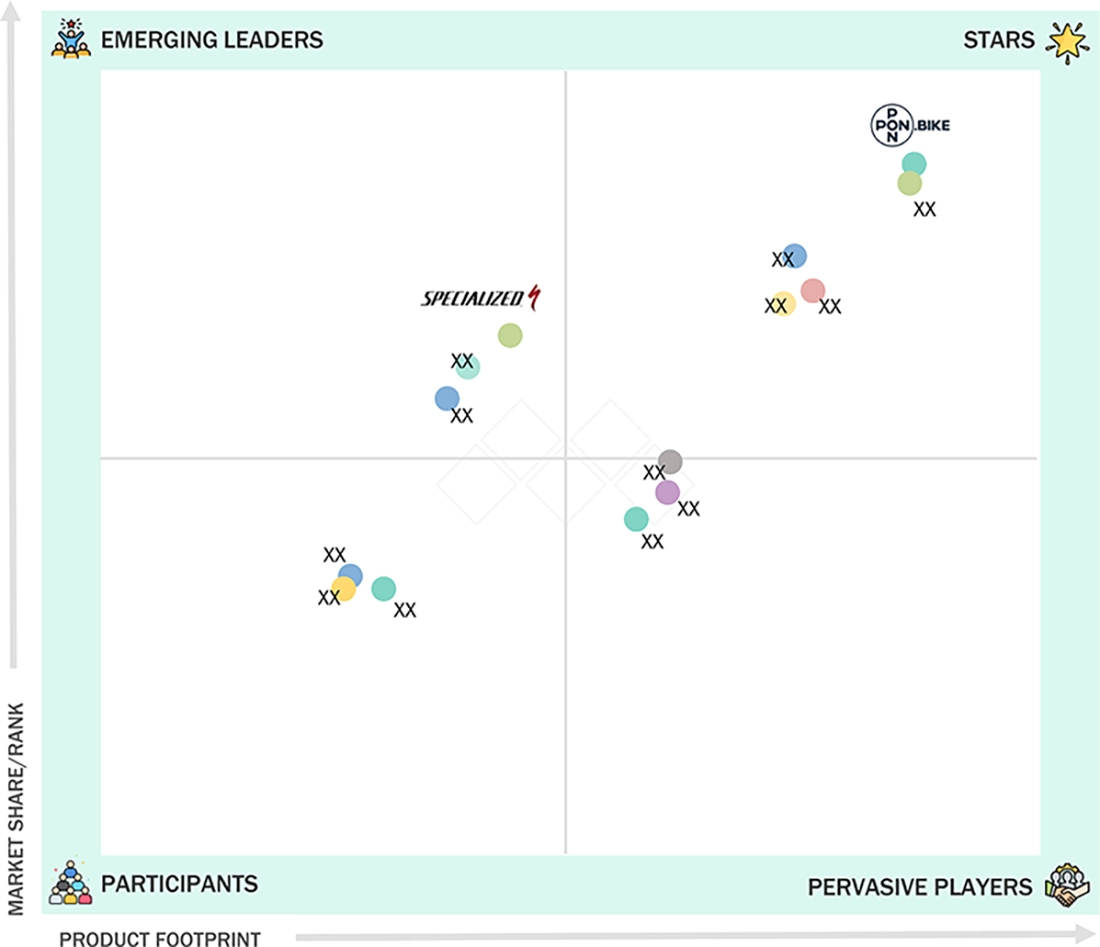
E-BIKE MARKET SIZE, SHARE & ANALYSIS: COMPANY EVALUATION MATRIX
Pon.Bike (Star) maintains a strong market presence and offers a wide range of products in the ebike market, enabling widespread adoption in cargo, city, gravel, mountain, and trekking ebikes. Specialized Bicycle Components (Emerging Leader) is gaining traction with innovative ebike with connected features and other services.
Source: Secondary Research, Interviews with Experts, MarketsandMarkets Analysis
KEY MARKET PLAYERS
- Pon.Bike (Netherlands)
- Yadea Group Holdings (China)
- AIMA Technology Group (China)
- Giant Bicycles (Taiwan)
- Yamaha Motor Company (Japan)
- Accelle Group (Netherlands)
- Merida Industries Co., Ltd. (Taiwan)
- Pedgo Electric Bikes (US)
- Specialized Bicycles Components (US)
- VanMoof (Netherlands)
- BH Bikes (Spain)
MARKET SCOPE
| REPORT METRIC | DETAILS |
|---|---|
| Market Size in 2026 (Value) | 46.39 Billion |
| Market Forecast in 2035 (Value) | 74.98 Billion |
| Growth Rate | CAGR of 5.5% from 2026 to 2035 |
| Years Considered | 2022–2035 |
| Base Year | 2025 |
| Forecast Period | 2025-2032 |
| Units Considered | Value (USD Billion), Volume (Thousand Ton) |
| Report Coverage | Revenue forecast, top companies market share, startup companies market share, growth factors and trends, TCO of ebikes, ASP of ebike according to key players, and AI impact on ebikes |
| Segments Covered |
|
| Regional Scope | Asia Pacific, Europe, North America |
WHAT IS IN IT FOR YOU: E-BIKE MARKET SIZE, SHARE & ANALYSIS REPORT CONTENT GUIDE
DELIVERED CUSTOMIZATIONS
We have successfully delivered the following deep-dive customizations:
| CLIENT REQUEST | CUSTOMIZATION DELIVERED | VALUE ADDS |
|---|---|---|
| Region-specific insights (Europe slowdown vs. Asia growth) | Country-level analysis with 2024–2026 sales estimates | Identification of high-growth segments (mid-drive, >250W) |
| Segmentation by Class I, II, III, motor type, and battery capacity | Detailed segmentation (pedal-assist vs. throttle, hub vs. mid-drive) | Explanation of regional market shifts and demand patterns |
| Pricing trends and impact of subsidies/tariffs (2025–2026) | Scenario-based forecasts (2026 decline vs. recovery outlook) | Actionable regional expansion recommendations |
| Consumer behavior analysis (commuting vs. recreation) | Company-specific insights and product launch tracking | Early signals on recovery timelines and risk factors |
| Regulatory and safety compliance updates | Currency conversions for cross-market comparison | Simplification of complex data into decision-ready insights |
RECENT DEVELOPMENTS
- April 2026 : Segwal launched a compact, utility-focused urban e-bike after CES 2026, featuring a 750W hub motor, ~80-mile range, and a 716Wh battery. It supports modular accessories (cargo racks, kid seats) and smart features like Apple FindMy and radar safety, making it ideal for last-mile logistics and city commuting.
- March 2026 : Specialized Bicycle Components, Inc. launched the "S-Works Turbo Levo 4 LTD" as a flagship electric mountain ebike, with a carbon frame structure and a 111 Nm torque motor with a 840 Wh battery.
- February 2026 : Viral Bikes launched the Wander-ee Gravel e-bike, featuring a Pinion Smart.Shift drivetrain and long-distance touring capability. Built for bikepacking, it integrates high-end components and rugged geometry, targeting niche high-performance riders.
- February 2026 : Merida launched the eONE-SIXTY/ETMO series of trail eMTBs, which were offered with Bosch CX motors and improved affordability in alloy frames.
- February 2025 : Zaragoza launched a fully electric public bike-sharing system available 24/7 across all districts, designated as the "24/7 Ebike System." It is an integral component of the “Bizi” bike-sharing program, implemented in collaboration with Lyft Urban Solutions and managed locally.
Table of Contents
 Exclusive indicates content/data unique to MarketsandMarkets and not available with any competitors.
TITLE
PAGE NO
1
INTRODUCTION
45
2
EXECUTIVE SUMMARY
52
3
PREMIUM INSIGHTS
57
4
MARKET OVERVIEW
Government backing and tech innovations drive eBike market growth despite infrastructure and cost challenges.
64
4.1
INTRODUCTION
4.2
MARKET DYNAMICS
4.2.1
DRIVERS
4.2.1.1
GOVERNMENT SUPPORT TO INCREASE EBIKE SALES FOR CO2 EMISSION REDUCTION
4.2.1.2
GROWING POPULARITY OF ELECTRIC MOUNTAIN AND CARGO BIKES
4.2.1.3
GROWTH OF MICRO MOBILITY SERVICES AND MOBILITY-AS-A-SERVICE (MAAS)
4.2.2
RESTRAINTS
4.2.2.1
LIMITED CHARGING INFRASTRUCTURE FOR EBIKES
4.2.2.2
VARIED GOVERNMENT REGULATIONS AND LACK OF PROPER INFRASTRUCTURE
4.2.2.3
POPULARITY OF EBIKE CONVERSION KITS
4.2.3
OPPORTUNITIES
4.2.3.1
TREND OF CONNECTED EBIKES
4.2.3.2
DEVELOPMENT OF LIGHTWEIGHT ELECTRICAL ENERGY STORAGE SYSTEMS
4.2.3.3
DEVELOPMENTS IN DRIVE MOTORS FOR IMPROVED PERFORMANCE OF EBIKES
4.2.4
CHALLENGES
4.2.4.1
HIGH PRICE OF EBIKES
4.2.4.2
CHALLENGES IMPORTING IN EUROPEAN UNION AND US FROM CHINA
4.2.4.2.1
CHINA TO EUROPEAN UNION: IMPORT REQUIREMENTS
4.2.4.2.2
CHINA TO US: IMPORT REQUIREMENTS
4.2.4.3
COMPETITION FROM ALTERNATIVE MICROMOBILITY SOLUTIONS
4.3
UNMET NEEDS AND WHITE SPACES
4.3.1
MID-MARKET PERFORMANCE GAP
4.3.2
WHITE SPACE OPPORTUNITY
4.4
INTERCONNECTED MARKETS AND CROSS-SECTOR OPPORTUNITIES
4.5
STRATEGIC MOVES BY TIER 1/2/3 PLAYERS
4.6
SUPPLIER ANALYSIS
4.6.1
MOTOR SUPPLIERS TO KEY OEMS
4.6.2
INVERTER SUPPLIERS TO KEY OEMS
4.6.3
BATTERY AND BATTERY MANAGEMENT SYSTEM SUPPLIERS TO KEY OEMS
4.6.4
COMPONENT AS A PACKAGE TO OEMS
4.6.5
IOT SERVICES OFFERED BY TOP PLAYERS
4.6.5.1
ROBERT BOSCH GMBH
4.6.5.1.1
EBIKE CONNECT
4.6.5.1.2
EBIKE FLOW APP
4.6.5.2
SPECIALIZED BICYCLE COMPONENTS, INC.
4.6.5.2.1
MISSION CONTROL APP
4.6.5.2.2
THE SPECIALIZED APP
4.6.5.3
SHIMANO INC.
4.6.5.3.1
E-TUBE
4.6.5.4
YAMAHA MOTOR CO., LTD.
4.6.5.4.1
YAMAHA MY RIDE APP
4.6.5.5
GIANT BICYCLES
4.6.5.5.1
RIDECONTROL APP
4.6.5.6
FAZUA GMBH
4.6.5.6.1
FAZUA RIDER APP
4.6.5.7
MAHLE GMBH
4.6.5.7.1
MYSMART BIKE APP
4.6.5.7.2
SMARTBIKE LAB APP
4.6.5.8
VELCO
4.6.5.8.1
VELCO RIDER APP
4.6.5.9
POWUNITY GMBH
4.6.5.9.1
POWUNITY APP
4.6.5.10
FIT
4.6.5.10.1
FIT EBIKE CONTROL APP
4.6.5.11
PORSCHE DIGITAL
4.6.5.11.1
CYKLÆR APP
4.6.5.12
ESB
4.6.5.12.1
ESB.APP
4.6.5.13
HAIBIKE
4.6.5.13.1
ECONNECT APP
4.6.5.14
HYENA INC
4.6.5.14.1
RIDER APP
4.6.5.15
STRAVA
4.6.5.15.1
STRAVA APP
4.6.5.16
BROSE
4.6.5.16.1
BROSE EBIKE APP
4.6.5.17
GARMIN LTD
4.6.5.17.1
GARMIN CONNECT APP
4.6.5.18
KOMOOT
4.6.5.18.1
KOMOOT APP
4.6.5.19
RIDE WITH GPS
4.6.5.19.1
RIDE WITH THE GPS APP
4.6.5.20
TRAINERROAD
4.6.5.20.1
TRAINERROAD APP
4.6.5.21
EPIC RIDE WEATHER
4.6.5.21.1
EPIC RIDE WEATHER APP
5
INDUSTRY TRENDS
Uncover how macroeconomic shifts and pricing dynamics redefine global eBike market strategies.
91
5.1
MACROECONOMIC INDICATORS
5.1.1
INTRODUCTION
5.1.2
GDP TRENDS AND FORECAST
5.1.3
TRENDS IN GLOBAL AUTOMOTIVE & TRANSPORTATION INDUSTRY
5.1.3.1
REGIONAL GDP DYNAMICS
5.1.3.1.1
DEVELOPED MARKETS (ASIA PACIFIC, EUROPE, NORTH AMERICA, AND REST OF THE WORLD)
5.1.3.1.2
EMERGING MARKETS
5.1.3.2
INVESTMENT ENVIRONMENT
5.2
SUPPLY CHAIN ANALYSIS
5.3
ECOSYSTEM ANALYSIS
5.4
PRICING ANALYSIS
5.4.1
AVERAGE SELLING PRICE OF EBIKES FOR KEY PLAYERS, BY USAGE
5.4.2
AVERAGE SELLING PRICE OF EBIKES, BY BATTERY TYPE
5.4.3
AVERAGE SELLING PRICE, BY REGION
5.5
TRADE ANALYSIS
5.5.1
IMPORT SCENARIO (HS CODE 871160)
5.5.2
EXPORT SCENARIO (HS CODE 871160)
5.6
KEY CONFERENCES & EVENTS, 2026–2027
5.7
TRENDS AND DISRUPTIONS IMPACTING CUSTOMER BUSINESS
5.8
INVESTMENT & FUNDING SCENARIO
5.9
CASE STUDY ANALYSIS
5.9.1
URBAN ARROW BIKES INCORPORATED COMODULE’S ADVANCED CELLULAR CONNECTIVITY TECHNOLOGY TO ENHANCE USER EXPERIENCE
5.9.2
NYE OFFERED LUBRICANTS FOR ROTARY MOTOR GEAR OF EBIKES
5.9.3
COMODULE INTRODUCED ADVANCED CONNECTIVITY SOLUTIONS FOR BIKE BRANDS THAT USE SHIMANO DRIVETRAINS
5.9.4
NYE LUBRICANTS: LAUNCH OF NEW LUBRICANTS IN EBIKE
5.10
TOTAL COST OF OWNERSHIP
5.10.1
TOTAL COST OF OWNERSHIP (GLOBAL)
5.10.2
TOTAL COST OF OWNERSHIP FOR EBIKES IN INDIA: EBIKE VS. E2W VS. ICE 2W
5.10.2.1
TOTAL COST OF OWNERSHIP FOR INDIAN EBIKES
5.10.3
COST BREAKDOWN
5.11
OEM ANALYSIS: OEM X BREATH OF PRODUCTS OFFERED
5.11.1
OEM X BREATH OF PRODUCTS OFFERED
5.12
OEM ANALYSIS: OEM X MOTOR TYPE
5.12.1
EBIKE OEM VS. MOTOR TYPE
5.13
OEM ANALYSIS: OEM X BATTERY VOLTAGE
5.13.1
EBIKE OEM VS. BATTERY VOLTAGE
5.14
DISTANCE DRIVEN PER APPLICATION OF EBIKES
5.14.1
EMTB: DISTANCE VS. RIDING TIME
5.14.2
EBIKE: DISTANCE VS. SYSTEM WEIGHT
5.14.3
EBIKE: BATTERY VOLTAGE VS. MILES
5.15
INDIA EUROPE FTA STRATEGY ANALYSIS
5.15.1
INDIA’S EFFECTIVE IMPORT DUTY ON MANY EUROPE
5.15.2
IMPACT OF REDUCTION IN IMPORT COST BETWEEN INDIA AND EUROPE FTA
5.15.3
STRATEGY BETWEEN INDIA AND EUROPE FTA
5.16
IMPACT OF ISRAEL-IRAN WAR ON AUTOMOTIVE INDUSTRY
5.16.1
IMPACT ON AUTOMOTIVE INDUSTRY
6
INDUSTRY TRENDS TECHNOLOGICAL ADVANCEMENTS, AI-DRIVEN IMPACT, PATENTS, INNOVATIONS, AND FUTURE STRATEGIC APPLICATIONS
AI-driven innovations redefine eBike technology, enhancing urban mobility and sustainable transportation solutions.
117
6.1
TECHNOLOGY ANALYSIS
6.1.1
KEY TECHNOLOGIES
6.1.1.1
ALL-WHEEL DRIVE
6.1.1.2
MOTOR DRIVE
6.1.1.3
BATTERY TECHNOLOGY
6.1.1.4
ELECTRIC MOUNTAIN BIKES
6.1.1.5
PEDAL-ASSIST SENSORS
6.1.2
COMPLEMENTARY TECHNOLOGIES
6.1.2.1
SWAPPABLE BATTERIES
6.1.2.2
INTEGRATION OF INTELLIGENT FEATURES
6.1.2.3
FOLDING EBIKES FOR URBAN MOBILITY
6.1.2.4
DIGITAL DISPLAYS AND HMI
6.1.2.5
REGENERATIVE BRAKING
6.1.3
ADJACENT TECHNOLOGIES
6.1.3.1
AFTERMARKET EBIKE KIT
6.1.3.2
SUBSCRIPTION AND SHARING SERVICES
6.2
TECHNOLOGY/PRODUCT ROADMAP
6.2.1
SHORT-TERM ROADMAP
6.2.2
MID-TERM ROADMAP
6.2.3
LONG-TERM ROADMAP
6.3
PATENT ANALYSIS
6.3.1
INTRODUCTION
6.4
FUTURE APPLICATIONS
6.5
IMPACT OF AI/GEN AI ON EBIKE MARKET
6.5.1
IMPACT AND RECOMMENDATIONS
6.5.2
SUCCESS STORIES AND REAL-WORLD APPLICATIONS
7
REGULATORY LANDSCAPE
Navigate complex eBike regulations and incentives across global markets for strategic compliance and growth.
134
7.1
REGULATORY LANDSCAPE
7.1.1
REGULATORY BODIES, GOVERNMENT AGENCIES, AND OTHER ORGANIZATIONS
7.1.2
REGULATORY ANALYSIS, BY REGION/COUNTRY
7.1.2.1
EUROPEAN UNION
7.1.2.1.1
EUROPE
7.1.2.2
ASIA OCEANIA
7.1.2.2.1
CHINA
7.1.2.2.2
INDIA
7.1.2.2.3
JAPAN
7.1.2.3
NORTH AMERICA
7.1.2.3.1
US
7.1.2.3.2
CALIFORNIA
7.1.3
EBIKE CLASSIFICATION AND REGULATION
7.2
GLOBAL SAFETY REGULATION
7.2.1
INDIRECT IMPACT ON AUTOMOTIVE INDUSTRY
7.2.2
SURGE IN OIL PRICES
7.2.3
RISE IN PETROL PRICES IN KEY COUNTRIES
8
CUSTOMER LANDSCAPE AND BUYER BEHAVIOUR
Unlock insights into stakeholder influence and unmet needs driving market profitability.
145
8.1
DECISION-MAKING PROCESS
8.2
KEY STAKEHOLDERS AND BUYING CRITERIA
8.3
ADOPTION BARRIERS AND INTERNAL CHALLENGES
8.4
UNMET NEEDS FROM VARIOUS END-USER INDUSTRIES
8.5
MARKET PROFITABILITY
9
EBIKE MARKET, BY CLASS
Market Size & Growth Rate Forecast Analysis to 2035 in USD Million and Units | 27 Data Tables
151
9.1
INTRODUCTION
9.2
CLASS I
9.2.1
DEMAND FOR CLASS I EBIKES FROM FITNESS ENTHUSIASTS TO DRIVE MARKET
9.2.1.1
PRODUCTION AND MODEL INSIGHTS FOR CLASS I EBIKE OEMS
9.3
CLASS II
9.3.1
STRINGENT REGULATORY MEASURES TO DRIVE MARKET
9.3.1.1
PRODUCTION AND MODEL INSIGHTS FOR CLASS II EBIKE OEMS
9.4
CLASS III
9.4.1
RISING DEMAND FOR CLASS III EBIKES TO DRIVE MARKET
9.4.1.1
PRODUCTION AND MODEL INSIGHTS FOR CLASS III EBIKE OEMS
9.5
PRIMARY INSIGHTS
10
EBIKE MARKET, BY SPEED
Market Size & Growth Rate Forecast Analysis to 2035 in USD Million and Units | 18 Data Tables
162
10.1
INTRODUCTION
10.2
UP TO 25 KM/H
10.2.1
REGULATIONS AROUND SPEED LIMITS TO DRIVE MARKET
10.3
25–45 KM/H
10.3.1
CUSTOMER PREFERENCE FOR EBIKE SPEED TO DRIVE MARKET
10.4
PRIMARY INSIGHTS
11
EBIKE MARKET, BY BATTERY TYPE
Market Size & Growth Rate Forecast Analysis to 2035 in USD Million and Units | 30 Data Tables
169
11.1
INTRODUCTION
11.2
LITHIUM-ION
11.2.1
DEMAND FOR EBIKES WITH LONGEVITY TO DRIVE DEMAND
11.3
LITHIUM-ION POLYMER
11.3.1
DEMAND FOR EBIKES WITH BETTER RANGE TO DRIVE GROWTH
11.4
LEAD-ACID
11.4.1
COST SENSITIVITY AMONG CUSTOMERS TO DRIVE MARKET
11.5
OTHERS
11.6
PRIMARY INSIGHTS
12
EBIKE MARKET, BY BATTERY CAPACITY
Market Size & Growth Rate Forecast Analysis to 2035 in USD Million and Units | 30 Data Tables
181
12.1
INTRODUCTION
12.2
< 250 W
12.2.1
NEED FOR BATTERIES FOR ENTRY-LEVEL CITY EBIKES, COMPACT FOLDING BIKES, AND LOW-SPEED ELECTRIC CYCLES TO DRIVE MARKET
12.2.1.1
< 250 W: EBIKE MODELS, BY MOTOR POWER AND BATTERY POWER
12.3
250−450 W
12.3.1
GROWING DEMAND FOR LONG-RANGE EBIKES IN EUROPE AND NORTH AMERICA TO DRIVE GROWTH
12.3.1.1
250−450 W: EBIKE MODELS, BY MOTOR POWER AND BATTERY CAPACITY
12.4
451−650 W
12.4.1
NEED FOR COST-EFFECTIVE AND EFFICIENT BATTERY OPTIONS TO DRIVE MARKET
12.4.1.1
451−650 W: EBIKE MODELS, BY MOTOR POWER AND BATTERY CAPACITY
12.5
> 650 W
12.5.1
INCREASING DEMAND FOR HIGH-POWERED EBIKES TO DRIVE MARKET
12.5.1.1
> 650 W: EBIKE MODELS, BY MOTOR POWER AND BATTERY CAPACITY
12.6
PRIMARY INSIGHTS
13
EBIKE MARKET, BY BATTERY VOLTAGE
Market Size & Growth Rate Forecast Analysis to 2035 in Units | 13 Data Tables
195
13.1
INTRODUCTION
13.2
EBIKE MODELS AND BATTERY VOLTAGES
13.3
< 39 V
13.3.1
EBIKE BATTERIES WITH VOLTAGE LESS THAN 39 V ARE WELL-SUITED FOR FOLDING EBIKES
13.3.1.1
< 39 V: KEY MARKET INSIGHTS
13.4
39–45 V
13.4.1
CUSTOMIZABLE BATTERY PREFERRED BY EBIKE ENTHUSIASTS
13.4.1.1
39–45 V BATTERIES: KEY MARKET INSIGHTS
13.5
45–51 V
13.5.1
IDEAL FOR PERFORMANCE-ORIENTED BIKES IN DEMANDING CONDITIONS
13.5.1.1
45–51 V BATTERIES: KEY MARKET INSIGHTS
13.6
PRIMARY INSIGHTS
14
EBIKE MARKET, BY TYPE OF BATTERY INTEGRATION
Market Size & Growth Rate Forecast Analysis to 2035 in Units | 10 Data Tables
204
14.1
INTRODUCTION
14.2
EBIKE MODELS AND TYPES OF BATTERY INTEGRATION
14.3
INTEGRATED
14.3.1
INTEGRATED BATTERIES OFFER CLEAN AESTHETICS AND BETTER WEIGHT DISTRIBUTION
14.4
EXTERNAL
14.4.1
EASY BATTERY SWAPPING AND CHARGING TO PROVIDE FLEXIBILITY ACROSS VEHICLE MODELS
14.5
PRIMARY INSIGHTS
15
EBIKE MARKET, BY MODE
Market Size & Growth Rate Forecast Analysis to 2035 in USD Million and Units | 18 Data Tables
211
15.1
INTRODUCTION
15.2
PEDAL ASSIST
15.2.1
PEDAL-ASSIST MODE EBIKES ARE IDEAL FOR COMMUTING AND LIGHT CARGO TRANSPORT
15.3
THROTTLE
15.3.1
GROWING DEMAND FOR LAST-MILE DELIVERIES TO DRIVE GROWTH
15.4
PRIMARY INSIGHTS
16
EBIKE MARKET, BY COMPONENT
Market Size & Growth Rate Forecast Analysis to 2035 in USD Million and Units | 55 Data Tables
219
16.1
INTRODUCTION
16.2
BATTERY
16.2.1
ADVANCEMENTS IN BATTERY TECHNOLOGIES FOR HIGH-PERFORMANCE EBIKES TO DRIVE MARKET
16.2.1.1
COMPREHENSIVE OVERVIEW OF LEADING EBIKE BATTERY MANUFACTURERS
16.3
ELECTRIC MOTOR
16.3.1
CONSTANT DEVELOPMENTS IN EBIKE MOTORS AND GROWING DEMAND FOR HIGH PERFORMANCE TO DRIVE MARKET
16.3.1.1
COMPREHENSIVE OVERVIEW OF LEADING EBIKE MOTOR MANUFACTURERS
16.4
FRAME WITH FORK
16.4.1
INCREASING DEMAND FOR TITANIUM AND CARBON FIBER FOR LIGHTWEIGHT FRAMES TO DRIVE MARKET
16.4.1.1
COMPREHENSIVE OVERVIEW OF EBIKE FRAME WITH FORK MANUFACTURERS
16.5
WHEEL
16.5.1
RISING DEMAND FOR PERFORMANCE EBIKES TO BOOST NEED FOR DURABLE, HIGH-QUALITY WHEEL SYSTEMS
16.5.1.1
COMPREHENSIVE OVERVIEW OF EBIKE WHEEL MANUFACTURERS
16.6
CRANK GEAR
16.6.1
DEMAND FOR HIGH-PERFORMANCE CRANK GEARS TO DRIVE MARKET
16.6.1.1
COMPREHENSIVE OVERVIEW OF EBIKE CRANK GEAR MANUFACTURERS
16.7
BRAKE SYSTEM
16.7.1
RISE IN REGULATIONS REGARDING SPEED LIMITS TO DRIVE MARKET
16.7.1.1
COMPREHENSIVE OVERVIEW OF EBIKE BRAKE SYSTEM MANUFACTURERS
16.8
MOTOR CONTROLLER
16.8.1
ADVANCEMENTS IN MOTOR CONTROLLERS FOR HIGH-PERFORMANCE EBIKES TO DRIVE MARKET
16.8.1.1
COMPREHENSIVE OVERVIEW OF EBIKE MOTOR CONTROLLER MANUFACTURERS
16.9
PRIMARY INSIGHTS
17
EBIKE MARKET, BY USAGE
Market Size & Growth Rate Forecast Analysis to 2035 in USD Million and Units | 31 Data Tables
240
17.1
INTRODUCTION
17.2
MOUNTAIN/TREKKING
17.2.1
AGILE FRAME STRUCTURE FOR EASY OFF-ROAD CYCLING TO DRIVE GROWTH
17.2.1.1
MOUNTAIN EBIKE USAGE, BY MOTOR POWER AND BATTERY WEIGHT
17.3
CITY/URBAN
17.3.1
DEMAND FOR EBIKES FOR MODERATE-PACE RIDES TO DRIVE MARKET
17.3.1.1
CITY/URBAN EBIKE USAGE, BY MOTOR POWER AND BATTERY WEIGHT
17.4
CARGO
17.4.1
RISE IN E-COMMERCE INDUSTRY TO DRIVE MARKET
17.4.1.1
CARGO EBIKE USAGE, BY MOTOR POWER AND BATTERY WEIGHT
17.5
OTHERS
17.5.1
OTHER EBIKE USAGE, BY MOTOR POWER AND BATTERY WEIGHT
17.6
PRIMARY INSIGHTS
18
EBIKE MARKET, BY OWNERSHIP
Market Size & Growth Rate Forecast Analysis to 2035 in Units | 9 Data Tables
256
18.1
INTRODUCTION
18.2
SHARED
18.2.1
COST-EFFECTIVENESS OF SHARED OWNERSHIP TO DRIVE MARKET
18.3
PERSONAL
18.3.1
LOW MAINTENANCE AND COST-EFFICIENCY OF PERSONAL EBIKES TO DRIVE MARKET
18.4
PRIMARY INSIGHTS
19
EBIKE MARKET, BY MOTOR TYPE
Market Size & Growth Rate Forecast Analysis to 2035 in USD Million and Units | 18 Data Tables
262
19.1
INTRODUCTION
19.2
HUB MOTOR
19.2.1
EXTRA TRACTION PROVIDED BY ALL-WHEEL DRIVE-LIKE SYSTEMS TO DRIVE MARKET
19.3
MID MOTOR
19.3.1
FOCUS ON HIGH-PERFORMANCE EBIKES TO DRIVE MARKET
19.4
PRIMARY INSIGHTS
20
EBIKE MARKET, BY MOTOR WEIGHT
Market Size & Growth Rate Forecast Analysis to 2035 in USD Million and Units | 25 Data Tables
269
20.1
INTRODUCTION
20.2
OPERATIONAL DATA
20.3
< 2 KG
20.3.1
RISING DEMAND FOR CITY EBIKES TO DRIVE MARKET
20.4
2−2.4 KG
20.4.1
SIGNIFICANT INVESTMENTS IN MICRO-MOBILITY PROJECTS TO DRIVE MARKET
20.5
> 2.4 KG
20.5.1
INCREASING USE OF HIGH-POWER MOTORS TO DRIVE MARKET
20.6
PRIMARY INSIGHTS
21
EBIKE MARKET, BY MOTOR POWER (NM)
Market Size & Growth Rate Forecast Analysis to 2035 in USD Million and Units | 26 Data Tables
279
21.1
INTRODUCTION
21.2
EBIKE MODEL VS. MOTOR POWER (NM)
21.3
< 40 NM
21.3.1
GROWING SALES OF AFFORDABLE EBIKES REQUIRING LESS MOTOR POWER TO DRIVE GROWTH
21.4
40–70 NM
21.4.1
HIGH DEMAND FOR CITY AND MULTI-PURPOSE EBIKES TO DRIVE GROWTH
21.5
> 70 NM
21.5.1
RISING DEMAND FOR MOUNTAIN AND TREKKING BIKES TO DRIVE GROWTH
21.6
PRIMARY INSIGHTS
22
EBIKE MARKET, BY MOTOR POWER (WATT)
Market Size & Growth Rate Forecast Analysis to 2035 in Units | 19 Data Tables
290
22.1
INTRODUCTION
22.2
EBIKE MODELS AND MOTOR POWER
22.3
< 250 W
22.3.1
NEED FOR LOW-POWERED, COST-EFFECTIVE EBIKES TO PROPEL MARKET
22.4
251–350 W
22.4.1
NEED FOR HIGH-ASSISTANT EBIKES TO DRIVE MARKET
22.5
351–500 W
22.5.1
FOCUS ON EBIKES THAT OFFER BALANCED PERFORMANCE AND ENERGY EFFICIENCY TO DRIVE MARKET
22.6
501–600 W
22.6.1
FOCUS ON PERFORMANCE OF EBIKES TO DRIVE MARKET
22.7
> 600 W
22.7.1
RISE IN DEMAND FOR MOUNTAIN EBIKES TO BOOST GROWTH
22.8
PRIMARY INSIGHTS
23
EBIKE MARKET, BY DRIVE SYSTEM
Market Size & Growth Rate Forecast Analysis to 2035 in Units | 10 Data Tables
301
23.1
INTRODUCTION
23.2
EBIKE MODELS AND DRIVE SYSTEMS
23.3
CHAIN DRIVE
23.3.1
NEED FOR COMPATIBILITY AMONG GEAR SYSTEMS TO BOOST MARKET
23.4
BELT DRIVE
23.4.1
RISING FOCUS ON URBAN RIDING TO BOOST GROWTH
23.5
PRIMARY INSIGHTS
24
EBIKE MARKET, BY REGION
Comprehensive coverage of 3 Regions with country-level deep-dive of 13 Countries | 279 Data Tables.
309
24.1
INTRODUCTION
24.1.1
GLOBAL: EBIKE MARKET, BY USAGE
24.1.2
GLOBAL: EBIKE MARKET, BY CLASS
24.2
ASIA OCEANIA
24.2.1
ASIA OCEANIA: COUNTRY-LEVEL EBIKE OEM MANUFACTURING PLANTS
24.2.2
ASIA OCEANIA: EBIKE MARKET, BY USAGE
24.2.3
ASIA OCEANIA: EBIKE MARKET, BY CLASS
24.2.4
CHINA
24.2.4.1
TRAFFIC CONGESTION IN URBAN CITIES TO DRIVE MARKET
24.2.5
JAPAN
24.2.5.1
PRESENCE OF MAJOR EBIKE COMPONENT INNOVATORS TO DRIVE MARKET
24.2.6
INDIA
24.2.6.1
GROWING FUEL PRICES TO DRIVE MARKET
24.2.7
SOUTH KOREA
24.2.7.1
GOVERNMENT INITIATIVES TO REDUCE CARBON EMISSIONS TO DRIVE MARKET
24.2.8
TAIWAN
24.2.8.1
GROWING EBIKE EXPORTS TO DRIVE MARKET
24.2.9
AUSTRALIA
24.2.9.1
INCREASE IN EBIKE TOURISM TO DRIVE MARKET
24.3
NORTH AMERICA
24.3.1
NORTH AMERICA: COUNTRY-LEVEL EBIKE OEM MANUFACTURING PLANTS
24.3.2
NORTH AMERICA: EBIKE MARKET, BY USAGE
24.3.3
US
24.3.3.1
INCREASING AWARENESS REGARDING SUSTAINABLE TRANSPORTATION SOLUTIONS TO DRIVE MARKET
24.3.4
CANADA
24.3.4.1
INVESTMENT IN SHARED MOBILITY INFRASTRUCTURE TO DRIVE MARKET
24.4
EUROPE
24.4.1
EUROPE: COUNTRY-LEVEL EBIKE OEM MANUFACTURING PLANTS
24.4.2
EUROPE: EBIKE MARKET, BY USAGE
24.4.3
EUROPE: EBIKE MARKET, BY CLASS
24.4.4
GERMANY
24.4.4.1
RISING DEMAND FOR TREKKING EBIKES TO DRIVE MARKET
24.4.5
NETHERLANDS
24.4.5.1
INCENTIVES OFFERED BY GOVERNMENT TO PROMOTE EBIKE ADOPTION TO DRIVE MARKET
24.4.6
FRANCE
24.4.6.1
GOVERNMENT INCENTIVES FOR PURCHASE OF CARGO EBIKES TO DRIVE MARKET
24.4.7
UK
24.4.7.1
CYCLE-TO-WORK SCHEME TO DRIVE MARKET
24.4.8
AUSTRIA
24.4.8.1
SHIFT TOWARD ELECTRIC MOBILITY TO DRIVE MARKET
24.4.9
ITALY
24.4.9.1
MOBILITY BONUS FOR HIGH EBIKE SALES TO DRIVE MARKET
24.4.10
BELGIUM
24.4.10.1
GOVERNMENT INITIATIVES TOWARD INFRASTRUCTURAL DEVELOPMENT TO DRIVE MARKET
24.4.11
SPAIN
24.4.11.1
BIKE-SHARING SCHEMES TO DRIVE MARKET
24.4.12
SWITZERLAND
24.4.12.1
GROWING DEMAND FOR CARGO EBIKES TO DRIVE MARKET
24.5
PRIMARY INSIGHTS
25
COMPETITIVE LANDSCAPE
Navigate the evolving eBike market with strategic insights on key players and regional dynamics.
397
25.1
OVERVIEW
25.2
KEY PLAYER STRATEGIES/RIGHT TO WIN
25.3
MARKET SHARE ANALYSIS, 2025
25.3.1
NORTH AMERICA: EBIKE MARKET SHARE ANALYSIS, 2025
25.3.2
EUROPE: EBIKE MARKET SHARE ANALYSIS, 2025
25.3.3
ASIA OCEANIA: EBIKE MARKET SHARE ANALYSIS, 2025
25.3.4
EBIKE DISPLAY MARKET SHARE ANALYSIS, 2025
25.3.5
EBIKE BATTERY MARKET SHARE ANALYSIS, 2025
25.3.6
OEM-LEVEL EBIKE MARKET SHARE ANALYSIS, 2024–2025
25.3.7
EBIKE DRIVE UNIT MARKET SHARE ANALYSIS FOR KEY PLAYERS, 2024–2025
25.3.8
EBIKE BATTERY MANAGEMENT SYSTEM MARKET: LIST OF MAJOR BATTERY MANAGEMENT SYSTEM SUPPLIERS
25.3.9
EBIKE CONNECTIVITY ECU MARKET: LIST OF MAJOR CONNECTIVITY ECU SUPPLIERS
25.3.10
EBIKE INVERTER MARKET: LIST OF MAJOR INVERTER SUPPLIERS
25.3.11
LIST OF EBIKE MANUFACTURERS IN CHINA
25.3.12
LIST OF PLAYERS WITH GRAVEL EBIKE PRODUCT OFFERINGS
25.4
REVENUE ANALYSIS OF KEY PLAYERS (EBIKE MANUFACTURERS)
25.5
COMPANY EVALUATION MATRIX: EBIKE MANUFACTURERS, 2025
25.5.1
STARS
25.5.2
EMERGING LEADERS
25.5.3
PERVASIVE PLAYERS
25.5.4
PARTICIPANTS
25.5.5
COMPANY FOOTPRINT
25.6
COMPANY EVALUATION MATRIX: EBIKE COMPONENT SUPPLIERS, 2025
25.6.1
STARS
25.6.2
EMERGING LEADERS
25.6.3
PERVASIVE PLAYERS
25.6.4
PARTICIPANTS
25.6.5
COMPANY FOOTPRINT
25.7
COMPANY EVALUATION MATRIX: STARTUPS/SMES, 2025
25.7.1
PROGRESSIVE COMPANIES
25.7.2
RESPONSIVE COMPANIES
25.7.3
DYNAMIC COMPANIES
25.7.4
STARTING BLOCKS
25.7.5
COMPETITIVE BENCHMARKING
25.8
COMPETITIVE SCENARIO
25.8.1
PRODUCT LAUNCHES/DEVELOPMENTS/ENHANCEMENTS
25.8.2
DEALS
25.8.3
EXPANSIONS
25.8.4
OTHER DEVELOPMENTS
25.9
BRAND COMPARISON
25.10
COMPANY VALUATION, 2026
25.11
COMPANY FINANCIAL METRICS, 2025
26
COMPANY PROFILES
In-depth Company Profiles of Leading Market Players with detailed Business Overview, Product and Service Portfolio, Recent Developments, and Unique Analyst Perspective (MnM View)
433
26.1
KEY PLAYERS (EBIKE MANUFACTURERS)
26.1.1
GIANT BICYCLES
26.1.1.1
BUSINESS OVERVIEW
26.1.1.2
PRODUCTS OFFERED
26.1.1.3
RECENT DEVELOPMENTS
26.1.1.3.1
PRODUCT LAUNCHES/DEVELOPMENTS/ENHANCEMENTS
26.1.1.3.2
DEALS
26.1.1.3.3
EXPANSIONS
26.1.1.3.4
OTHER DEVELOPMENTS
26.1.1.4
MNM VIEW
26.1.1.4.1
KEY STRENGTHS
26.1.1.4.2
STRATEGIC CHOICES
26.1.1.4.3
WEAKNESSES AND COMPETITIVE THREATS
26.1.2
YADEA TECHNOLOGY GROUP CO., LTD.
26.1.3
YAMAHA MOTOR CO., LTD.
26.1.4
PON BICYCLE HOLDING B.V.
26.1.5
ACCELL GROUP
26.1.6
PEDEGO
26.1.7
AIMA TECHNOLOGY GROUP CO., LTD.
26.1.8
MERIDA
26.1.9
TREK BICYCLE CORPORATION
26.1.10
SPECIALIZED BICYCLE COMPONENTS, INC.
26.2
EBIKE COMPONENT SUPPLIERS
26.2.1
ROBERT BOSCH GMBH
26.2.2
SAMSUNG SDI.
26.2.3
PANASONIC HOLDINGS CORPORATION
26.2.4
BAFANG ELECTRIC (SUZHOU) CO., LTD.
26.2.5
SHIMANO INC.
26.2.6
PROMOVEC A/S
26.2.7
BMZ GROUP
26.2.8
WUXI TRUCKRUN MOTOR CO., LTD
26.2.9
ANANDA DRIVE TECHNOLOGY (SHANGHAI) CO., LTD.
26.2.10
MAHLE GMBH
26.2.11
ZF FRIEDRICHSHAFEN AG
26.2.12
SRAM LLC.
26.2.13
TQ GROUP GMBH
26.3
OTHER PLAYERS
26.3.1
HERO LECTRO E-CYCLES
26.3.2
CUBE
26.3.3
FUJITABIKE
26.3.4
ELECTRIC BIKE COMPANY
26.3.5
RAD POWER BIKES LLC
26.3.6
VANMOOF
26.3.7
BH BIKES
26.3.8
BROMPTON BICYCLE LIMITED
26.3.9
RIESE & MÜLLER GMBH
26.3.10
MYSTROMER AG
26.3.11
COWBOY
27
RESEARCH METHODOLOGY
538
27.1
RESEARCH DATA
27.1.1
SECONDARY DATA
27.1.1.1
KEY SECONDARY SOURCES FOR EBIKE SALES/MARKET SIZING
27.1.1.2
KEY DATA FROM SECONDARY SOURCES
27.1.2
PRIMARY DATA
27.1.2.1
PRIMARY INTERVIEW PARTICIPANTS
27.2
MARKET SIZE ESTIMATION
27.2.1
BOTTOM-UP APPROACH: BY REGION, CLASS, AND USAGE
27.2.2
TOP-DOWN APPROACH: BY BATTERY TYPE AND MOTOR TYPE
27.3
MARKET BREAKDOWN AND DATA TRIANGULATION
27.4
FACTOR ANALYSIS
27.4.1
FACTOR ANALYSIS FOR MARKET SIZING: DEMAND AND SUPPLY SIDES
27.5
RESEARCH ASSUMPTIONS AND RISK ASSESSMENT
27.6
RESEARCH LIMITATIONS
28
RECOMMENDATIONS
550
28.1
ASIA OCEANIA TO BE MAJOR MARKET FOR EBIKES
28.2
CITY/URBAN EBIKES AND DEVELOPMENTS IN DRIVE MOTORS TO BE KEY FOCUS FOR MANUFACTURERS
28.3
RISING DEMAND FOR MID MOTORS COMPARED TO HUB MOTORS
28.4
RISING DEMAND FOR 250–450 W BATTERY CAPACITY IN EBIKES
28.5
CONCLUSION
29
APPENDIX
552
29.1
KEY INSIGHTS FROM INDUSTRY EXPERTS
29.2
DISCUSSION GUIDE
29.3
KNOWLEDGESTORE: MARKETSANDMARKETS’ SUBSCRIPTION PORTAL
29.4
CUSTOMIZATION OPTIONS
29.4.1
BY DESIGN
29.4.1.1
FOLDABLE
29.4.1.2
UNFOLDABLE
29.4.2
BY FRAME MATERIAL
29.4.2.1
CARBON FIBER
29.4.2.2
CARBON STEEL
29.4.2.3
ALUMINUM
29.4.2.4
ALUMINUM ALLOY
29.4.3
EMTB MARKET, BY TYPE
29.4.3.1
LIGHT
29.4.3.2
TREKKING
29.4.3.3
ENDURO
29.4.4
CITY EBIKE MARKET, BY TYPE
29.4.4.1
SPEED
29.4.4.2
FOLDABLE
29.4.5
MARKET SHARE ANALYSIS, BY CLASS
29.4.6
TECHNICAL SPECIFICATIONS OF EBIKES, BY OEM AND COUNTRY
29.4.6.1
US
29.4.6.2
CANADA
29.4.6.3
GERMANY
29.4.6.4
NETHERLANDS
29.4.6.5
UK
29.4.6.6
FRANCE
29.4.6.7
CHINA
29.4.6.8
JAPAN
29.5
RELATED REPORTS
29.6
AUTHOR DETAILS
LIST OF TABLES
TABLE 1
EBIKE NOMENCLATURE, BY REGION/COUNTRY
TABLE 2
CURRENCY EXCHANGE RATES, BY COUNTRY, 2022–2025
TABLE 3
KEY STRENGTHS OF EBIKE MANUFACTURERS GLOBALLY
TABLE 4
MOTOR SUPPLIERS TO KEY OEMS
TABLE 5
INVERTER SUPPLIERS TO KEY OEMS
TABLE 6
BATTERY AND BATTERY MANAGEMENT SYSTEM SUPPLIERS TO KEY OEMS
TABLE 7
COMPONENT AS A PACKAGE TO OEMS
TABLE 8
GDP PERCENTAGE CHANGE, BY COUNTRY, 2022–2030
TABLE 9
ROLE OF PLAYERS IN ECOSYSTEM
TABLE 10
AVERAGE SELLING PRICE OF EBIKES FOR KEY PLAYERS, BY USAGE, 2025 (USD)
TABLE 11
AVERAGE SELLING PRICE OF EBIKES, BY BATTERY TYPE, 2025 (USD)
TABLE 12
AVERAGE SELLING PRICE TREND, BY REGION, 2022–2026 (USD)
TABLE 13
IMPORT DATA FOR HS CODE 842710-COMPLIANT PRODUCTS, BY COUNTRY, 2021–2025 (USD THOUSAND)
TABLE 14
EXPORT DATA FOR HS CODE 842710-COMPLIANT PRODUCTS, BY COUNTRY, 2021–2025 (USD THOUSAND)
TABLE 15
EBIKE MARKET: KEY CONFERENCES & EVENTS, 2026–2027
TABLE 16
LIST OF FUNDING, 2022–2025
TABLE 17
TOTAL COST OF OWNERSHIP OF EBIKES
TABLE 18
5-YEAR TOTAL COST OF OWNERSHIP FOR INDIAN EBIKES
TABLE 19
FACTORS AFFECTING RANGE OF EBIKES
TABLE 20
EBIKE: BATTERY VOLTAGE VS. MILES
TABLE 21
KEY PATENTS, 2021–2025
TABLE 22
AI IMPLEMENTATION: RECENT DEVELOPMENTS, 2024–2025
TABLE 23
NORTH AMERICA: REGULATORY BODIES, GOVERNMENT AGENCIES, AND OTHER ORGANIZATIONS
TABLE 24
EUROPE: REGULATORY BODIES, GOVERNMENT AGENCIES, AND OTHER ORGANIZATIONS
TABLE 25
ASIA OCEANIA: REGULATORY BODIES, GOVERNMENT AGENCIES, AND OTHER ORGANIZATIONS
TABLE 26
EUROPEAN UNION: EBIKE REGULATIONS [(EU) NO 168/2013]
TABLE 27
EUROPE: COUNTRY-WISE INCENTIVES/REBATE PROGRAMS TO BOOST EBIKE SALES
TABLE 28
ASIA OCEANIA: COUNTRY-WISE INCENTIVES/REBATE PROGRAMS TO BOOST EBIKE SALES
TABLE 29
CHINA: EBIKE REGULATIONS (GB 17761-2018)
TABLE 30
INDIA: EBIKE REGULATIONS [GSR 709 (E)]
TABLE 31
JAPAN: EBIKE REGULATIONS (FOR PEDAL ASSIST - JIS D9115)
TABLE 32
NORTH AMERICA: COUNTRY-WISE INCENTIVES/REBATE PROGRAMS TO BOOST EBIKE SALES
TABLE 33
US: EBIKE REGULATIONS [SIMILAR TO §312.5 (CALIFORNIA)]
TABLE 34
CALIFORNIA: EBIKE REGULATIONS (CALIFORNIA VEHICLE CODE §312.5)
TABLE 35
EBIKE CLASSIFICATION AND REGULATIONS
TABLE 36
GLOBAL EBIKE SAFETY REGULATIONS, 2025–2026
TABLE 37
KEY BUYING CRITERIA, BY KEY USAGE
TABLE 38
INFLUENCE OF STAKEHOLDERS ON BUYING PROCESS, BY KEY USAGE
TABLE 39
EBIKE MARKET, BY CLASS, 2022–2025 (THOUSAND UNITS)
TABLE 40
EBIKE MARKET, BY CLASS, 2026–2030 (THOUSAND UNITS)
TABLE 41
EBIKE MARKET, BY CLASS, 2031–2035 (THOUSAND UNITS)
TABLE 42
EBIKE MARKET, BY CLASS, 2022–2025 (USD MILLION)
TABLE 43
EBIKE MARKET, BY CLASS, 2026–2030 (USD MILLION)
TABLE 44
EBIKE MARKET, BY CLASS, 2031–2035 (USD MILLION)
TABLE 45
CLASS I EBIKE OEMS: PRODUCT LINE, MANUFACTURING FACILITIES, AND TECHNICAL DETAILS
TABLE 46
CLASS I: EBIKE MARKET, BY REGION, 2022–2025 (THOUSAND UNITS)
TABLE 47
CLASS I: EBIKE MARKET, BY REGION, 2026–2030 (THOUSAND UNITS)
TABLE 48
CLASS I: EBIKE MARKET, BY REGION, 2031–2035 (THOUSAND UNITS)
TABLE 49
CLASS I: EBIKE MARKET, BY REGION, 2022–2025 (USD MILLION)
TABLE 50
CLASS I: EBIKE MARKET, BY REGION, 2026–2030 (USD MILLION)
TABLE 51
CLASS I: EBIKE MARKET, BY REGION, 2031–2035 (USD MILLION)
TABLE 52
CLASS II EBIKE OEMS: PRODUCT LINE, MANUFACTURING FACILITIES, AND TECHNICAL DETAILS
TABLE 53
CLASS II: EBIKE MARKET, BY REGION, 2022–2025 (THOUSAND UNITS)
TABLE 54
CLASS II: EBIKE MARKET, BY REGION, 2026–2030 (THOUSAND UNITS)
TABLE 55
CLASS II: EBIKE MARKET, BY REGION, 2031–2035 (THOUSAND UNITS)
TABLE 56
CLASS II: EBIKE MARKET, BY REGION, 2022–2025 (USD MILLION)
TABLE 57
CLASS II: EBIKE MARKET, BY REGION, 2026–2030 (USD MILLION)
TABLE 58
CLASS II: EBIKE MARKET, BY REGION, 2031–2035 (USD MILLION)
TABLE 59
CLASS III EBIKE OEMS: PRODUCT LINE, MANUFACTURING FACILITIES, AND TECHNICAL DETAILS
TABLE 60
CLASS III: EBIKE MARKET, BY REGION, 2022–2025 (THOUSAND UNITS)
TABLE 61
CLASS III: EBIKE MARKET, BY REGION, 2026–2030 (THOUSAND UNITS)
TABLE 62
CLASS III: EBIKE MARKET, BY REGION, 2031–2035 (THOUSAND UNITS)
TABLE 63
CLASS III: EBIKE MARKET, BY REGION, 2022–2025 (USD MILLION)
TABLE 64
CLASS III, EBIKE MARKET, BY REGION, 2026–2030 (USD MILLION)
TABLE 65
CLASS III, EBIKE MARKET, BY REGION, 2031–2035 (USD MILLION)
TABLE 66
EBIKE MARKET, BY SPEED, 2022–2025 (THOUSAND UNITS)
TABLE 67
EBIKE MARKET, BY SPEED, 2026–2030 (THOUSAND UNITS)
TABLE 68
EBIKE MARKET, BY SPEED, 2031–2035 (THOUSAND UNITS)
TABLE 69
EBIKE MARKET, BY SPEED, 2022–2025 (USD MILLION)
TABLE 70
EBIKE MARKET, BY SPEED, 2026–2030 (USD MILLION)
TABLE 71
EBIKE MARKET, BY SPEED, 2031–2035 (USD MILLION)
TABLE 72
UP TO 25 KM/H: EBIKE MARKET, BY REGION, 2022–2025 (THOUSAND UNITS)
TABLE 73
UP TO 25 KM/H: EBIKE MARKET, BY REGION, 2026–2030 (THOUSAND UNITS)
TABLE 74
UP TO 25 KM/H: EBIKE MARKET, BY REGION, 2031–2035 (THOUSAND UNITS)
TABLE 75
UP TO 25 KM/H: EBIKE MARKET, BY REGION, 2022–2025 (USD MILLION)
TABLE 76
UP TO 25 KM/H: EBIKE MARKET, BY REGION, 2026–2030 (USD MILLION)
TABLE 77
UP TO 25 KM/H: EBIKE MARKET, BY REGION, 2031–2035 (USD MILLION)
TABLE 78
25–45 KM/H: EBIKE MARKET, BY REGION, 2022–2025 (THOUSAND UNITS)
TABLE 79
25–45 KM/H: EBIKE MARKET, BY REGION, 2026–2030 (THOUSAND UNITS)
TABLE 80
25–45 KM/H: EBIKE MARKET, BY REGION, 2031–2035 (THOUSAND UNITS)
TABLE 81
25–45 KM/H: EBIKE MARKET, BY REGION, 2022–2025 (USD MILLION)
TABLE 82
25–45 KM/H: EBIKE MARKET, BY REGION, 2026–2030 (USD MILLION)
TABLE 83
25–45 KM/H: EBIKE MARKET, BY REGION, 2031–2035 (USD MILLION)
TABLE 84
EBIKE MARKET, BY BATTERY TYPE, 2022–2025 (THOUSAND UNITS)
TABLE 85
EBIKE MARKET, BY BATTERY TYPE, 2026–2030 (THOUSAND UNITS)
TABLE 86
EBIKE MARKET, BY BATTERY TYPE, 2031–2035 (THOUSAND UNITS)
TABLE 87
EBIKE MARKET, BY BATTERY TYPE, 2022–2025 (USD MILLION)
TABLE 88
EBIKE MARKET, BY BATTERY TYPE, 2026–2030 (USD MILLION)
TABLE 89
EBIKE MARKET, BY BATTERY TYPE, 2031–2035 (USD MILLION)
TABLE 90
LITHIUM-ION: EBIKE MARKET, BY REGION, 2022–2025 (THOUSAND UNITS)
TABLE 91
LITHIUM-ION: EBIKE MARKET, BY REGION, 2026–2030 (THOUSAND UNITS)
TABLE 92
LITHIUM-ION: EBIKE MARKET, BY REGION, 2031–2035 (THOUSAND UNITS)
TABLE 93
LITHIUM-ION: EBIKE MARKET, BY REGION, 2022–2025 (USD MILLION)
TABLE 94
LITHIUM-ION: EBIKE MARKET, BY REGION, 2026–2030 (USD MILLION)
TABLE 95
LITHIUM-ION: EBIKE MARKET, BY REGION, 2031–2035 (USD MILLION)
TABLE 96
LITHIUM-ION POLYMER: EBIKE MARKET, BY REGION, 2022–2025 (THOUSAND UNITS)
TABLE 97
LITHIUM-ION POLYMER: EBIKE MARKET, BY REGION, 2026–2030 (THOUSAND UNITS)
TABLE 98
LITHIUM-ION POLYMER: EBIKE MARKET, BY REGION, 2031–2035 (THOUSAND UNITS)
TABLE 99
LITHIUM-ION POLYMER: EBIKE MARKET, BY REGION, 2022–2025 (USD MILLION)
TABLE 100
LITHIUM-ION POLYMER: EBIKE MARKET, BY REGION, 2026–2030 (USD MILLION)
TABLE 101
LITHIUM-ION POLYMER: EBIKE MARKET, BY REGION, 2031–2035 (USD MILLION)
TABLE 102
LEAD-ACID: EBIKE MARKET, BY REGION, 2022–2025 (THOUSAND UNITS)
TABLE 103
LEAD-ACID: EBIKE MARKET, BY REGION, 2026–2030 (THOUSAND UNITS)
TABLE 104
LEAD-ACID: EBIKE MARKET, BY REGION, 2031–2035 (THOUSAND UNITS)
TABLE 105
LEAD-ACID: EBIKE MARKET, BY REGION, 2022–2025 (USD MILLION)
TABLE 106
LEAD-ACID: EBIKE MARKET, BY REGION, 2026–2030 (USD MILLION)
TABLE 107
LEAD-ACID: EBIKE MARKET, BY REGION, 2031–2035 (USD MILLION)
TABLE 108
OTHER BATTERY TYPES: EBIKE MARKET, BY REGION, 2022–2025 (THOUSAND UNITS)
TABLE 109
OTHER BATTERY TYPES: EBIKE MARKET, BY REGION, 2026–2030 (THOUSAND UNITS)
TABLE 110
OTHER BATTERY TYPES: EBIKE MARKET, BY REGION, 2031–2035 (THOUSAND UNITS)
TABLE 111
OTHER BATTERY TYPES: EBIKE MARKET, BY REGION, 2022–2025 (USD MILLION)
TABLE 112
OTHER BATTERY TYPES: EBIKE MARKET, BY REGION, 2026–2030 (USD MILLION)
TABLE 113
OTHER BATTERY TYPES: EBIKE MARKET, BY REGION, 2031–2035 (USD MILLION)
TABLE 114
EBIKE MARKET, BY BATTERY CAPACITY, 2022–2025 (THOUSAND UNITS)
TABLE 115
EBIKE MARKET, BY BATTERY CAPACITY, 2026–2030 (THOUSAND UNITS)
TABLE 116
EBIKE MARKET, BY BATTERY CAPACITY, 2031–2035 (THOUSAND UNITS)
TABLE 117
EBIKE MARKET, BY BATTERY CAPACITY, 2022–2025 (USD MILLION)
TABLE 118
EBIKE MARKET, BY BATTERY CAPACITY, 2026–2030 (USD MILLION)
TABLE 119
EBIKE MARKET, BY BATTERY CAPACITY, 2031–2035 (USD MILLION)
TABLE 120
< 250 W: EBIKE MARKET, BY REGION, 2022–2025 (THOUSAND UNITS)
TABLE 121
< 250 W: EBIKE MARKET, BY REGION, 2026–2030 (THOUSAND UNITS)
TABLE 122
< 250 W: EBIKE MARKET, BY REGION, 2031–2035 (THOUSAND UNITS)
TABLE 123
< 250 W: EBIKE MARKET, BY REGION, 2022–2025 (USD MILLION)
TABLE 124
< 250 W: EBIKE MARKET, BY REGION, 2026–2030 (USD MILLION)
TABLE 125
< 250 W: EBIKE MARKET, BY REGION, 2031–2035 (USD MILLION)
TABLE 126
250−450 W: EBIKE MARKET, BY REGION, 2022–2025 (THOUSAND UNITS)
TABLE 127
250−450 W: EBIKE MARKET, BY REGION, 2026–2030 (THOUSAND UNITS)
TABLE 128
250−450 W: EBIKE MARKET, BY REGION, 2031–2035 (THOUSAND UNITS)
TABLE 129
250−450 W: EBIKE MARKET, BY REGION, 2022–2025 (USD MILLION)
TABLE 130
250−450 W: EBIKE MARKET, BY REGION, 2026–2030 (USD MILLION)
TABLE 131
250−450 W: EBIKE MARKET, BY REGION, 2031–2035 (USD MILLION)
TABLE 132
451−650 W: EBIKE MARKET, BY REGION, 2022–2025 (THOUSAND UNITS)
TABLE 133
451−650 W: EBIKE MARKET, BY REGION, 2026–2030 (THOUSAND UNITS)
TABLE 134
451−650 W: EBIKE MARKET, BY REGION, 2031–2035 (THOUSAND UNITS)
TABLE 135
451−650 W: EBIKE MARKET, BY REGION, 2022–2025 (USD MILLION)
TABLE 136
451−650 W: EBIKE MARKET, BY REGION, 2026–2030 (USD MILLION)
TABLE 137
451−650 W: EBIKE MARKET, BY REGION, 2031–2035 (USD MILLION)
TABLE 138
> 650 W: EBIKE MARKET, BY REGION, 2022–2025 (THOUSAND UNITS)
TABLE 139
> 650 W: EBIKE MARKET, BY REGION, 2026–2030 (THOUSAND UNITS)
TABLE 140
> 650 W: EBIKE MARKET, BY REGION, 2031–2035 (THOUSAND UNITS)
TABLE 141
> 650 W: EBIKE MARKET, BY REGION, 2022–2025 (USD MILLION)
TABLE 142
> 650 W: EBIKE MARKET, BY REGION, 2026–2030 (USD MILLION)
TABLE 143
> 650 W: EBIKE MARKET, BY REGION, 2031–2035 (USD MILLION)
TABLE 144
SUPPLIER ANALYSIS, BY COMPANY NAME, MODEL, AND BATTERY VOLTAGE
TABLE 145
EBIKE MARKET, BY BATTERY VOLTAGE, 2022–2025 (THOUSAND UNITS)
TABLE 146
EBIKE MARKET, BY BATTERY VOLTAGE, 2026–2030 (THOUSAND UNITS)
TABLE 147
EBIKE MARKET, BY BATTERY VOLTAGE, 2031–2035 (THOUSAND UNITS)
TABLE 148
< 39 V: EBIKE MARKET, BY REGION, 2022–2025 (THOUSAND UNITS)
TABLE 149
< 39 V: EBIKE MARKET, BY REGION, 2026–2030 (THOUSAND UNITS)
TABLE 150
< 39 V: EBIKE MARKET, BY REGION, 2031–2035 (THOUSAND UNITS)
TABLE 151
39–45 V: EBIKE MARKET, BY REGION, 2022–2025 (THOUSAND UNITS)
TABLE 152
39–45 V: EBIKE MARKET, BY REGION, 2026–2030 (THOUSAND UNITS)
TABLE 153
39–45 V: EBIKE MARKET, BY REGION, 2031–2035 (THOUSAND UNITS)
TABLE 154
45–51 V: EBIKE MARKET, BY REGION, 2022–2025 (THOUSAND UNITS)
TABLE 155
45–51 V: EBIKE MARKET, BY REGION, 2026–2030 (THOUSAND UNITS)
TABLE 156
45–51 V: EBIKE MARKET, BY REGION, 2031–2035 (THOUSAND UNITS)
TABLE 157
SUPPLIER ANALYSIS, BY COMPANY NAME, MODEL, AND BATTERY INTEGRATION
TABLE 158
EBIKE MARKET, BY TYPE OF BATTERY INTEGRATION, 2022–2025 (THOUSAND UNITS)
TABLE 159
EBIKE MARKET, BY TYPE OF BATTERY INTEGRATION, 2026–2030 (THOUSAND UNITS)
TABLE 160
EBIKE MARKET, BY TYPE OF BATTERY INTEGRATION, 2031–2035 (THOUSAND UNITS)
TABLE 161
INTEGRATED: EBIKE MARKET, BY REGION, 2022–2025 (THOUSAND UNITS)
TABLE 162
INTEGRATED: EBIKE MARKET, BY REGION, 2026–2030 (THOUSAND UNITS)
TABLE 163
INTEGRATED: EBIKE MARKET, BY REGION, 2031–2035 (THOUSAND UNITS)
TABLE 164
EXTERNAL: EBIKE MARKET, BY REGION, 2022–2025 (THOUSAND UNITS)
TABLE 165
EXTERNAL: EBIKE MARKET, BY REGION, 2026–2030 (THOUSAND UNITS)
TABLE 166
EXTERNAL: EBIKE MARKET, BY REGION, 2031–2035 (THOUSAND UNITS)
TABLE 167
EBIKE MARKET, BY MODE, 2022–2025 (THOUSAND UNITS)
TABLE 168
EBIKE MARKET, BY MODE, 2026–2030 (THOUSAND UNITS)
TABLE 169
EBIKE MARKET, BY MODE, 2031–2035 (THOUSAND UNITS)
TABLE 170
EBIKE MARKET, BY MODE, 2022–2025 (USD MILLION)
TABLE 171
EBIKE MARKET, BY MODE, 2026–2030 (USD MILLION)
TABLE 172
EBIKE MARKET, BY MODE, 2031–2035 (USD MILLION)
TABLE 173
PEDAL ASSIST: EBIKE MARKET, BY REGION, 2022–2025 (THOUSAND UNITS)
TABLE 174
PEDAL ASSIST: EBIKE MARKET, BY REGION, 2026–2030 (THOUSAND UNITS)
TABLE 175
PEDAL ASSIST: EBIKE MARKET, BY REGION, 2031–2035 (THOUSAND UNITS)
TABLE 176
PEDAL ASSIST: EBIKE MARKET, BY REGION, 2022–2025 (USD MILLION)
TABLE 177
PEDAL ASSIST: EBIKE MARKET, BY REGION, 2026–2030 (USD MILLION)
TABLE 178
PEDAL ASSIST: EBIKE MARKET, BY REGION, 2031–2035 (USD MILLION)
TABLE 179
THROTTLE: EBIKE MARKET, BY REGION, 2022–2025 (THOUSAND UNITS)
TABLE 180
THROTTLE: EBIKE MARKET, BY REGION, 2026–2030 (THOUSAND UNITS)
TABLE 181
THROTTLE: EBIKE MARKET, BY REGION, 2031–2035 (THOUSAND UNITS)
TABLE 182
THROTTLE: EBIKE MARKET, BY REGION, 2022–2025 (USD MILLION)
TABLE 183
THROTTLE: EBIKE MARKET, BY REGION, 2026–2030 (USD MILLION)
TABLE 184
THROTTLE: EBIKE MARKET, BY REGION, 2031–2035 (USD MILLION)
TABLE 185
EBIKE MARKET, BY COMPONENT, 2022–2025 (THOUSAND UNITS)
TABLE 186
EBIKE MARKET, BY COMPONENT, 2026–2030 (THOUSAND UNITS)
TABLE 187
EBIKE MARKET, BY COMPONENT, 2031–2035 (THOUSAND UNITS)
TABLE 188
EBIKE MARKET, BY COMPONENT, 2022–2025 (USD MILLION)
TABLE 189
EBIKE MARKET, BY COMPONENT, 2026–2030 (USD MILLION)
TABLE 190
EBIKE MARKET, BY COMPONENT, 2031–2035 (USD MILLION)
TABLE 191
EBIKE BATTERY MANUFACTURERS: PRODUCT OFFERINGS & TECHNICAL SPECIFICATIONS
TABLE 192
BATTERY: EBIKE MARKET, BY REGION, 2022–2025 (THOUSAND UNITS)
TABLE 193
BATTERY: EBIKE MARKET, BY REGION, 2026–2030 (THOUSAND UNITS)
TABLE 194
BATTERY: EBIKE MARKET, BY REGION, 2031–2035 (THOUSAND UNITS)
TABLE 195
BATTERY: EBIKE MARKET, BY REGION, 2022–2025 (USD MILLION)
TABLE 196
BATTERY: EBIKE MARKET, BY REGION, 2026–2030 (USD MILLION)
TABLE 197
BATTERY: EBIKE MARKET, BY REGION, 2031–2035 (USD MILLION)
TABLE 198
EBIKE ELECTRIC MOTOR MANUFACTURERS: PRODUCT OFFERINGS & TECHNICAL SPECIFICATIONS
TABLE 199
ELECTRIC MOTOR: EBIKE MARKET, BY REGION, 2022–2025 (THOUSAND UNITS)
TABLE 200
ELECTRIC MOTOR: EBIKE MARKET, BY REGION, 2026–2030 (THOUSAND UNITS)
TABLE 201
ELECTRIC MOTOR: EBIKE MARKET, BY REGION, 2031–2035 (THOUSAND UNITS)
TABLE 202
ELECTRIC MOTOR: EBIKE MARKET, BY REGION, 2022–2025 (USD MILLION)
TABLE 203
ELECTRIC MOTOR: EBIKE MARKET, BY REGION, 2026–2030 (USD MILLION)
TABLE 204
ELECTRIC MOTOR: EBIKE MARKET, BY REGION, 2031–2035 (USD MILLION)
TABLE 205
EBIKE FRAME WITH FORK MANUFACTURERS: PRODUCT OFFERINGS & HIGHLIGHTS
TABLE 206
FRAME WITH FORK: EBIKE MARKET, BY REGION, 2022–2025 (THOUSAND UNITS)
TABLE 207
FRAME WITH FORK: EBIKE MARKET, BY REGION, 2026–2030 (THOUSAND UNITS)
TABLE 208
FRAME WITH FORK: EBIKE MARKET, BY REGION, 2031–2035 (THOUSAND UNITS)
TABLE 209
FRAME WITH FORK: EBIKE MARKET, BY REGION, 2022–2025 (USD MILLION)
TABLE 210
FRAME WITH FORK: EBIKE MARKET, BY REGION, 2026–2030 (USD MILLION)
TABLE 211
FRAME WITH FORK: EBIKE MARKET, BY REGION, 2031–2035 (USD MILLION)
TABLE 212
EBIKE WHEEL MANUFACTURERS: PRODUCT OFFERINGS & HIGHLIGHTS
TABLE 213
WHEEL: EBIKE MARKET, BY REGION, 2022–2025 (THOUSAND UNITS)
TABLE 214
WHEEL: EBIKE MARKET, BY REGION, 2026–2030 (THOUSAND UNITS)
TABLE 215
WHEEL: EBIKE MARKET, BY REGION, 2031–2035 (THOUSAND UNITS)
TABLE 216
WHEEL: EBIKE MARKET, BY REGION, 2022–2025 (USD MILLION)
TABLE 217
WHEEL: EBIKE MARKET, BY REGION, 2026–2030 (USD MILLION)
TABLE 218
WHEEL: EBIKE MARKET, BY REGION, 2031–2035 (USD MILLION)
TABLE 219
EBIKE CRANK GEAR MANUFACTURERS: PRODUCT OFFERINGS & HIGHLIGHTS
TABLE 220
CRANK GEAR: EBIKE MARKET, BY REGION, 2022–2025 (THOUSAND UNITS)
TABLE 221
CRANK GEAR: EBIKE MARKET, BY REGION, 2026–2030 (THOUSAND UNITS)
TABLE 222
CRANK GEAR: EBIKE MARKET, BY REGION, 2031–2035 (THOUSAND UNITS)
TABLE 223
CRANK GEAR: EBIKE MARKET, BY REGION, 2022–2025 (USD MILLION)
TABLE 224
CRANK GEAR: EBIKE MARKET, BY REGION, 2026–2030 (USD MILLION)
TABLE 225
CRANK GEAR: EBIKE MARKET, BY REGION, 2031–2035 (USD MILLION)
TABLE 226
EBIKE BRAKE SYSTEM MANUFACTURERS: PRODUCT OFFERINGS & HIGHLIGHTS
TABLE 227
BRAKE SYSTEM: EBIKE MARKET, BY REGION, 2022–2025 (THOUSAND UNITS)
TABLE 228
BRAKE SYSTEM: EBIKE MARKET, BY REGION, 2026–2030 (THOUSAND UNITS)
TABLE 229
BRAKE SYSTEM: EBIKE MARKET, BY REGION, 2031–2035 (THOUSAND UNITS)
TABLE 230
BRAKE SYSTEM: EBIKE MARKET, BY REGION, 2022–2025 (USD MILLION)
TABLE 231
BRAKE SYSTEM: EBIKE MARKET, BY REGION, 2026–2030 (USD MILLION)
TABLE 232
BRAKE SYSTEM: EBIKE MARKET, BY REGION, 2031–2035 (USD MILLION)
TABLE 233
EBIKE MOTOR CONTROLLER MANUFACTURERS: PRODUCT OFFERINGS & HIGHLIGHTS
TABLE 234
MOTOR CONTROLLER: EBIKE MARKET, BY REGION, 2022–2025 (THOUSAND UNITS)
TABLE 235
MOTOR CONTROLLER: EBIKE MARKET, BY REGION, 2026–2030 (THOUSAND UNITS)
TABLE 236
MOTOR CONTROLLER: EBIKE MARKET, BY REGION, 2031–2035 (THOUSAND UNITS)
TABLE 237
MOTOR CONTROLLER: EBIKE MARKET, BY REGION, 2022–2025 (USD MILLION)
TABLE 238
MOTOR CONTROLLER: EBIKE MARKET, BY REGION, 2026–2030 (USD MILLION)
TABLE 239
MOTOR CONTROLLER: EBIKE MARKET, BY REGION, 2031–2035 (USD MILLION)
TABLE 240
ELECTRIC MOUNTAIN AND CARGO BIKE MODELS AND THEIR TECHNICAL SPECIFICATIONS
TABLE 241
EBIKE MARKET, BY USAGE, 2022–2025 (THOUSAND UNITS)
TABLE 242
EBIKE MARKET, BY USAGE, 2026–2030 (THOUSAND UNITS)
TABLE 243
EBIKE MARKET, BY USAGE, 2031–2035 (THOUSAND UNITS)
TABLE 244
EBIKE MARKET, BY USAGE, 2022–2025 (USD MILLION)
TABLE 245
EBIKE MARKET, BY USAGE, 2026–2030 (USD MILLION)
TABLE 246
EBIKE MARKET, BY USAGE, 2031–2035 (USD MILLION)
TABLE 247
MOUNTAIN/TREKKING: EBIKE MARKET, BY REGION, 2022–2025 (THOUSAND UNITS)
TABLE 248
MOUNTAIN/TREKKING: EBIKE MARKET, BY REGION, 2026–2030 (THOUSAND UNITS)
TABLE 249
MOUNTAIN/TREKKING: EBIKE MARKET, BY REGION, 2031–2035 (THOUSAND UNITS)
TABLE 250
MOUNTAIN/TREKKING: EBIKE MARKET, BY REGION, 2022–2025 (USD MILLION)
TABLE 251
MOUNTAIN/TREKKING: EBIKE MARKET, BY REGION, 2026–2030 (USD MILLION)
TABLE 252
MOUNTAIN/TREKKING: EBIKE MARKET, BY REGION, 2031–2035 (USD MILLION)
TABLE 253
CITY/URBAN: EBIKE MARKET, BY REGION, 2022–2025 (THOUSAND UNITS)
TABLE 254
CITY/URBAN: EBIKE MARKET, BY REGION, 2026–2030 (THOUSAND UNITS)
TABLE 255
CITY/URBAN: EBIKE MARKET, BY REGION, 2031–2035 (THOUSAND UNITS)
TABLE 256
CITY/URBAN: EBIKE MARKET, BY REGION, 2022–2025 (USD MILLION)
TABLE 257
CITY/URBAN: EBIKE MARKET, BY REGION, 2026–2030 (USD MILLION)
TABLE 258
CITY/URBAN: EBIKE MARKET, BY REGION, 2031–2035 (USD MILLION)
TABLE 259
CARGO: EBIKE MARKET, BY REGION, 2022–2025 (THOUSAND UNITS)
TABLE 260
CARGO: EBIKE MARKET, BY REGION, 2026–2030 (THOUSAND UNITS)
TABLE 261
CARGO: EBIKE MARKET, BY REGION, 2031–2035 (THOUSAND UNITS)
TABLE 262
CARGO: EBIKE MARKET, BY REGION, 2022–2025 (USD MILLION)
TABLE 263
CARGO: EBIKE MARKET, BY REGION, 2026–2030 (USD MILLION)
TABLE 264
CARGO: EBIKE MARKET, BY REGION, 2031–2035 (USD MILLION)
TABLE 265
OTHERS: EBIKE MARKET, BY REGION, 2022–2025 (THOUSAND UNITS)
TABLE 266
OTHERS: EBIKE MARKET, BY REGION, 2026–2030 (THOUSAND UNITS)
TABLE 267
OTHERS: EBIKE MARKET, BY REGION, 2031–2035 (THOUSAND UNITS)
TABLE 268
OTHERS: EBIKE MARKET, BY REGION, 2022–2025 (USD MILLION)
TABLE 269
OTHERS: EBIKE MARKET, BY REGION, 2026–2030 (USD MILLION)
TABLE 270
OTHERS: EBIKE MARKET, BY REGION, 2031–2035 (USD MILLION)
TABLE 271
EBIKE MARKET, BY OWNERSHIP, 2022–2025 (THOUSAND UNITS)
TABLE 272
EBIKE MARKET, BY OWNERSHIP, 2026–2030 (THOUSAND UNITS)
TABLE 273
EBIKE MARKET, BY OWNERSHIP, 2031–2035 (THOUSAND UNITS)
TABLE 274
SHARED: EBIKE MARKET, BY REGION, 2022–2025 (THOUSAND UNITS)
TABLE 275
SHARED: EBIKE MARKET, BY REGION, 2026–2030 (THOUSAND UNITS)
TABLE 276
SHARED: EBIKE MARKET, BY REGION, 2031–2035 (THOUSAND UNITS)
TABLE 277
PERSONAL: EBIKE MARKET, BY REGION, 2022–2025 (THOUSAND UNITS)
TABLE 278
PERSONAL: EBIKE MARKET, BY REGION, 2026–2030 (THOUSAND UNITS)
TABLE 279
PERSONAL: EBIKE MARKET, BY REGION, 2031–2035 (THOUSAND UNITS)
TABLE 280
EBIKE MARKET, BY MOTOR TYPE, 2022–2025 (THOUSAND UNITS)
TABLE 281
EBIKE MARKET, BY MOTOR TYPE, 2026–2030 (THOUSAND UNITS)
TABLE 282
EBIKE MARKET, BY MOTOR TYPE, 2031–2035 (THOUSAND UNITS)
TABLE 283
EBIKE MARKET, BY MOTOR TYPE, 2022–2025 (USD MILLION)
TABLE 284
EBIKE MARKET, BY MOTOR TYPE, 2026–2030 (USD MILLION)
TABLE 285
EBIKE MARKET, BY MOTOR TYPE, 2031–2035 (USD MILLION)
TABLE 286
HUB MOTOR: EBIKE MARKET, BY REGION, 2022–2025 (THOUSAND UNITS)
TABLE 287
HUB MOTOR: EBIKE MARKET, BY REGION, 2026–2030 (THOUSAND UNITS)
TABLE 288
HUB MOTOR: EBIKE MARKET, BY REGION, 2031–2035 (THOUSAND UNITS)
TABLE 289
HUB MOTOR: EBIKE MARKET, BY REGION, 2022–2025 (USD MILLION)
TABLE 290
HUB MOTOR: EBIKE MARKET, BY REGION, 2026–2030 (USD MILLION)
TABLE 291
HUB MOTOR: EBIKE MARKET, BY REGION, 2031–2035 (USD MILLION)
TABLE 292
MID MOTOR: EBIKE MARKET, BY REGION, 2022–2025 (THOUSAND UNITS)
TABLE 293
MID MOTOR: EBIKE MARKET, BY REGION, 2026–2030 (THOUSAND UNITS)
TABLE 294
MID MOTOR: EBIKE MARKET, BY REGION, 2031–2035 (THOUSAND UNITS)
TABLE 295
MID MOTOR: EBIKE MARKET, BY REGION, 2022–2025 (USD MILLION)
TABLE 296
MID MOTOR: EBIKE MARKET, BY REGION, 2026–2030 (USD MILLION)
TABLE 297
MID MOTOR: EBIKE MARKET, BY REGION, 2031–2035 (USD MILLION)
TABLE 298
EBIKE MOTORS, BY COMPANY NAME AND MOTOR WEIGHT (KG)
TABLE 299
EBIKE MARKET, BY MOTOR WEIGHT, 2022–2025 (THOUSAND UNITS)
TABLE 300
EBIKE MARKET, BY MOTOR WEIGHT, 2026–2030 (THOUSAND UNITS)
TABLE 301
EBIKE MARKET, BY MOTOR WEIGHT, 2031–2035 (THOUSAND UNITS)
TABLE 302
EBIKE MARKET, BY MOTOR WEIGHT, 2022–2025 (USD MILLION)
TABLE 303
EBIKE MARKET, BY MOTOR WEIGHT, 2026–2030 (USD MILLION)
TABLE 304
EBIKE MARKET, BY MOTOR WEIGHT, 2031–2035 (USD MILLION)
TABLE 305
< 2 KG: EBIKE MARKET, BY REGION, 2022–2025 (THOUSAND UNITS)
TABLE 306
< 2 KG: EBIKE MARKET, BY REGION, 2026–2030 (THOUSAND UNITS)
TABLE 307
< 2 KG: EBIKE MARKET, BY REGION, 2031–2035 (THOUSAND UNITS)
TABLE 308
< 2 KG: EBIKE MARKET, BY REGION, 2022–2025 (USD MILLION)
TABLE 309
< 2 KG: EBIKE MARKET, BY REGION, 2026–2030 (USD MILLION)
TABLE 310
< 2 KG: EBIKE MARKET, BY REGION, 2031–2035 (USD MILLION)
TABLE 311
2−2.4 KG: EBIKE MARKET, BY REGION, 2022–2025 (THOUSAND UNITS)
TABLE 312
2−2.4 KG: EBIKE MARKET, BY REGION, 2026–2030 (THOUSAND UNITS)
TABLE 313
2−2.4 KG: EBIKE MARKET, BY REGION, 2031–2035 (THOUSAND UNITS))
TABLE 314
2−2.4 KG: EBIKE MARKET, BY REGION, 2022–2025 (USD MILLION)
TABLE 315
2−2.4 KG: EBIKE MARKET, BY REGION, 2026–2030 (USD MILLION)
TABLE 316
2−2.4 KG: EBIKE MARKET, BY REGION, 2031–2035 (USD MILLION)
TABLE 317
> 2.4 KG: EBIKE MARKET, BY REGION, 2022–2025 (THOUSAND UNITS)
TABLE 318
> 2.4 KG: EBIKE MARKET, BY REGION, 2026–2030 (THOUSAND UNITS)
TABLE 319
> 2.4 KG: EBIKE MARKET, BY REGION, 2031–2035 (THOUSAND UNITS))
TABLE 320
> 2.4 KG: EBIKE MARKET, BY REGION, 2022–2025 (USD MILLION)
TABLE 321
> 2.4 KG: EBIKE MARKET, BY REGION, 2026–2030 (USD MILLION)
TABLE 322
> 2.4 KG: EBIKE MARKET, BY REGION, 2031–2035 (USD MILLION)
TABLE 323
EBIKE MARKET: SUPPLIER ANALYSIS, BY COMPANY NAME, MODEL, AND POWER (NM)
TABLE 324
TORQUE LEVELS OF EBIKES, BY KEY OEM AND MOTOR MODEL
TABLE 325
EBIKE MARKET, BY MOTOR POWER, 2022–2025 (THOUSAND UNITS)
TABLE 326
EBIKE MARKET, BY MOTOR POWER, 2026–2030 (THOUSAND UNITS)
TABLE 327
EBIKE MARKET, BY MOTOR POWER, 2031–2035 (THOUSAND UNITS)
TABLE 328
EBIKE MARKET, BY MOTOR POWER, 2022–2025 (USD MILLION)
TABLE 329
EBIKE MARKET, BY MOTOR POWER, 2026–2030 (USD MILLION)
TABLE 330
EBIKE MARKET, BY MOTOR POWER, 2031–2035 (USD MILLION)
TABLE 331
< 40 NM: EBIKE MARKET, BY REGION, 2022–2025 (THOUSAND UNITS)
TABLE 332
< 40 NM: EBIKE MARKET, BY REGION, 2026–2030 (THOUSAND UNITS)
TABLE 333
< 40 NM: EBIKE MARKET, BY REGION, 2031–2035 (THOUSAND UNITS)
TABLE 334
< 40 NM: EBIKE MARKET, BY REGION, 2022–2025 (USD MILLION)
TABLE 335
< 40 NM: EBIKE MARKET, BY REGION, 2026–2030 (USD MILLION)
TABLE 336
< 40 NM: EBIKE MARKET, BY REGION, 2031–2035 (USD MILLION)
TABLE 337
40–70 NM: EBIKE MARKET, BY REGION, 2022–2025 (THOUSAND UNITS)
TABLE 338
40–70 NM: EBIKE MARKET, BY REGION, 2026–2030 (THOUSAND UNITS)
TABLE 339
40–70 NM: EBIKE MARKET, BY REGION, 2031–2035 (THOUSAND UNITS)
TABLE 340
40–70 NM: EBIKE MARKET, BY REGION, 2022–2025 (USD MILLION)
TABLE 341
40–70 NM: EBIKE MARKET, BY REGION, 2026–2030 (USD MILLION)
TABLE 342
40–70 NM: EBIKE MARKET, BY REGION, 2031–2035 (USD MILLION)
TABLE 343
> 70 NM: EBIKE MARKET, BY REGION, 2022–2025 (THOUSAND UNITS)
TABLE 344
> 70 NM: EBIKE MARKET, BY REGION, 2026–2030 (THOUSAND UNITS)
TABLE 345
> 70 NM: EBIKE MARKET, BY REGION, 2031–2035 (THOUSAND UNITS)
TABLE 346
> 70 NM: EBIKE MARKET, BY REGION, 2022–2025 (USD MILLION)
TABLE 347
> 70 NM: EBIKE MARKET, BY REGION, 2026–2030 (USD MILLION)
TABLE 348
> 70 NM: EBIKE MARKET, BY REGION, 2031–2035 (USD MILLION)
TABLE 349
EBIKE MARKET SUPPLIER ANALYSIS, BY COMPANY NAME, MODEL, AND MOTOR POWER
TABLE 350
EBIKE MARKET, BY MOTOR POWER (WATT), 2022–2025 (THOUSAND UNITS)
TABLE 351
EBIKE MARKET, BY MOTOR POWER (WATT), 2026–2030 (THOUSAND UNITS)
TABLE 352
EBIKE MARKET, BY MOTOR POWER (WATT), 2031–2035 (THOUSAND UNITS)
TABLE 353
< 250 W: EBIKE MARKET, BY REGION, 2022–2025 (THOUSAND UNITS)
TABLE 354
< 250 W: EBIKE MARKET, BY REGION, 2026–2030 (THOUSAND UNITS)
TABLE 355
< 250 W: EBIKE MARKET, BY REGION, 2031–2035 (THOUSAND UNITS)
TABLE 356
251–350 W: EBIKE MARKET, BY REGION, 2022–2025 (THOUSAND UNITS)
TABLE 357
251–350 W: EBIKE MARKET, BY REGION, 2026–2030 (THOUSAND UNITS)
TABLE 358
251–350 W: EBIKE MARKET, BY REGION, 2031–2035 (THOUSAND UNITS)
TABLE 359
351–500 W: EBIKE MARKET, BY REGION, 2022–2025 (THOUSAND UNITS)
TABLE 360
351–500 W: EBIKE MARKET, BY REGION, 2026–2030 (THOUSAND UNITS)
TABLE 361
351–500 W: EBIKE MARKET, BY REGION, 2031–2035 (THOUSAND UNITS)
TABLE 362
501–600 W: EBIKE MARKET, BY REGION, 2022–2025 (THOUSAND UNITS)
TABLE 363
501–600 W: EBIKE MARKET, BY REGION, 2026–2030 (THOUSAND UNITS)
TABLE 364
501–600 W: EBIKE MARKET, BY REGION, 2031–2035 (THOUSAND UNITS)
TABLE 365
> 600 W: EBIKE MARKET, BY REGION, 2022–2025 (THOUSAND UNITS)
TABLE 366
> 600 W: EBIKE MARKET, BY REGION, 2026–2030 (THOUSAND UNITS)
TABLE 367
> 600 W: EBIKE MARKET, BY REGION, 2031–2035 (THOUSAND UNITS)
TABLE 368
EBIKE MARKET: SUPPLIER ANALYSIS, BY COMPANY NAME, MODEL, AND DRIVE SYSTEM
TABLE 369
EBIKE MARKET, BY DRIVE SYSTEM, 2022–2025 (THOUSAND UNITS)
TABLE 370
EBIKE MARKET, BY DRIVE SYSTEM, 2026–2030 (THOUSAND UNITS)
TABLE 371
EBIKE MARKET, BY DRIVE SYSTEM, 2031–2035 (THOUSAND UNITS)
TABLE 372
CHAIN DRIVE: EBIKE MARKET, BY REGION, 2022–2025 (THOUSAND UNITS)
TABLE 373
CHAIN DRIVE: EBIKE MARKET, BY REGION, 2026–2030 (THOUSAND UNITS)
TABLE 374
CHAIN DRIVE: EBIKE MARKET, BY REGION, 2031–2035 (THOUSAND UNITS)
TABLE 375
BELT DRIVE: EBIKE MARKET, BY REGION, 2022–2025 (THOUSAND UNITS)
TABLE 376
BELT DRIVE: EBIKE MARKET, BY REGION, 2026–2030 (THOUSAND UNITS)
TABLE 377
BELT DRIVE: EBIKE MARKET, BY REGION, 2031–2035 (THOUSAND UNITS)
TABLE 378
EBIKE MARKET, BY REGION, 2022–2025 (THOUSAND UNITS)
TABLE 379
EBIKE MARKET, BY REGION, 2026–2030 (THOUSAND UNITS)
TABLE 380
EBIKE MARKET, BY REGION, 2031–2035 (THOUSAND UNITS)
TABLE 381
EBIKE MARKET, BY REGION, 2022–2025 (USD MILLION)
TABLE 382
EBIKE MARKET, BY REGION, 2026–2030 (USD MILLION)
TABLE 383
EBIKE MARKET, BY REGION, 2031–2035 (USD MILLION)
TABLE 384
GLOBAL: EBIKE MARKET, BY USAGE, 2022–2025 (THOUSAND UNITS)
TABLE 385
GLOBAL: EBIKE MARKET, BY USAGE, 2026–2030 (THOUSAND UNITS)
TABLE 386
GLOBAL: EBIKE MARKET, BY USAGE, 2031–2035 (THOUSAND UNITS)
TABLE 387
GLOBAL: EBIKE MARKET, BY USAGE, 2022–2025 (USD MILLION)
TABLE 388
GLOBAL: EBIKE MARKET, BY USAGE, 2026–2030 (USD MILLION)
TABLE 389
GLOBAL: EBIKE MARKET, BY USAGE, 2031–2035 (USD MILLION)
TABLE 390
GLOBAL: EBIKE MARKET, BY CLASS, 2022–2025 (THOUSAND UNITS)
TABLE 391
GLOBAL: EBIKE MARKET, BY CLASS, 2026–2030 (THOUSAND UNITS)
TABLE 392
GLOBAL: EBIKE MARKET, BY CLASS, 2031–2035 (THOUSAND UNITS)
TABLE 393
GLOBAL: EBIKE MARKET, BY CLASS, 2022–2025 (USD MILLION)
TABLE 394
GLOBAL: EBIKE MARKET, BY CLASS, 2026–2030 (USD MILLION)
TABLE 395
GLOBAL: EBIKE MARKET, BY CLASS, 2031–2035 (USD MILLION)
TABLE 396
ASIA OCEANIA: COUNTRY LEVEL EBIKE OEM MANUFACTURING PLANTS
TABLE 397
ASIA OCEANIA: EBIKE MARKET, BY COUNTRY, 2022–2025 (THOUSAND UNITS)
TABLE 398
ASIA OCEANIA: EBIKE MARKET, BY COUNTRY, 2026–2030 (THOUSAND UNITS)
TABLE 399
ASIA OCEANIA: EBIKE MARKET, BY COUNTRY, 2031–2035 (THOUSAND UNITS)
TABLE 400
ASIA OCEANIA: EBIKE MARKET, BY COUNTRY, 2022–2025 (USD MILLION)
TABLE 401
ASIA OCEANIA: EBIKE MARKET, BY COUNTRY, 2026–2030 (USD MILLION)
TABLE 402
ASIA OCEANIA: EBIKE MARKET, BY COUNTRY, 2031–2035 (USD MILLION)
TABLE 403
ASIA OCEANIA: EBIKE MARKET, BY USAGE, 2022–2025 (THOUSAND UNITS)
TABLE 404
ASIA OCEANIA: EBIKE MARKET, BY USAGE, 2026–2030 (THOUSAND UNITS)
TABLE 405
ASIA OCEANIA: EBIKE MARKET, BY USAGE, 2031–2035 (THOUSAND UNITS)
TABLE 406
ASIA OCEANIA: EBIKE MARKET, BY USAGE, 2022–2025 (USD MILLION)
TABLE 407
ASIA OCEANIA: EBIKE MARKET, BY USAGE, 2026–2030 (USD MILLION)
TABLE 408
ASIA OCEANIA: EBIKE MARKET, BY USAGE, 2031–2035 (USD MILLION)
TABLE 409
ASIA OCEANIA: EBIKE MARKET, BY CLASS, 2022–2025 (THOUSAND UNITS)
TABLE 410
ASIA OCEANIA: EBIKE MARKET, BY CLASS, 2026–2030 (THOUSAND UNITS)
TABLE 411
ASIA OCEANIA: EBIKE MARKET, BY CLASS, 2031–2035 (THOUSAND UNITS)
TABLE 412
ASIA OCEANIA: EBIKE MARKET, BY CLASS, 2022–2025 (USD MILLION)
TABLE 413
ASIA OCEANIA: EBIKE MARKET, BY CLASS, 2026–2030 (USD MILLION)
TABLE 414
ASIA OCEANIA: EBIKE MARKET, BY CLASS, 2031–2035 (USD MILLION)
TABLE 415
CHINA: EBIKE MARKET, BY USAGE, 2022–2025 (THOUSAND UNITS)
TABLE 416
CHINA: EBIKE MARKET, BY USAGE, 2026–2030 (THOUSAND UNITS)
TABLE 417
CHINA: EBIKE MARKET, BY USAGE, 2031–2035 (THOUSAND UNITS)
TABLE 418
CHINA: EBIKE MARKET, BY USAGE, 2022–2025 (USD MILLION)
TABLE 419
CHINA: EBIKE MARKET, BY USAGE, 2026–2030 (USD MILLION)
TABLE 420
CHINA: EBIKE MARKET, BY USAGE, 2031–2035 (USD MILLION)
TABLE 421
CHINA: EBIKE MARKET, BY CLASS, 2022–2025 (THOUSAND UNITS)
TABLE 422
CHINA: EBIKE MARKET, BY CLASS, 2026–2030 (THOUSAND UNITS)
TABLE 423
CHINA: EBIKE MARKET, BY CLASS, 2031–2035 (THOUSAND UNITS)
TABLE 424
CHINA: EBIKE MARKET, BY CLASS, 2022–2025 (USD MILLION)
TABLE 425
CHINA: EBIKE MARKET, BY CLASS, 2026–2030 (USD MILLION)
TABLE 426
CHINA: EBIKE MARKET, BY CLASS, 2031–2035 (USD MILLION)
TABLE 427
JAPAN: EBIKE MARKET, BY USAGE, 2022–2025 (THOUSAND UNITS)
TABLE 428
JAPAN: EBIKE MARKET, BY USAGE, 2026–2030 (THOUSAND UNITS)
TABLE 429
JAPAN: EBIKE MARKET, BY USAGE, 2031–2035 (THOUSAND UNITS)
TABLE 430
JAPAN: EBIKE MARKET, BY USAGE, 2022–2025 (USD MILLION)
TABLE 431
JAPAN: EBIKE MARKET, BY USAGE, 2026–2030 (USD MILLION)
TABLE 432
JAPAN: EBIKE MARKET, BY USAGE, 2031–2035 (USD MILLION)
TABLE 433
JAPAN: EBIKE MARKET, BY CLASS, 2022–2025 (THOUSAND UNITS)
TABLE 434
JAPAN: EBIKE MARKET, BY CLASS, 2026–2030 (THOUSAND UNITS)
TABLE 435
JAPAN: EBIKE MARKET, BY CLASS, 2031–2035 (THOUSAND UNITS)
TABLE 436
JAPAN: EBIKE MARKET, BY CLASS, 2022–2025 (USD MILLION)
TABLE 437
JAPAN: EBIKE MARKET, BY CLASS, 2026–2030 (USD MILLION)
TABLE 438
JAPAN: EBIKE MARKET, BY CLASS, 2031–2035 (USD MILLION)
TABLE 439
INDIA: EBIKE MARKET, BY USAGE, 2022–2025 (THOUSAND UNITS)
TABLE 440
INDIA: EBIKE MARKET, BY USAGE, 2026–2030 (THOUSAND UNITS)
TABLE 441
INDIA: EBIKE MARKET, BY USAGE, 2031–2035 (THOUSAND UNITS)
TABLE 442
INDIA: EBIKE MARKET, BY USAGE, 2022–2025 (USD MILLION)
TABLE 443
INDIA: EBIKE MARKET, BY USAGE, 2026–2030 (USD MILLION)
TABLE 444
INDIA: EBIKE MARKET, BY USAGE, 2031–2035 (USD MILLION)
TABLE 445
INDIA: EBIKE MARKET, BY CLASS, 2022–2025 (THOUSAND UNITS)
TABLE 446
INDIA: EBIKE MARKET, BY CLASS, 2026–2030 (THOUSAND UNITS)
TABLE 447
INDIA: EBIKE MARKET, BY CLASS, 2031–2035 (THOUSAND UNITS)
TABLE 448
INDIA: EBIKE MARKET, BY CLASS, 2022–2025 (USD MILLION)
TABLE 449
INDIA: EBIKE MARKET, BY CLASS, 2026–2030 (USD MILLION)
TABLE 450
INDIA: EBIKE MARKET, BY CLASS, 2031–2035 (USD MILLION)
TABLE 451
SOUTH KOREA: EBIKE MARKET, BY USAGE, 2022–2025 (THOUSAND UNITS)
TABLE 452
SOUTH KOREA: EBIKE MARKET, BY USAGE, 2026–2030 (THOUSAND UNITS)
TABLE 453
SOUTH KOREA: EBIKE MARKET, BY USAGE, 2031–2035 (THOUSAND UNITS)
TABLE 454
SOUTH KOREA: EBIKE MARKET, BY USAGE, 2022–2025 (USD MILLION)
TABLE 455
SOUTH KOREA: EBIKE MARKET, BY USAGE, 2026–2030 (USD MILLION)
TABLE 456
SOUTH KOREA: EBIKE MARKET, BY USAGE, 2031–2035 (USD MILLION)
TABLE 457
SOUTH KOREA: EBIKE MARKET, BY CLASS, 2022–2025 (THOUSAND UNITS)
TABLE 458
SOUTH KOREA: EBIKE MARKET, BY CLASS, 2026–2030 (THOUSAND UNITS)
TABLE 459
SOUTH KOREA: EBIKE MARKET, BY CLASS, 2031–2035 (THOUSAND UNITS)
TABLE 460
SOUTH KOREA: EBIKE MARKET, BY CLASS, 2022–2025 (USD MILLION)
TABLE 461
SOUTH KOREA: EBIKE MARKET, BY CLASS, 2026–2030 (USD MILLION)
TABLE 462
SOUTH KOREA: EBIKE MARKET, BY CLASS, 2031–2035 (USD MILLION)
TABLE 463
TAIWAN: EBIKE MARKET, BY USAGE, 2022–2025 (THOUSAND UNITS)
TABLE 464
TAIWAN: EBIKE MARKET, BY USAGE, 2026–2030 (THOUSAND UNITS)
TABLE 465
TAIWAN: EBIKE MARKET, BY USAGE, 2031–2035 (THOUSAND UNITS)
TABLE 466
TAIWAN: EBIKE MARKET, BY USAGE, 2022–2025 (USD MILLION)
TABLE 467
TAIWAN: EBIKE MARKET, BY USAGE, 2026–2030 (USD MILLION)
TABLE 468
TAIWAN: EBIKE MARKET, BY USAGE, 2031–2035 (USD MILLION)
TABLE 469
TAIWAN: EBIKE MARKET, BY CLASS, 2022–2025 (THOUSAND UNITS)
TABLE 470
TAIWAN: EBIKE MARKET, BY CLASS, 2026–2030 (THOUSAND UNITS)
TABLE 471
TAIWAN: EBIKE MARKET, BY CLASS, 2031–2035 (THOUSAND UNITS)
TABLE 472
TAIWAN: EBIKE MARKET, BY CLASS, 2022–2025 (USD MILLION)
TABLE 473
TAIWAN: EBIKE MARKET, BY CLASS, 2026–2030 (USD MILLION)
TABLE 474
TAIWAN: EBIKE MARKET, BY CLASS, 2031–2035 (USD MILLION)
TABLE 475
AUSTRALIA: EBIKE MARKET, BY USAGE, 2022–2025 (THOUSAND UNITS)
TABLE 476
AUSTRALIA: EBIKE MARKET, BY USAGE, 2026–2030 (THOUSAND UNITS)
TABLE 477
AUSTRALIA: EBIKE MARKET, BY USAGE, 2031–2035 (THOUSAND UNITS)
TABLE 478
AUSTRALIA: EBIKE MARKET, BY USAGE, 2022–2025 (USD MILLION)
TABLE 479
AUSTRALIA: EBIKE MARKET, BY USAGE, 2026–2030 (USD MILLION)
TABLE 480
AUSTRALIA: EBIKE MARKET, BY USAGE, 2031–2035 (USD MILLION)
TABLE 481
AUSTRALIA: EBIKE MARKET, BY CLASS, 2022–2025 (THOUSAND UNITS)
TABLE 482
AUSTRALIA: EBIKE MARKET, BY CLASS, 2026–2030 (THOUSAND UNITS)
TABLE 483
AUSTRALIA: EBIKE MARKET, BY CLASS, 2031–2035 (THOUSAND UNITS)
TABLE 484
AUSTRALIA: EBIKE MARKET, BY CLASS, 2022–2025 (USD MILLION)
TABLE 485
AUSTRALIA: EBIKE MARKET, BY CLASS, 2026–2030 (USD MILLION)
TABLE 486
AUSTRALIA: EBIKE MARKET, BY CLASS, 2031–2035 (USD MILLION)
TABLE 487
NORTH AMERICA: COUNTRY-LEVEL EBIKE OEM MANUFACTURING PLANTS
TABLE 488
NORTH AMERICA: EBIKE MARKET, BY COUNTRY, 2022–2025 (THOUSAND UNITS)
TABLE 489
NORTH AMERICA: EBIKE MARKET, BY COUNTRY, 2026–2030 (THOUSAND UNITS)
TABLE 490
NORTH AMERICA: EBIKE MARKET, BY COUNTRY, 2031–2035 (THOUSAND UNITS)
TABLE 491
NORTH AMERICA: EBIKE MARKET, BY COUNTRY, 2022–2025 (USD MILLION)
TABLE 492
NORTH AMERICA: EBIKE MARKET, BY COUNTRY, 2026–2030 (USD MILLION)
TABLE 493
NORTH AMERICA: EBIKE MARKET, BY COUNTRY, 2031–2035 (USD MILLION)
TABLE 494
NORTH AMERICA: EBIKE MARKET, BY USAGE, 2022–2025 (THOUSAND UNITS)
TABLE 495
NORTH AMERICA: EBIKE MARKET, BY USAGE, 2026–2030 (THOUSAND UNITS)
TABLE 496
NORTH AMERICA: EBIKE MARKET, BY USAGE, 2031–2035 (THOUSAND UNITS)
TABLE 497
NORTH AMERICA: EBIKE MARKET, BY USAGE, 2022–2025 (USD MILLION)
TABLE 498
NORTH AMERICA: EBIKE MARKET, BY USAGE, 2026–2030 (USD MILLION)
TABLE 499
NORTH AMERICA: EBIKE MARKET, BY USAGE, 2031–2035 (USD MILLION)
TABLE 500
NORTH AMERICA: EBIKE MARKET, BY CLASS, 2022–2025 (THOUSAND UNITS)
TABLE 501
NORTH AMERICA: EBIKE MARKET, BY CLASS, 2026–2030 (THOUSAND UNITS)
TABLE 502
NORTH AMERICA: EBIKE MARKET, BY CLASS, 2031–2035 (THOUSAND UNITS)
TABLE 503
NORTH AMERICA: EBIKE MARKET, BY CLASS, 2022–2025 (USD MILLION)
TABLE 504
NORTH AMERICA: EBIKE MARKET, BY CLASS, 2026–2030 (USD MILLION)
TABLE 505
NORTH AMERICA: EBIKE MARKET, BY CLASS, 2031–2035 (USD MILLION)
TABLE 506
US: EBIKE MARKET, BY USAGE, 2022–2025 (THOUSAND UNITS)
TABLE 507
US: EBIKE MARKET, BY USAGE, 2026–2030 (THOUSAND UNITS)
TABLE 508
US: EBIKE MARKET, BY USAGE, 2031–2035 (THOUSAND UNITS)
TABLE 509
US: EBIKE MARKET, BY USAGE, 2022–2025 (USD MILLION)
TABLE 510
US: EBIKE MARKET, BY USAGE, 2026–2030 (USD MILLION)
TABLE 511
US: EBIKE MARKET, BY USAGE, 2031–2035 (USD MILLION)
TABLE 512
US: EBIKE MARKET, BY CLASS, 2022–2025 (THOUSAND UNITS)
TABLE 513
US: EBIKE MARKET, BY CLASS, 2026–2030 (THOUSAND UNITS)
TABLE 514
US: EBIKE MARKET, BY CLASS, 2031–2035 (THOUSAND UNITS)
TABLE 515
US: EBIKE MARKET, BY CLASS, 2022–2025 (USD MILLION)
TABLE 516
US: EBIKE MARKET, BY CLASS, 2026–2030 (USD MILLION)
TABLE 517
US: EBIKE MARKET, BY CLASS, 2031–2035 (USD MILLION)
TABLE 518
CANADA: EBIKE MARKET, BY USAGE, 2022–2025 (THOUSAND UNITS)
TABLE 519
CANADA: EBIKE MARKET, BY USAGE, 2026–2030 (THOUSAND UNITS)
TABLE 520
CANADA: EBIKE MARKET, BY USAGE, 2031–2035 (THOUSAND UNITS)
TABLE 521
CANADA: EBIKE MARKET, BY USAGE, 2022–2025 (USD MILLION)
TABLE 522
CANADA: EBIKE MARKET, BY USAGE, 2026–2030 (USD MILLION)
TABLE 523
CANADA: EBIKE MARKET, BY USAGE, 2031–2035 (USD MILLION)
TABLE 524
CANADA: EBIKE MARKET, BY CLASS, 2022–2025 (THOUSAND UNITS)
TABLE 525
CANADA: EBIKE MARKET, BY CLASS, 2026–2030 (THOUSAND UNITS)
TABLE 526
CANADA: EBIKE MARKET, BY CLASS, 2031–2035 (THOUSAND UNITS)
TABLE 527
CANADA: EBIKE MARKET, BY CLASS, 2022–2025 (USD MILLION)
TABLE 528
CANADA: EBIKE MARKET, BY CLASS, 2026–2030 (USD MILLION)
TABLE 529
CANADA: EBIKE MARKET, BY CLASS, 2031–2035 (USD MILLION)
TABLE 530
EUROPE: COUNTRY-LEVEL EBIKE OEM MANUFACTURING PLANTS
TABLE 531
EUROPE: EBIKE MARKET, BY COUNTRY, 2022–2025 (THOUSAND UNITS)
TABLE 532
EUROPE: EBIKE MARKET, BY COUNTRY, 2026–2030 (THOUSAND UNITS)
TABLE 533
EUROPE: EBIKE MARKET, BY COUNTRY, 2031–2035 (THOUSAND UNITS)
TABLE 534
EUROPE: EBIKE MARKET, BY COUNTRY, 2022–2025 (USD MILLION)
TABLE 535
EUROPE: EBIKE MARKET, BY COUNTRY, 2026–2030 (USD MILLION)
TABLE 536
EUROPE: EBIKE MARKET, BY COUNTRY, 2031–2035 (USD MILLION)
TABLE 537
EUROPE: EBIKE MARKET, BY USAGE, 2022–2025 (THOUSAND UNITS)
TABLE 538
EUROPE: EBIKE MARKET, BY USAGE, 2026–2030 (THOUSAND UNITS)
TABLE 539
EUROPE: EBIKE MARKET, BY USAGE, 2031–2035 (THOUSAND UNITS)
TABLE 540
EUROPE: EBIKE MARKET, BY USAGE, 2022–2025 (USD MILLION)
TABLE 541
EUROPE: EBIKE MARKET, BY USAGE, 2026–2030 (USD MILLION)
TABLE 542
EUROPE: EBIKE MARKET, BY USAGE, 2031–2035 (USD MILLION)
TABLE 543
EUROPE: EBIKE MARKET, BY CLASS, 2022–2025 (THOUSAND UNITS)
TABLE 544
EUROPE: EBIKE MARKET, BY CLASS, 2026–2030 (THOUSAND UNITS)
TABLE 545
EUROPE: EBIKE MARKET, BY CLASS, 2031–2035 (THOUSAND UNITS)
TABLE 546
EUROPE: EBIKE MARKET, BY CLASS, 2022–2025 (USD MILLION)
TABLE 547
EUROPE: EBIKE MARKET, BY CLASS, 2026–2030 (USD MILLION)
TABLE 548
EUROPE: EBIKE MARKET, BY CLASS, 2031–2035 (USD MILLION)
TABLE 549
GERMANY: EBIKE MARKET, BY USAGE, 2022–2025 (THOUSAND UNITS)
TABLE 550
GERMANY: EBIKE MARKET, BY USAGE, 2026–2030 (THOUSAND UNITS)
TABLE 551
GERMANY: EBIKE MARKET, BY USAGE, 2031–2035 (THOUSAND UNITS)
TABLE 552
GERMANY: EBIKE MARKET, BY USAGE, 2022–2025 (USD MILLION)
TABLE 553
GERMANY: EBIKE MARKET, BY USAGE, 2026–2030 (USD MILLION)
TABLE 554
GERMANY: EBIKE MARKET, BY USAGE, 2031–2035 (USD MILLION)
TABLE 555
GERMANY: EBIKE MARKET, BY CLASS, 2022–2025 (THOUSAND UNITS)
TABLE 556
GERMANY: EBIKE MARKET, BY CLASS, 2026–2030 (THOUSAND UNITS)
TABLE 557
GERMANY: EBIKE MARKET, BY CLASS, 2031–2035 (THOUSAND UNITS)
TABLE 558
GERMANY: EBIKE MARKET, BY CLASS, 2022–2025 (USD MILLION)
TABLE 559
GERMANY: EBIKE MARKET, BY CLASS, 2026–2030 (USD MILLION)
TABLE 560
GERMANY: EBIKE MARKET, BY CLASS, 2031–2035 (USD MILLION)
TABLE 561
NETHERLANDS: EBIKE MARKET, BY USAGE, 2022–2025 (THOUSAND UNITS)
TABLE 562
NETHERLANDS: EBIKE MARKET, BY USAGE, 2026–2030 (THOUSAND UNITS)
TABLE 563
NETHERLANDS: EBIKE MARKET, BY USAGE, 2031–2035 (THOUSAND UNITS)
TABLE 564
NETHERLANDS: EBIKE MARKET, BY USAGE, 2022–2025 (USD MILLION)
TABLE 565
NETHERLANDS: EBIKE MARKET, BY USAGE, 2026–2030 (USD MILLION)
TABLE 566
NETHERLANDS: EBIKE MARKET, BY USAGE, 2031–2035 (USD MILLION)
TABLE 567
NETHERLANDS: EBIKE MARKET, BY CLASS, 2022–2025 (THOUSAND UNITS)
TABLE 568
NETHERLANDS: EBIKE MARKET, BY CLASS, 2026–2030 (THOUSAND UNITS)
TABLE 569
NETHERLANDS: EBIKE MARKET, BY CLASS, 2031–2035 (THOUSAND UNITS)
TABLE 570
NETHERLANDS: EBIKE MARKET, BY CLASS, 2022–2025 (USD MILLION)
TABLE 571
NETHERLANDS: EBIKE MARKET, BY CLASS, 2026–2030 (USD MILLION)
TABLE 572
NETHERLANDS: EBIKE MARKET, BY CLASS, 2031–2035 (USD MILLION)
TABLE 573
FRANCE: EBIKE MARKET, BY USAGE, 2022–2025 (THOUSAND UNITS)
TABLE 574
FRANCE: EBIKE MARKET, BY USAGE, 2026–2030 (THOUSAND UNITS)
TABLE 575
FRANCE: EBIKE MARKET, BY USAGE, 2031–2035 (THOUSAND UNITS)
TABLE 576
FRANCE: EBIKE MARKET, BY USAGE, 2022–2025 (USD MILLION)
TABLE 577
FRANCE: EBIKE MARKET, BY USAGE, 2026–2030 (USD MILLION)
TABLE 578
FRANCE: EBIKE MARKET, BY USAGE, 2031–2035 (USD MILLION)
TABLE 579
FRANCE: EBIKE MARKET, BY CLASS, 2022–2025 (THOUSAND UNITS)
TABLE 580
FRANCE: EBIKE MARKET, BY CLASS, 2026–2030 (THOUSAND UNITS)
TABLE 581
FRANCE: EBIKE MARKET, BY CLASS, 2031–2035 (THOUSAND UNITS)
TABLE 582
FRANCE: EBIKE MARKET, BY CLASS, 2022–2025 (USD MILLION)
TABLE 583
FRANCE: EBIKE MARKET, BY CLASS, 2026–2030 (USD MILLION)
TABLE 584
FRANCE: EBIKE MARKET, BY CLASS, 2031–2035 (USD MILLION)
TABLE 585
UK: EBIKE MARKET, BY USAGE, 2022–2025 (THOUSAND UNITS)
TABLE 586
UK: EBIKE MARKET, BY USAGE, 2026–2030 (THOUSAND UNITS)
TABLE 587
UK: EBIKE MARKET, BY USAGE, 2031–2035 (THOUSAND UNITS)
TABLE 588
UK: EBIKE MARKET, BY USAGE, 2022–2025 (USD MILLION)
TABLE 589
UK: EBIKE MARKET, BY USAGE, 2026–2030 (USD MILLION)
TABLE 590
UK: EBIKE MARKET, BY USAGE, 2031–2035 (USD MILLION)
TABLE 591
UK: EBIKE MARKET, BY CLASS, 2022–2025 (THOUSAND UNITS)
TABLE 592
UK: EBIKE MARKET, BY CLASS, 2026–2030 (THOUSAND UNITS)
TABLE 593
UK: EBIKE MARKET, BY CLASS, 2031–2035 (THOUSAND UNITS)
TABLE 594
UK: EBIKE MARKET, BY CLASS, 2022–2025 (USD MILLION)
TABLE 595
UK: EBIKE MARKET, BY CLASS, 2026–2030 (USD MILLION)
TABLE 596
UK: EBIKE MARKET, BY CLASS, 2031–2035 (USD MILLION)
TABLE 597
AUSTRIA: EBIKE MARKET, BY USAGE, 2022–2025 (THOUSAND UNITS)
TABLE 598
AUSTRIA: EBIKE MARKET, BY USAGE, 2026–2030 (THOUSAND UNITS)
TABLE 599
AUSTRIA: EBIKE MARKET, BY USAGE, 2031–2035 (THOUSAND UNITS)
TABLE 600
AUSTRIA: EBIKE MARKET, BY USAGE, 2022–2025 (USD MILLION)
TABLE 601
AUSTRIA: EBIKE MARKET, BY USAGE, 2026–2030 (USD MILLION)
TABLE 602
AUSTRIA: EBIKE MARKET, BY USAGE, 2031–2035 (USD MILLION)
TABLE 603
AUSTRIA: EBIKE MARKET, BY CLASS, 2022–2025 (THOUSAND UNITS)
TABLE 604
AUSTRIA: EBIKE MARKET, BY CLASS, 2026–2030 (THOUSAND UNITS)
TABLE 605
AUSTRIA: EBIKE MARKET, BY CLASS, 2031–2035 (THOUSAND UNITS)
TABLE 606
AUSTRIA: EBIKE MARKET, BY CLASS, 2022–2025 (USD MILLION)
TABLE 607
AUSTRIA: EBIKE MARKET, BY CLASS, 2026–2030 (USD MILLION)
TABLE 608
AUSTRIA: EBIKE MARKET, BY CLASS, 2031–2035 (USD MILLION)
TABLE 609
ITALY: EBIKE MARKET, BY USAGE, 2022–2025 (THOUSAND UNITS)
TABLE 610
ITALY: EBIKE MARKET, BY USAGE, 2026–2030 (THOUSAND UNITS)
TABLE 611
ITALY: EBIKE MARKET, BY USAGE, 2031–2035 (THOUSAND UNITS)
TABLE 612
ITALY: EBIKE MARKET, BY USAGE, 2022–2025 (USD MILLION)
TABLE 613
ITALY: EBIKE MARKET, BY USAGE, 2026–2030 (USD MILLION)
TABLE 614
ITALY: EBIKE MARKET, BY USAGE, 2031–2035 (USD MILLION)
TABLE 615
ITALY: EBIKE MARKET, BY CLASS, 2022–2025 (THOUSAND UNITS)
TABLE 616
ITALY: EBIKE MARKET, BY CLASS, 2026–2030 (THOUSAND UNITS)
TABLE 617
ITALY: EBIKE MARKET, BY CLASS, 2031–2035 (THOUSAND UNITS)
TABLE 618
ITALY: EBIKE MARKET, BY CLASS, 2022–2025 (USD MILLION)
TABLE 619
ITALY: EBIKE MARKET, BY CLASS, 2026–2030 (USD MILLION)
TABLE 620
ITALY: EBIKE MARKET, BY CLASS, 2031–2035 (USD MILLION)
TABLE 621
BELGIUM: EBIKE MARKET, BY USAGE, 2022–2025 (THOUSAND UNITS)
TABLE 622
BELGIUM: EBIKE MARKET, BY USAGE, 2026–2030 (THOUSAND UNITS)
TABLE 623
BELGIUM: EBIKE MARKET, BY USAGE, 2031–2035 (THOUSAND UNITS)
TABLE 624
BELGIUM: EBIKE MARKET, BY USAGE, 2022–2025 (USD MILLION)
TABLE 625
BELGIUM: EBIKE MARKET, BY USAGE, 2026–2030 (USD MILLION)
TABLE 626
BELGIUM: EBIKE MARKET, BY USAGE, 2031–2035 (USD MILLION)
TABLE 627
BELGIUM: EBIKE MARKET, BY CLASS, 2022–2025 (THOUSAND UNITS)
TABLE 628
BELGIUM: EBIKE MARKET, BY CLASS, 2026–2030 (THOUSAND UNITS)
TABLE 629
BELGIUM: EBIKE MARKET, BY CLASS, 2031–2035 (THOUSAND UNITS)
TABLE 630
BELGIUM: EBIKE MARKET, BY CLASS, 2022–2025 (USD MILLION)
TABLE 631
BELGIUM: EBIKE MARKET, BY CLASS, 2026–2030 (USD MILLION)
TABLE 632
BELGIUM: EBIKE MARKET, BY CLASS, 2031–2035 (USD MILLION)
TABLE 633
SPAIN: EBIKE MARKET, BY USAGE, 2022–2025 (THOUSAND UNITS)
TABLE 634
SPAIN: EBIKE MARKET, BY USAGE, 2026–2030 (THOUSAND UNITS)
TABLE 635
SPAIN: EBIKE MARKET, BY USAGE, 2031–2035 (THOUSAND UNITS)
TABLE 636
SPAIN: EBIKE MARKET, BY USAGE, 2022–2025 (USD MILLION)
TABLE 637
SPAIN: EBIKE MARKET, BY USAGE, 2026–2030 (USD MILLION)
TABLE 638
SPAIN: EBIKE MARKET, BY USAGE, 2031–2035 (USD MILLION)
TABLE 639
SPAIN: EBIKE MARKET, BY CLASS, 2022–2025 (THOUSAND UNITS)
TABLE 640
SPAIN: EBIKE MARKET, BY CLASS, 2026–2030 (THOUSAND UNITS)
TABLE 641
SPAIN: EBIKE MARKET, BY CLASS, 2031–2035 (THOUSAND UNITS)
TABLE 642
SPAIN: EBIKE MARKET, BY CLASS, 2022–2025 (USD MILLION)
TABLE 643
SPAIN: EBIKE MARKET, BY CLASS, 2026–2030 (USD MILLION)
TABLE 644
SPAIN: EBIKE MARKET, BY CLASS, 2031–2035 (USD MILLION)
TABLE 645
SWITZERLAND: EBIKE MARKET, BY USAGE, 2022–2025 (THOUSAND UNITS)
TABLE 646
SWITZERLAND: EBIKE MARKET, BY USAGE, 2026–2030 (THOUSAND UNITS)
TABLE 647
SWITZERLAND: EBIKE MARKET, BY USAGE, 2031–2035 (THOUSAND UNITS)
TABLE 648
SWITZERLAND: EBIKE MARKET, BY USAGE, 2022–2025 (USD MILLION)
TABLE 649
SWITZERLAND: EBIKE MARKET, BY USAGE, 2026–2030 (USD MILLION)
TABLE 650
SWITZERLAND: EBIKE MARKET, BY USAGE, 2031–2035 (USD MILLION)
TABLE 651
SWITZERLAND: EBIKE MARKET, BY CLASS, 2022–2025 (THOUSAND UNITS)
TABLE 652
SWITZERLAND: EBIKE MARKET, BY CLASS, 2026–2030 (THOUSAND UNITS)
TABLE 653
SWITZERLAND: EBIKE MARKET, BY CLASS, 2031–2035 (THOUSAND UNITS)
TABLE 654
SWITZERLAND: EBIKE MARKET, BY CLASS, 2022–2025 (USD MILLION)
TABLE 655
SWITZERLAND: EBIKE MARKET, BY CLASS, 2026–2030 (USD MILLION)
TABLE 656
SWITZERLAND: EBIKE MARKET, BY CLASS, 2031–2035 (USD MILLION)
TABLE 657
KEY PLAYER STRATEGIES/RIGHT TO WIN
TABLE 658
OEM-LEVEL EBIKE MARKET SHARE ANALYSIS, 2024–2025
TABLE 659
LIST OF PLAYERS WITH GRAVEL EBIKE PRODUCT OFFERINGS, 2025
TABLE 660
EBIKE PRODUCT OFFERINGS FOR KIDS, BY KEY PLAYER, 2025
TABLE 661
EBIKE MARKET: SPEED FOOTPRINT (EBIKE MANUFACTURERS), 2025
TABLE 662
EBIKE MARKET: USAGE FOOTPRINT (EBIKE MANUFACTURERS), 2025
TABLE 663
EBIKE MARKET: REGION FOOTPRINT (EBIKE MANUFACTURERS), 2025
TABLE 664
EBIKE MARKET: MOTOR TYPE FOOTPRINT (EBIKE COMPONENT SUPPLIERS), 2025
TABLE 665
EBIKE MARKET: COMPONENT FOOTPRINT (EBIKE COMPONENT SUPPLIERS), 2025
TABLE 666
EBIKE MARKET: REGION FOOTPRINT (EBIKE COMPONENT SUPPLIERS), 2025
TABLE 667
EBIKE MARKET: LIST OF KEY STARTUPS/SMES
TABLE 668
EBIKE MARKET: COMPETITIVE BENCHMARKING OF STARTUPS/SMES
TABLE 669
EBIKE MARKET: PRODUCT LAUNCHES/DEVELOPMENTS/ENHANCEMENTS, JANUARY 2024 –MARCH 2026
TABLE 670
EBIKE MARKET: DEALS, JANUARY 2024–MARCH 2026
TABLE 671
EBIKE MARKET: EXPANSIONS, JANUARY 2024–MARCH 2026
TABLE 672
EBIKE MARKET: OTHER DEVELOPMENTS, JANUARY 2024–MARCH 2026
TABLE 673
GIANT BICYCLES: COMPANY OVERVIEW
TABLE 674
GIANT BICYCLES: PRODUCTS OFFERED
TABLE 675
GIANT BICYCLES: PRODUCT LAUNCHES/DEVELOPMENTS/ENHANCEMENTS
TABLE 676
GIANT BICYCLES: DEALS
TABLE 677
GIANT BICYCLES: EXPANSIONS
TABLE 678
GIANT BICYCLES: OTHER DEVELOPMENTS
TABLE 679
YADEA TECHNOLOGY GROUP CO., LTD.: COMPANY OVERVIEW
TABLE 680
YADEA TECHNOLOGY GROUP CO., LTD.: PRODUCTS OFFERED
TABLE 681
YADEA TECHNOLOGY GROUP CO., LTD.: PRODUCT LAUNCHES/DEVELOPMENTS/ENHANCEMENTS
TABLE 682
YADEA TECHNOLOGY GROUP CO., LTD: DEALS
TABLE 683
YADEA TECHNOLOGY GROUP CO., LTD.: EXPANSIONS
TABLE 684
YADEA TECHNOLOGY GROUP CO., LTD: OTHER DEVELOPMENTS
TABLE 685
YAMAHA MOTOR CO., LTD.: COMPANY OVERVIEW
TABLE 686
YAMAHA MOTOR CO., LTD.: PRODUCTS OFFERED
TABLE 687
YAMAHA MOTOR CO., LTD.: PRODUCT LAUNCHES/DEVELOPMENTS/ENHANCEMENTS
TABLE 688
YAMAHA MOTOR CO., LTD.: DEALS
TABLE 689
YAMAHA MOTOR CO., LTD.: EXPANSIONS
TABLE 690
PON BICYCLE HOLDING B.V.: COMPANY OVERVIEW
TABLE 691
PON BICYCLE HOLDING B.V.: PRODUCTS OFFERED
TABLE 692
PON BICYCLE HOLDING B.V.: PRODUCT LAUNCHES/DEVELOPMENTS/ENHANCEMENTS
TABLE 693
PON BICYCLE HOLDING B.V.: DEALS
TABLE 694
PON BICYCLE HOLDING B.V.: EXPANSIONS
TABLE 695
PON BICYCLE HOLDING B.V.: OTHER DEVELOPMENTS
TABLE 696
ACCELL GROUP: COMPANY OVERVIEW
TABLE 697
ACCELL GROUP: PRODUCTS OFFERED
TABLE 698
ACCELL GROUP: PRODUCT LAUNCHES/DEVELOPMENTS/ENHANCEMENTS
TABLE 699
ACCELL GROUP: DEALS
TABLE 700
ACCELL GROUP: EXPANSIONS
TABLE 701
ACCELL GROUP: OTHER DEVELOPMENTS
TABLE 702
PEDEGO: COMPANY OVERVIEW
TABLE 703
PEDEGO: PRODUCTS OFFERED
TABLE 704
PEDEGO: PRODUCT LAUNCHES/DEVELOPMENTS/ENHANCEMENTS
TABLE 705
PEDEGO: DEALS
TABLE 706
PEDEGO: EXPANSIONS
TABLE 707
PEDEGO: OTHER DEVELOPMENTS
TABLE 708
AIMA TECHNOLOGY GROUP CO., LTD.: COMPANY OVERVIEW
TABLE 709
AIMA TECHNOLOGY GROUP CO., LTD.: PRODUCTS OFFERED
TABLE 710
AIMA TECHNOLOGY GROUP CO., LTD.: PRODUCT LAUNCHES/DEVELOPMENTS/ENHANCEMENTS
TABLE 711
AIMA TECHNOLOGY GROUP CO., LTD.: DEALS
TABLE 712
MERIDA: COMPANY OVERVIEW
TABLE 713
MERIDA: PRODUCTS OFFERED
TABLE 714
MERIDA: PRODUCT LAUNCHES/DEVELOPMENTS/ENHANCEMENTS
TABLE 715
MERIDA: DEALS
TABLE 716
MERIDA INDUSTRY CO. LTD.: EXPANSIONS
TABLE 717
TREK BICYCLE CORPORATION: COMPANY OVERVIEW
TABLE 718
TREK BICYCLE CORPORATION: PRODUCTS OFFERED
TABLE 719
TREK BICYCLE CORPORATION: PRODUCT LAUNCHES/DEVELOPMENTS/ENHANCEMENTS
TABLE 720
TREK BICYCLE CORPORATION: DEALS
TABLE 721
SPECIALIZED BICYCLE COMPONENTS, INC.: COMPANY OVERVIEW
TABLE 722
SPECIALIZED BICYCLE COMPONENTS, INC.: PRODUCTS OFFERED
TABLE 723
SPECIALIZED BICYCLE COMPONENTS, INC.: PRODUCT LAUNCHES/DEVELOPMENTS/ENHANCEMENTS
TABLE 724
SPECIALIZED BICYCLE COMPONENTS, INC.: DEALS
TABLE 725
ROBERT BOSCH GMBH: COMPANY OVERVIEW
TABLE 726
ROBERT BOSCH GMBH: PRODUCTS OFFERED
TABLE 727
ROBERT BOSCH GMBH: PRODUCT LAUNCHES/DEVELOPMENTS/ENHANCEMENTS
TABLE 728
ROBERT BOSCH GMBH: DEALS
TABLE 729
ROBERT BOSCH GMBH: OTHER DEVELOPMENTS
TABLE 730
SAMSUNG SDI.: COMPANY OVERVIEW
TABLE 731
SAMSUNG SDI.: PRODUCTS OFFERED
TABLE 732
SAMSUNG SDI.: PRODUCT LAUNCHES/DEVELOPMENTS/ENHANCEMENTS
TABLE 733
PANASONIC HOLDINGS CORPORATION: COMPANY OVERVIEW
TABLE 734
PANASONIC HOLDINGS CORPORATION: PRODUCTS OFFERED
TABLE 735
PANASONIC HOLDINGS CORPORATION: DEALS
TABLE 736
BAFANG ELECTRIC (SUZHOU) CO., LTD.: COMPANY OVERVIEW
TABLE 737
BAFANG ELECTRIC (SUZHOU) CO., LTD.: PRODUCTS OFFERED
TABLE 738
BAFANG ELECTRIC (SUZHOU) CO., LTD.: PRODUCT LAUNCHES/DEVELOPMENTS/ENHANCEMENTS
TABLE 739
BAFANG ELECTRIC (SUZHOU) CO., LTD.: DEALS
TABLE 740
BAFANG ELECTRIC (SUZHOU) CO., LTD.: EXPANSIONS
TABLE 741
SHIMANO INC.: COMPANY OVERVIEW
TABLE 742
SHIMANO INC.: PRODUCTS OFFERED
TABLE 743
SHIMANO INC.: PRODUCT LAUNCHES/DEVELOPMENTS/ENHANCEMENTS
TABLE 744
SHIMANO INC.: DEALS
TABLE 745
PROMOVEC A/S: COMPANY OVERVIEW
TABLE 746
PROMOVEC A/S: PRODUCTS OFFERED
TABLE 747
PROMOVEC A/S: DEALS
TABLE 748
PROMOVEC A/S: OTHER DEVELOPMENTS
TABLE 749
BMZ GROUP: COMPANY OVERVIEW
TABLE 750
BMZ GROUP: PRODUCTS OFFERED
TABLE 751
BMZ GROUP: PRODUCT LAUNCHES/DEVELOPMENTS/ENHANCEMENTS
TABLE 752
BMZ GROUP: DEALS
TABLE 753
BMZ GROUP: EXPANSIONS
TABLE 754
BMZ GROUP: OTHER DEVELOPMENTS
TABLE 755
WUXI TRUCKRUN MOTOR CO., LTD: COMPANY OVERVIEW
TABLE 756
WUXI TRUCKRUN MOTOR CO., LTD: PRODUCTS OFFERED
TABLE 757
ANANDA DRIVE TECHNOLOGY (SHANGHAI) CO., LTD.: COMPANY OVERVIEW
TABLE 758
ANANDA DRIVE TECHNOLOGY (SHANGHAI) CO., LTD.: PRODUCTS OFFERED
TABLE 759
ANANDA DRIVE TECHNOLOGY (SHANGHAI) CO., LTD.: PRODUCT LAUNCHES/DEVELOPMENTS/ENHANCEMENTS
TABLE 760
ANANDA DRIVE TECHNOLOGY (SHANGHAI) CO., LTD.: DEALS
TABLE 761
ANANDA DRIVE TECHNOLOGY (SHANGHAI) CO., LTD.: EXPANSIONS
TABLE 762
ANANDA DRIVE TECHNOLOGY (SHANGHAI) CO., LTD.: OTHER DEVELOPMENTS
TABLE 763
MAHLE GMBH: COMPANY OVERVIEW
TABLE 764
MAHLE GMBH: PRODUCTS OFFERED
TABLE 765
MAHLE GMBH: PRODUCT LAUNCHES/DEVELOPMENTS/ENHANCEMENTS
TABLE 766
MAHLE GMBH: DEALS
TABLE 767
MAHLE GMBH: OTHER DEVELOPMENTS
TABLE 768
ZF FRIEDRICHSHAFEN AG: COMPANY OVERVIEW
TABLE 769
ZF FRIEDRICHSHAFEN AG: PRODUCTS OFFERED
TABLE 770
ZF FRIEDRICHSHAFEN AG: PRODUCT LAUNCHES/DEVELOPMENTS/ENHANCEMENTS
TABLE 771
SRAM LLC: COMPANY OVERVIEW
TABLE 772
SRAM LLC: PRODUCTS OFFERED
TABLE 773
SRAM LLC: DEALS
TABLE 774
SRAM LLC: OTHER DEVELOPMENTS
TABLE 775
SRAM LLC: EXPANSIONS
TABLE 776
TQ GROUP GMBH: COMPANY OVERVIEW
TABLE 777
TQ GROUP GMBH: PRODUCTS OFFERED
TABLE 778
TQ GROUP GMBH: PRODUCT LAUNCHES/DEVELOPMENTS/ENHANCEMENTS
TABLE 779
HERO LECTRO E-CYCLES: COMPANY OVERVIEW
TABLE 780
CUBE: COMPANY OVERVIEW
TABLE 781
FUJITABIKE: COMPANY OVERVIEW
TABLE 782
ELECTRIC BIKE COMPANY: COMPANY OVERVIEW
TABLE 783
RAD POWER BIKES LLC: COMPANY OVERVIEW
TABLE 784
VANMOOF: COMPANY OVERVIEW
TABLE 785
BH BIKES: COMPANY OVERVIEW
TABLE 786
BROMPTON BICYCLE LIMITED: COMPANY OVERVIEW
TABLE 787
RIESE & MÜLLER GMBH: COMPANY OVERVIEW
TABLE 788
MYSTROMER AG: COMPANY OVERVIEW
TABLE 789
COWBOY: COMPANY OVERVIEW
TABLE 790
PRIMARY INTERVIEWEES FROM DEMAND AND SUPPLY SIDES
TABLE 791
RESEARCH ASSUMPTIONS AND RISK ASSESSMENT
LIST OF FIGURES
FIGURE 1
MARKET SCENARIO
FIGURE 2
MAJOR STRATEGIES ADOPTED BY KEY PLAYERS IN EBIKE MARKET
FIGURE 3
EBIKE MARKET, BY REGION, 2026 VS. 2035 (USD MILLION)
FIGURE 4
EBIKE MARKET, BY MOTOR TYPE, 2026 VS. 2035 (USD MILLION)
FIGURE 5
HIGH-GROWTH SEGMENTS IN EBIKE MARKET
FIGURE 6
INCREASING ADOPTION OF EBIKES FOR DAILY COMMUTE, RECREATION, AND FITNESS ACTIVITIES TO DRIVE MARKET
FIGURE 7
PEDAL ASSIST EBIKES TO LEAD MARKET DURING FORECAST PERIOD
FIGURE 8
EBIKES WITH MID MOTOR TO GROW AT SIGNIFICANT RATE DURING FORECAST PERIOD
FIGURE 9
CLASS I EBIKES TO ACCOUNT FOR LARGEST SHARE IN 2026
FIGURE 10
CITY/URBAN EBIKES TO LEAD MARKET DURING FORECAST PERIOD
FIGURE 11
LITHIUM-ION SEGMENT TO LEAD MARKET DURING FORECAST PERIOD
FIGURE 12
UP TO 25 KM/H SEGMENT TO LEAD MARKET IN 2026
FIGURE 13
BATTERY TO BE LEADING EBIKE COMPONENT, IN TERMS OF MARKET VALUE, DURING FORECAST PERIOD
FIGURE 14
> 2.4 KG SEGMENT TO DOMINATE MARKET IN 2026
FIGURE 15
250−450 W BATTERY CAPACITY EBIKES ARE EXPECTED TO LEAD MARKET DURING FORECAST PERIOD
FIGURE 16
EBIKES WITH 40–70 NM MOTOR POWER WOULD LEAD MARKET DURING FORECAST PERIOD
FIGURE 17
CHAIN DRIVE SEGMENT TO ACCOUNT FOR LARGEST SHARE DURING FORECAST PERIOD
FIGURE 18
ASIA OCEANIA TO LEAD MARKET IN 2026
FIGURE 19
DRIVERS, RESTRAINTS, OPPORTUNITIES, AND CHALLENGES IN EBIKE MARKET
FIGURE 20
CO2 EMISSIONS FOR EBIKES AND OTHER TRANSPORTATION MODES (G/KM), 2025
FIGURE 21
BATTERY TECHNOLOGY DEVELOPMENT AND ITS IMPACT ON ENVIRONMENT
FIGURE 22
SUPPLY CHAIN ANALYSIS
FIGURE 23
EBIKE MARKET ECOSYSTEM
FIGURE 24
ECOSYSTEM MAP
FIGURE 25
IMPORT DATA FOR HS CODE 871160-COMPLIANT PRODUCTS, BY COUNTRY, 2021–2025 (USD THOUSAND)
FIGURE 26
EXPORT DATA FOR HS CODE 842710-COMPLIANT PRODUCTS, BY COUNTRY, 2021–2025 (USD THOUSAND)
FIGURE 27
TRENDS AND DISRUPTIONS IMPACTING CUSTOMER BUSINESS
FIGURE 28
INVESTMENT SCENARIO, 2022−2025
FIGURE 29
EBIKE MARKET: COST BREAKDOWN
FIGURE 30
OEM X BREATH OF PRODUCTS OFFERED
FIGURE 31
OEM ANALYSIS: EBIKE OEM X MOTOR TYPE
FIGURE 32
OEM ANALYSIS: EBIKE OEM X BATTERY VOLTAGE
FIGURE 33
EMTB: DISTANCE VS. RIDING TIME
FIGURE 34
EBIKE: DISTANCE VS. SYSTEM WEIGHT
FIGURE 35
INDIA’S FTA STRATEGY FOR EUROPE
FIGURE 36
INDIA’S FTA STRATEGY FOR EUROPE
FIGURE 37
STRATEGY BETWEEN INDIA AND EUROPE FTA
FIGURE 38
PATENTS GRANTED, 2015–2025
FIGURE 39
FUTURE APPLICATIONS
FIGURE 40
DIRECT IMPACT ON AUTOMOTIVE INDUSTRY
FIGURE 41
INDIRECT IMPACT ON AUTOMOTIVE INDUSTRY
FIGURE 42
HISTORY OF CRUDE OIL PRICES
FIGURE 43
RISE IN PETROL PRICES IN KEY COUNTRIES
FIGURE 44
KEY BUYING CRITERIA, BY KEY USAGE
FIGURE 45
EBIKE MARKET, BY CLASS, 2026 VS. 2035 (USD MILLION)
FIGURE 46
EBIKE MARKET, BY SPEED, 2026 VS. 2035 (USD MILLION)
FIGURE 47
EBIKE MARKET, BY BATTERY TYPE, 2025 VS. 2032 (USD MILLION)
FIGURE 48
EBIKE MARKET, BY BATTERY CAPACITY, 2026 VS. 2035 (USD MILLION)
FIGURE 49
< 250 W: EBIKE MARKET INSIGHTS
FIGURE 50
250−450 W: EBIKE MARKET INSIGHTS
FIGURE 51
451−650 W: EBIKE MARKET INSIGHTS
FIGURE 52
> 650 W: EBIKE MARKET INSIGHTS
FIGURE 53
EBIKE MARKET, BY BATTERY VOLTAGE, 2026 VS. 2035 (THOUSAND UNITS)
FIGURE 54
< 39 V: EBIKE MARKET INSIGHTS
FIGURE 55
39–45 V BATTERIES: EBIKE MARKET INSIGHTS
FIGURE 56
45–51 V BATTERIES: EBIKE MARKET INSIGHTS
EBIKE MARKET, BY TYPE OF BATTERY INTEGRATION,
2026
VS. 2035 (THOUSAND UNITS)
207
FIGURE 58
EBIKE MARKET, BY MODE, 2026 VS. 2035 (USD MILLION)
FIGURE 59
EBIKE MARKET, BY COMPONENT, 2026 VS. 2035 (USD MILLION)
FIGURE 60
EBIKE MARKET, BY USAGE, 2026 VS. 2035 (USD MILLION)
FIGURE 61
MOUNTAIN/TREKKING EBIKE MARKET INSIGHTS
FIGURE 62
CITY/URBAN EBIKE USAGE: MARKET INSIGHTS
FIGURE 63
CARGO EBIKE USAGE: MARKET INSIGHTS
FIGURE 64
OTHER EBIKE USAGE: MARKET INSIGHTS
FIGURE 65
EBIKE MARKET, BY OWNERSHIP, 2026 VS. 2035 (THOUSAND UNITS)
FIGURE 66
EBIKE MARKET, BY MOTOR TYPE, 2026 VS. 2032 (USD MILLION)
FIGURE 67
EBIKE MARKET, BY MOTOR WEIGHT, 2026 VS. 2035 (USD MILLION)
FIGURE 68
EBIKE MARKET, BY MOTOR POWER, 2026 VS. 2035 (USD MILLION)
FIGURE 69
EBIKE MARKET, BY MOTOR POWER (WATT), 2026 VS. 2035 (THOUSAND UNITS)
FIGURE 70
< 250 W: EBIKE MARKET INSIGHTS
FIGURE 71
251–350 W: EBIKE MARKET INSIGHTS
FIGURE 72
351–500 W: EBIKE MARKET INSIGHTS
FIGURE 73
501–600 W: EBIKE MARKET INSIGHTS
FIGURE 74
> 600 W: EBIKE MARKET INSIGHTS
FIGURE 75
EBIKE MARKET, BY DRIVE SYSTEM, 2025 VS. 2032 (THOUSAND UNITS)
FIGURE 76
EBIKE MARKET, BY REGION, 2026 VS. 2035 (USD MILLION)
FIGURE 77
ASIA OCEANIA: EBIKE MARKET SNAPSHOT
FIGURE 78
NORTH AMERICA: EBIKE MARKET SNAPSHOT
FIGURE 79
EUROPE: EBIKE MARKET SNAPSHOT
FIGURE 80
MARKET SHARE ANALYSIS OF KEY PLAYERS, 2025
FIGURE 81
NORTH AMERICA: EBIKE MARKET SHARE ANALYSIS, 2025
FIGURE 82
EUROPE: EBIKE MARKET SHARE ANALYSIS, 2025
FIGURE 83
ASIA OCEANIA: EBIKE MARKET SHARE ANALYSIS, 2025
FIGURE 84
EBIKE DISPLAY MARKET SHARE ANALYSIS, 2025
FIGURE 85
EBIKE BATTERY MARKET SHARE ANALYSIS, 2025
FIGURE 86
EBIKE DRIVE UNIT MARKET SHARE ANALYSIS FOR KEY PLAYERS, 2024–2025
FIGURE 87
REVENUE ANALYSIS OF KEY PLAYERS (EBIKE MANUFACTURERS), 2022–2025 (USD BILLION)
FIGURE 88
EBIKE MARKET: COMPANY EVALUATION MATRIX (EBIKE MANUFACTURERS), 2025
FIGURE 89
EBIKE MARKET: COMPANY FOOTPRINT (EBIKE MANUFACTURERS), 2025
FIGURE 90
EBIKE MARKET: COMPANY EVALUATION MATRIX (EBIKE COMPONENT SUPPLIERS), 2025
FIGURE 91
EBIKE MARKET: COMPANY FOOTPRINT (EBIKE COMPONENT SUPPLIERS), 2025
FIGURE 92
EBIKE MARKET: COMPANY EVALUATION MATRIX (STARTUPS/SMES), 2025
FIGURE 93
BRAND COMPARISON
FIGURE 94
COMPANY VALUATION, 2026 (USD BILLION)
FIGURE 95
COMPANY FINANCIAL METRICS, 2026 (USD BILLION)
FIGURE 96
GIANT BICYCLES: COMPANY SNAPSHOT
FIGURE 97
YADEA TECHNOLOGY GROUP CO., LTD.: COMPANY SNAPSHOT
FIGURE 98
YAMAHA MOTOR CO., LTD.: COMPANY SNAPSHOT
FIGURE 99
ACCELL GROUP: COMPANY SNAPSHOT
FIGURE 100
AIMA TECHNOLOGY GROUP CO., LTD.: COMPANY SNAPSHOT
FIGURE 101
MERIDA: COMPANY SNAPSHOT
FIGURE 102
ROBERT BOSCH GMBH: COMPANY SNAPSHOT
FIGURE 103
SAMSUNG SDI.: COMPANY SNAPSHOT
FIGURE 104
PANASONIC HOLDINGS CORPORATION: COMPANY SNAPSHOT
FIGURE 105
SHIMANO INC.: COMPANY SNAPSHOT
FIGURE 106
MAHLE GMBH: COMPANY SNAPSHOT
FIGURE 107
ZF FRIEDRICHSHAFEN AG: COMPANY SNAPSHOT
FIGURE 108
EBIKE MARKET: RESEARCH DESIGN
FIGURE 109
RESEARCH METHODOLOGY MODEL
FIGURE 110
BREAKDOWN OF PRIMARY INTERVIEWS
FIGURE 111
RESEARCH METHODOLOGY: HYPOTHESIS BUILDING
FIGURE 112
EBIKE MARKET SIZE ESTIMATION: BOTTOM-UP APPROACH, BY REGION AND CLASS
FIGURE 113
EBIKE MARKET SIZE ESTIMATION: TOP-DOWN APPROACH, BY BATTERY TYPE
FIGURE 114
DATA TRIANGULATION
Methodology
Various secondary sources, directories, and databases were used to identify and collect information for an extensive ebike market study. The study involved four main activities in estimating the current size of the market: secondary research, validation through primary research, assumptions, and market analysis. The research study drew on secondary sources such as company annual reports and presentations, industry association publications, ebike magazine articles, directories, technical handbooks, the World Economic Outlook, trade websites, technical articles, and databases to identify and collect information for an extensive study of the market. Primary sources, including experts from related industries, automobile OEMs, and suppliers, were interviewed to obtain and verify critical information and to assess prospects and market estimates.
Secondary Research
Secondary sources for this research study included the ebike industry associations, internal databases, corporate filings (such as annual reports, investor presentations, and financial statements), and data from trade and business publications. Secondary data was collected and analyzed to determine the overall market size, and the findings were further validated by primary research.
Primary Research
In the primary research process, several interviews were conducted with market experts from the demand and supply sides across three major regions: North America, Europe, and Asia-Oceania. 30% of primary interviews were conducted with OEMs, and 70% with Tier-1.
Primary data was collected through questionnaires, emails, and telephone interviews. In the canvassing of primary sources, various departments within organizations, such as sales, operations, and administration, were included to provide a holistic viewpoint in the report. After interacting with industry experts, brief sessions were held with highly experienced independent consultants to validate the findings from the primary sources. These sessions, along with insights from in-house subject-matter experts, led to the conclusions described in the remainder of this report.

Note: Company tiers are based on the supply chain (Tier 1: component manufacturers; Tier 2: OEMs; Tier 3: ebike manufacturers). Other designations include sales, marketing, and product managers.
To know about the assumptions considered for the study, download the pdf brochure
Market Size Estimation
The bottom-up approach derived the market size based on volume and value. This was followed by primary interviews and feature mapping on a regional basis, using the MarketsandMarkets repository.
The market size was validated through in-depth interviews with industry experts, excerpts from the discussion guide in the appendix, and secondary research. The report-writing phase begins after the final market size numbers are determined.
Bottom-Up Approach: By Usage
The bottom-up approach was used to estimate and validate the size of the ebike market by usage. Country-level ebike sales (in units) were derived from secondary sources such as country-wise manufacturing associations, paid databases, research publications and journals, and secondary articles, and were validated through primary interviews to determine the size of the market by class and usage in terms of volume. Country-level penetration and usage types (mountain/trekking bikes, city/urban, cargo, and others) were derived from secondary sources and paid databases and validated through primary interviews.
The market is then forecast based on various parameters, including analysis of historical data, market trends, and growth drivers such as increasing bike sales, increased infrastructure development activities, economic conditions, and government incentives and subsidies. Technological advancements in e-bike motors, emerging market opportunities, and competitive landscape assessments are also considered to arrive at the country-wise forecast of e-bikes by usage.
Country-level ebike sales (in units) were multiplied by the penetration of each usage type to derive the ebike market volume by usage type. The average OE price by usage type was derived from secondary sources and validated by primary sources. The market volume by usage type was then multiplied by the average OE usage price to derive the market value by usage type (USD million). The summation of country-level markets provided the regional-level market. Further summation of the regional-level markets provided the global market in terms of volume (thousand units) and value (USD million) by usage.
Top-Down Approach – By Battery Type
Regional market size estimates for ebikes by battery type were derived from the global ebike market by volume. The percentage share of ebikes by battery type (lithium-ion, lithium-ion polymer, lead-acid, and others) was derived from secondary sources and validated through primary research. This share was multiplied by the region-wise market volume to derive the market volume for ebikes by battery type. The average OE price of an ebike by battery type at the regional level was derived from secondary sources and validated through primary research. The market volume for ebikes by battery type was then multiplied by the average OE price of ebikes to derive the market for ebikes by battery type in value (USD million). All region-wise markets were summed to obtain the total market for ebikes by battery type in volume (thousand units) and value (USD million).
A similar approach was followed to obtain the ebike market by motor type, mode, battery type, component, and speed.
ebike Market : Top-Down and Bottom-Up Approach
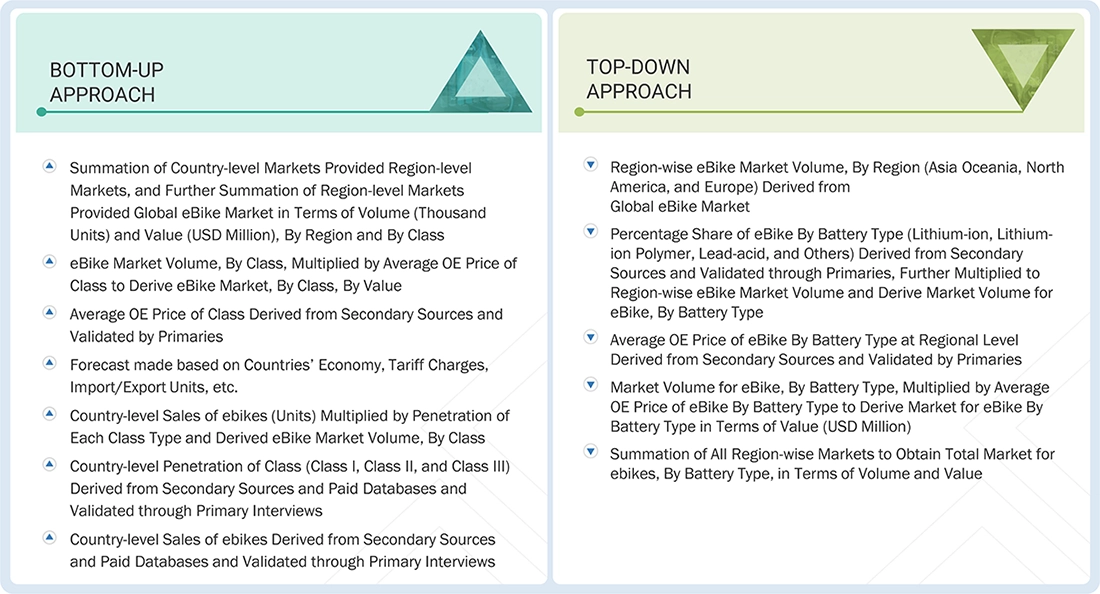
Data Triangulation
All percentage shares, splits, and breakdowns were determined using secondary sources and verified through primary sources. All parameters expected to affect the markets covered in this research study were accounted for, viewed in extensive detail, verified through primary research, and analyzed to obtain the final quantitative and qualitative data. This data was consolidated, supplemented with detailed inputs and analysis from MarketsandMarkets, and presented in the report.
Market Definition
An ebike is a bicycle equipped with a small electric motor and a rechargeable battery that assists the rider's pedaling power. The battery can be recharged by plugging it into a power source. Typically, an ebike takes about 6 to 8 hours to fully charge and can travel a distance of 35 to 50 kilometers at a speed of approximately 20 km/h.
Key Stakeholders
- ebike manufacturers
- ebike battery & motor manufacturers
- Component suppliers for ebikes
- Raw material suppliers for ebikes
- Country-level associations
- Traders, distributors, and suppliers of ebikes
Report Objectives
-
To define, describe, and forecast the size of the global ebike market in terms of value (USD million) and volume (thousand units)
- By Class (Class-I, Class-II, Class-III) at the regional level
- By Speed (up to 25 km/h, 25-45 km/h) at the regional level
- By Battery Type (Lithium-ion, Lithium-ion Polymer, Lead Acid, and Others) at the regional level
- By Motor Type (Hub and Mid) at the regional level
- By Mode (Pedal Assist and Throttle) at the regional level
- By Component (Batteries, Electric Motors, Frames with Forks, Wheels, Crank Gears, Brake Systems, and Motor Controller) at the regional level
- By Usage (Mountain/Trekking, City/Urban, Cargo, and Others) at the regional level
- By Ownership (Shared and Personal)
- By Battery Capacity (<250W, >250 & <450W, >450 & <650W, and >650W)
- By Motor Weight (<2 kg, >2 kg & <2.4 kg, >2.4 kg)
- By Motor Power (<40 Nm, >40 Nm-<70 Nm, >70 Nm)
- Country-level Analysis of Class-wise and Usage-wise segments (Asia Pacific, Europe, and North America)
- To understand the dynamics (drivers, restraints, opportunities, and challenges) of the market
- To strategically analyze market with trade analysis, pricing analysis, recession impact, case study analysis, patent analysis, technology analysis, regulatory analysis, key conferences and events, bill of material, the total cost of ownership, pricing analysis trends/disruptions impacting buyers, financial matrix, investment, and funding case scenario.
- To analyze the competitive landscape of the global players in the market, along with their market share/ranking
- To analyze the Competitive Evaluation Matrix of the global and regional ebike manufacturers and ebike component suppliers in the market
- To analyze a detailed listing of OEMs and their brands, OEM-wise technical specifications, mergers & acquisitions, partnerships, collaborations, expansions, and new product launches/developments undertaken by critical participants in the market.
Available customizations:
Along with the market data, MarketsandMarkets offers customizations per company-specific needs.
The following customization options are available for the report:
Fact checked
Personalize This Research
- Triangulate with your Own Data
- Get Data as per your Format and Definition
- Gain a Deeper Dive on a Specific Application, Geography, Customer or Competitor
- Any level of Personalization
Let Us Help You
- What are the Known and Unknown Adjacencies Impacting the ebike Market
- What will your New Revenue Sources be?
- Who will be your Top Customer; what will make them switch?
- Defend your Market Share or Win Competitors
- Get a Scorecard for Target Partners

Custom Market Research Services
We Will Customise The Research For You, In Case The Report Listed Above Does Not Meet With Your Requirements
Get 10% Free CustomisationTESTIMONIALS

JIM NAAS
PRODUCT DIRECTOR, WEASLER
Weasler Engineering, a CentroMotion organization
Global Provider of Industrial Actuation & Control Solutionswww.weasler.com
Our organization was interested in learning more about the attractiveness of a particular market space. We contacted MarketsandMarkets to help us based on previous positive experiences we had with them. The results did not disappoint! We discussed our objectives with them, and the team at MarketsandMarkets developed and executed a proposal that met our needs precisely. We were very impressed by their level of expertise, the quality of the analysis and their insightful recommendations. We would not hesitate in working with them again in the future.

Matt Kardel,
Vice President
Aptiv,
A global technology company that develops safer, greener and more connected solutions.www.aptiv.com
We contracted with
MarketsandMarkets to evaluate the value chain and potential go-to-market partners related to our
interest in the Fleet Management space. The team successfully completed the work on time and at the
pricing agreed. MarketsandMarkets listened and understood our objectives and collaborated well with
us to help us get the visibility we needed to make an investment.
We have subsequently used
MarketsandMarkets again related to Smart Cities to good results.
- China ebike Market
- Japan ebike Market
- India ebike Market
- South Korea ebike Market
- Taiwan ebike Market
- Australia ebike Market
- Canada ebike Market
- US ebike Market
- Germany ebike Market
- Netherlands ebike Market
- France ebike Market
- UK ebike Market
- Austria ebike Market
- Italy ebike Market
- Belgium ebike Market
- Spain ebike Market
- Switzerland ebike Market
Growth opportunities and latent adjacency in ebike Market





luna
Apr, 2021
Merida Industry Co., Ltd is a Taiwan-based company.
User
Jan, 2021
We are an electric bike brand and we are interested in obtaining this report. .
Daniela
Feb, 2020
Is it possible to discuss the market segmentation by the country-level?.
MnM Analyst
May, 2020
Market Segment is already discussed at country level. Do you have any specific requirement?.
Ekaterina
Jul, 2022
Profiles of key players in U.S market, their product portfolio analysis, organic and in-organic growth strategies, contract awarded & details of the contracts, key investments and all other key development including SWOT analysis will be provided. Similarly, for the E-Scooter and E- Motorcycles market we will provide the historical units sales data and revenues and growth forecast. Profiles of key players in U.S market, their product portfolio analysis, organic and in-organic growth strategies, contract awarded & details of the contracts, key investments and all other key development including SWOT analysis will be provided. Demographic analysis is only done from qualitative standpoint, and we have covered the buyer behaviour analysis by age, however we have provided the market size and growth forecast by Usage – (Mountain, Trekking, City/Urban, Cargo, Others), at a regional level and country level. for the E-Scooter and E- Motorcycles market we will provide the historical units sales data and revenues and growth forecast. .
Sofia
Jul, 2022
E-Bike market report was published early this year, and this new version has an improved scope and we have provided the regional and country level market size and growth forecast in terms of unit sales and revenues further broken down by By Class, By Usage, By Battery, By Speed, By Motor and By Mode and Average Selling Price by segments.Market share analysis of key players, including their revenue analysis for last three years, product and business revenues, key financial analysis, organic and in-organic growth strategies, contract awarded & details of the contracts, key investments and expansions plans in terms of production and market penetration, and all other key development including SWOT analysis are provided for all global and regional players..
Jo
Jul, 2020
There is no reference to RAD BIkes in the report and yet they appear to be taking the US market by storm.... am I missing something?.
apoorv
Jul, 2019
I may be interested in buying your E-bike market report and like to get a better idea of scope and contents..
Akshit
Jun, 2019
Looking for e-bike market potential and forecasting data. To analyse and size the market for investment potential for Valeo. .
User
Jun, 2019
The following are the specific items that we are looking to gather from the e-bike report: 1) market size ($) breakdown by geography 2) market size forecast overall and by geography 3) volume (units) breakdown by geography 4) Market share breakdown by key buyers (e.g. OEMs) 5) Total available market for connected services overall and by geography 6) Connected Services market share by competition 7) Percentage of OEMs producing connected solutions in-house vs outsourcing 8) What jobs are OEMs trying to accomplish with connected services 9) What are some pains OEMs are experiencing with connected services, how are they trying to solve them 10) What are some gains that OEMs are creating through connected service solutions Please let me know which items would be available in the report and which portion(s) of the report they would be contained in. If this would be best addressed in a conversation, do you have availability to speak, preferably tomorrow - my phone number should be attached. Thank you.
Nilesh
Jun, 2019
We are building a global e-bike brand and we would like to have access to the report to get more information and identify opportunities to prepare our master plan for the next five years.
Nilesh
Jun, 2019
We are the biggest lead-acid battery in North America and we are seeing the market for electric bikes growing. So, we would like to understand more about this market in South America..
Nilesh
Jun, 2019
Would like to know the current Global Market scenario in E-bike and accordingly what is the future of this category in India.
Atul
May, 2019
I`m trying to make a general view of the electro bikes and other electric two wheels vehicles, use in mexican cities and their potential to reduce criteria pollutants as a substitute of internal combustion engines vehicles..
Caroline
May, 2026
Need to know more about E-mobility segmentation and regenerative tech for e-mobility. .
Likele
May, 2026
Future of ebike market and the value chain from components to service parts .
Sagar
May, 2026
We are more interested in clusters HMI, ECU/VCU and BMS, also the Sensors , Switches, terminal overmold .