
Application Security Market

Application Security Market by Component (Solutions (Security Testing Tools, Container Security, API Security, and Others), Services), Type (Web, Mobile), Deployment Mode (Cloud, On-premises), Organization Size, Vertical - Global Forecast to 2031




OVERVIEW
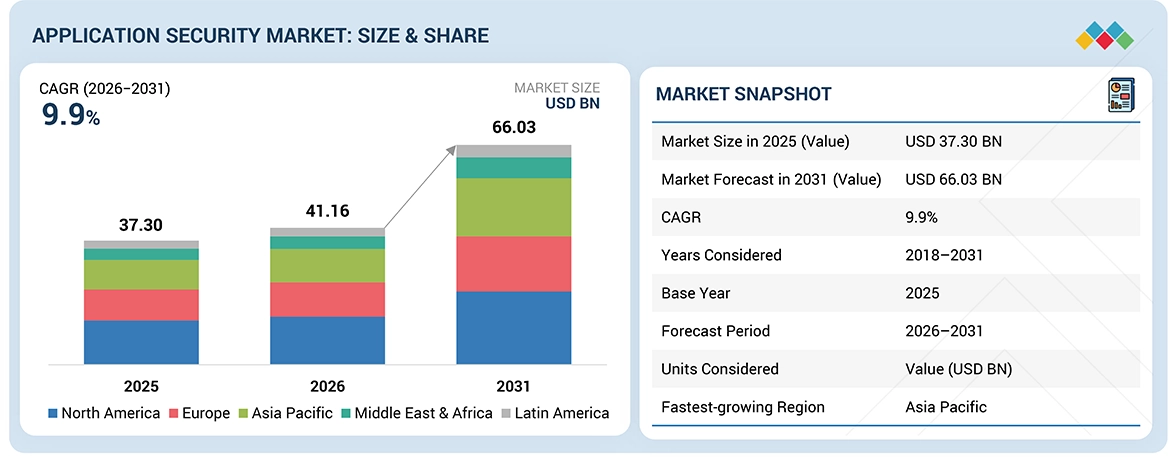
Source: Secondary Research, Interviews with Experts, MarketsandMarkets Analysis
The application security market is projected to reach USD 66.03 billion by 2031 from USD 41.16 billion in 2026, at a CAGR of 9.9% from 2026 to 2031. The market is driven by the growing complexity of contemporary applications that are hosted on cloud-native applications, microservices, and APIs, which increases the application attack surface significantly. Companies are moving toward integrating security in the development chains to identify vulnerabilities earlier in the software development lifecycle. Also, the growing risks that exist in software supply chains due to open-source software and third-party software are driving the need to seek an all-encompassing approach to the protection of applications.
KEY TAKEAWAYS
-
BY REGIONNorth America is estimated to account for the largest share (35.0%) of the application security market in 2026.
-
BY TYPEBy type, the web application security segment is estimated to dominate the market in terms of share in 2026.
-
BY COMPONENTBy component, the solutions segment is estimated to account for the major market share of 74.3% in 2026.
-
BY DEPLOYMENT MODEBy deployment mode, the cloud segment is projected to register a higher CAGR than the on-premises segment during the forecast period.
-
BY ORGANIZATION SIZEBy organization size, the SMEs segment will witness a higher CAGR than the large enterprises segment during the forecast period.
-
BY VERTICALBy vertical, the government & public sector segment is projected to register the highest CAGR of 13.4% during the forecast period.
-
COMPETITIVE LANDSCAPE - KEY PLAYERSIBM, HCLTech, and F5 Networks are dominant players in the application security market with a holistic platform that provides web application protection, API security, vulnerability management, and DevSecOps integration. They secure applications in the enterprise across a multifaceted digital landscape.
-
Application Security Testing MarketApplication Security Testing Market is projected to grow from USD 1.83 billion in 2025 to USD 7.60 billion by 2031, at a CAGR of 26.7%
-
COMPETITIVE LANDSCAPE - STARTUPS/SMEsThe emerging innovators in the application security market are Data Theorem, Contrast Security, and Pradeo Security Systems. They provide API security, runtime protection, and mobile application security solutions that are cloud-native, mobile-first, and dynamically growing.
The complexity and exposure of modern application environments are on the rise owing to the increasing dependence on cloud-based applications, APIs, and microservices-based architectures. Rapid software development and continuous deployment practices demand security to be incorporated throughout the development life cycle. Application security solutions facilitate the early identification of vulnerabilities, enhance the protection of the applications, and contribute to efficient risk management within dynamic and changing digital infrastructures.
TRENDS & DISRUPTIONS IMPACTING CUSTOMERS' CUSTOMERS
As organizations expand beyond simple vulnerability detection to ongoing and collective application protection, better application security platforms, DevSecOps Market integration, and cloud-native development are increasing growth in the market. Demand in application security is growing in the BFSI, healthcare, and government & public sectors due to the growing Cybersecurity Market investments. These solutions are used to guard sensitive information, guarantee regulatory conformance, and secure vital digital applications in a more complex and distributed IT infrastructure.
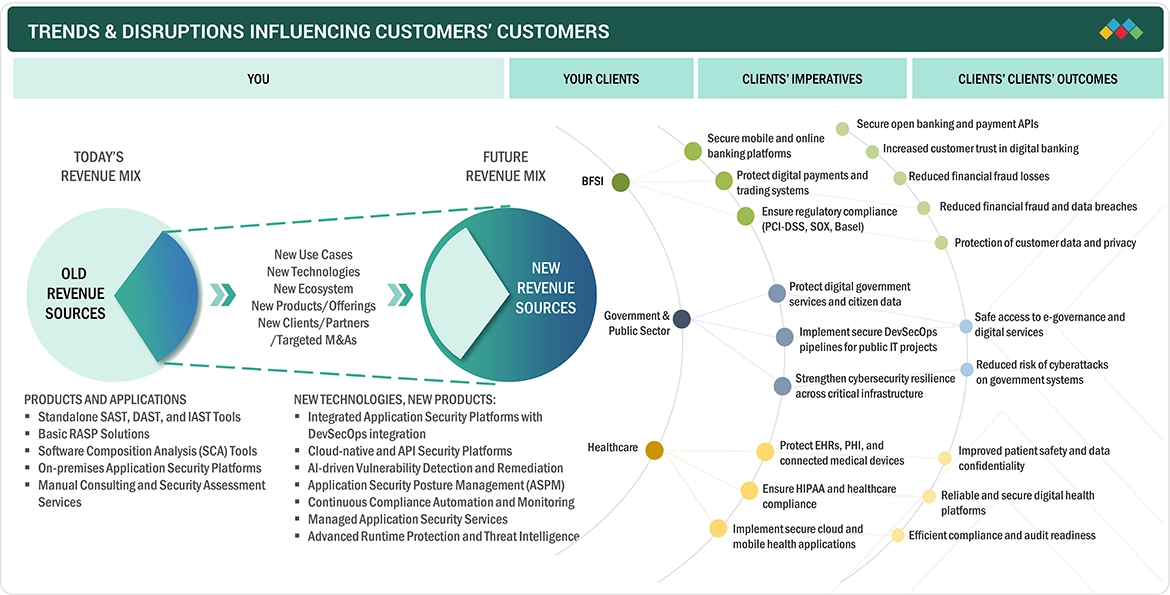
Source: Secondary Research, Interviews with Experts, MarketsandMarkets Analysis
MARKET DYNAMICS

Level
-
Surge in application-targeted breaches and vulnerabilities

-
Regulatory and compliance mandates across regions


Level
-
High implementation & ongoing operational costs

-
Integration complexity with legacy and multi-tech stacks


Level
-
Mobile and API-centric security demand

-
AI/ML-driven security testing and automation


Level
-
Rapid evolution of threat landscape & zero-day exploits

-
Balancing speed-to-market with security rigor

Source: Secondary Research, Interviews with Experts, MarketsandMarkets Analysis
Driver: Surge in application-targeted breaches and vulnerabilities
The rising rate of application-layer attacks and software vulnerabilities is a key driver of the application security market. Since organizations are growing web, mobile, and cloud applications, attackers are moving toward APIs, logins, and backend services. This increased threat is compelling business organizations to migrate to superior application security systems to identify vulnerabilities in time and to guard important applications.
Restraint: High implementation & ongoing operational costs
High implementation costs and ongoing operational expenses remain key restraints for the application security market. Implementing an all-encompassing security system can be expensive both in terms of investment in tools and infrastructure, as well as in human resources. SMEs, especially, might face challenges in implementing more sophisticated application security platforms into current development platforms and dealing with the complexity of operations and maintenance expenses.
Opportunity: Mobile and API-centric security demand
Mobile application and API-driven digital services are booming, creating a significant opportunity in the application security market. The use of APIs is becoming a vital aspect of businesses in their need to bridge platforms, services, and third-party applications. The need to protect such interfaces has become urgent, which has led to the demand for specific application security solutions that offer API protection, mobile application security testing, and monitoring.
Challenge: Rapid evolution of threat landscape & zero-day exploits
The ever-changing nature of cybersecurity threats is one of the major challenges to the application security market growth. The attackers are finding new vulnerabilities and exploiting the zero-day vulnerabilities in applications. To stay abreast of the new attack tactics, organizations need to continuously refresh security tools, testing capabilities, and threat intelligence capabilities to safeguard multifaceted digital application settings.
APPLICATION SECURITY MARKET: COMMERCIAL USE CASES ACROSS INDUSTRIES
| COMPANY | USE CASE DESCRIPTION | BENEFITS |
|---|---|---|
 |
Veracode implemented automated application security testing within CI/CD pipelines to detect vulnerabilities early during software development cycles. | Improved secure coding practices, reduced vulnerabilities in production, strengthened compliance readiness, and accelerated secure digital banking application releases. |
 |
Checkmarx implemented static application security testing across enterprise development environments to enforce secure coding and identify vulnerabilities during development. | Enhanced code security visibility, faster vulnerability remediation, reduced risk in deployed applications, and improved enterprise-wide security governance. |
 |
Qualys implemented web application vulnerability scanning to continuously monitor externally facing applications and identify potential security weaknesses. | Strengthened vulnerability management, improved compliance with security regulations, reduced attack surface, and enhanced protection of sensitive customer data. |
Logos and trademarks shown above are the property of their respective owners. Their use here is for informational and illustrative purposes only.
MARKET ECOSYSTEM
The application security ecosystem comprises solution providers, service providers, and regulatory bodies, which, in combination, provide application protection throughout the development and deployment lifecycle. Solution providers offer application security using web applications, API security, runtime security, and vulnerability management systems. Service providers provide consulting, implementation, and managed services to promote efficient deployment and operation. Regulatory bodies set standards of cybersecurity and standards of compliance. Together, these stakeholders help organizations strengthen DevSecOps practices, enhance vulnerability visibility, and secure modern cloud-native and API-driven environments.
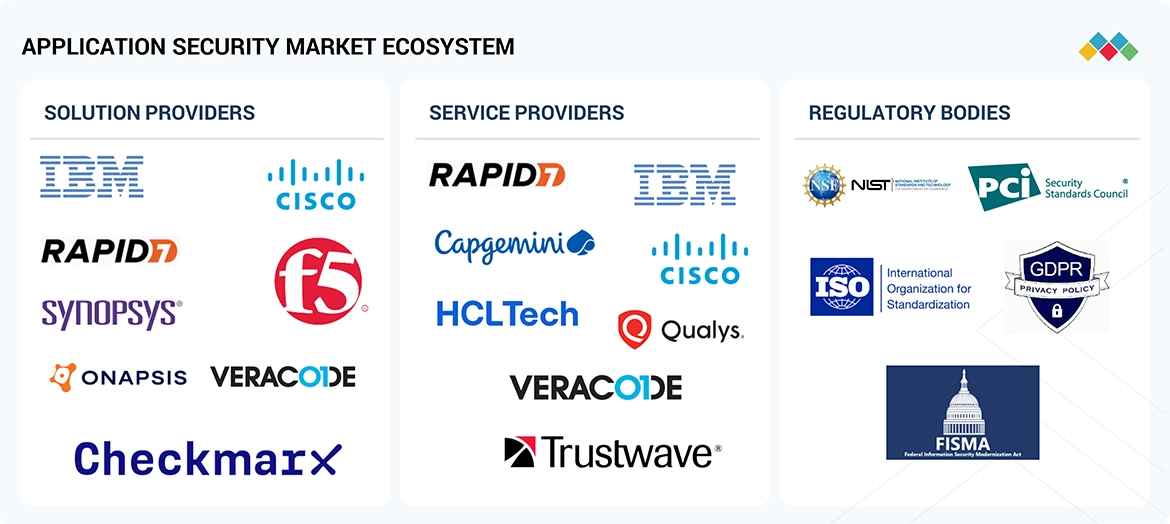
Logos and trademarks shown above are the property of their respective owners. Their use here is for informational and illustrative purposes only.
MARKET SEGMENTS
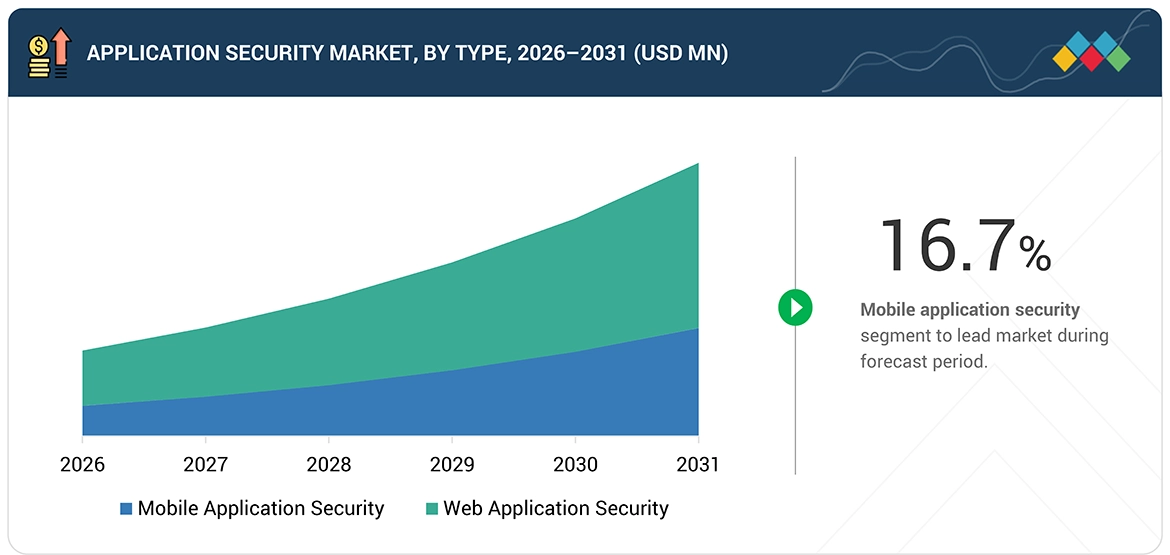
Source: Secondary Research, Interviews with Experts, MarketsandMarkets Analysis
Application Security Market, by Type
The web application security segment is expected to lead the application security market during the forecast period due to the increasing use of web-based platforms in the delivery of digital services and operations by businesses. The rising number of web application attacks, such as SQL injection and cross-site scripting, is forcing companies to consider using more modern security solutions in order to protect sensitive information and deliver secure application services.
Application Security Market, by Component
The solutions segment is projected to lead the application security market because more organizations will be implementing dedicated tools to detect and reduce vulnerabilities within application environments. Such solutions, comprising testing, runtime protection, and vulnerability management systems, assist enterprises in incorporating security into the development lifecycle to facilitate proactive threat detection and enhance overall application resilience within complex digital environments.
Application Security Market, by Deployment Mode
The application security market is projected to be dominated by the cloud segment, due to the increasing use of cloud-native applications and hybrid IT environments. The cloud-based security platforms are scalable, flexible, and capable of real-time monitoring of threats, thus helping organizations in securing their distributed applications in addition to facilitating the agile development process and ensuring robust security measures of dynamic digital infrastructures.
Application Security Market, by Organization Size
The large enterprises segment is expected to hold a significant market share because these organizations operate large application portfolios and multifaceted digital infrastructures. As large businesses become more exposed to cyber threats and more demanding regarding compliance policies, more businesses are venturing into and adopting holistic application security solutions that will help them secure critical data, secure software development procedures, and continue running their businesses.
Application Security Market, by Vertical
The BFSI segment is projected to lead the application security market because the sector is highly dependent on secure digital platforms to conduct financial transactions and customer services. The increase in cyber threats to financial information and the high regulatory compliance demands are compelling banks and other financial institutions to implement sophisticated application security tools to safeguard confidential information and avoid the loss of confidence in online banking environments.
REGION
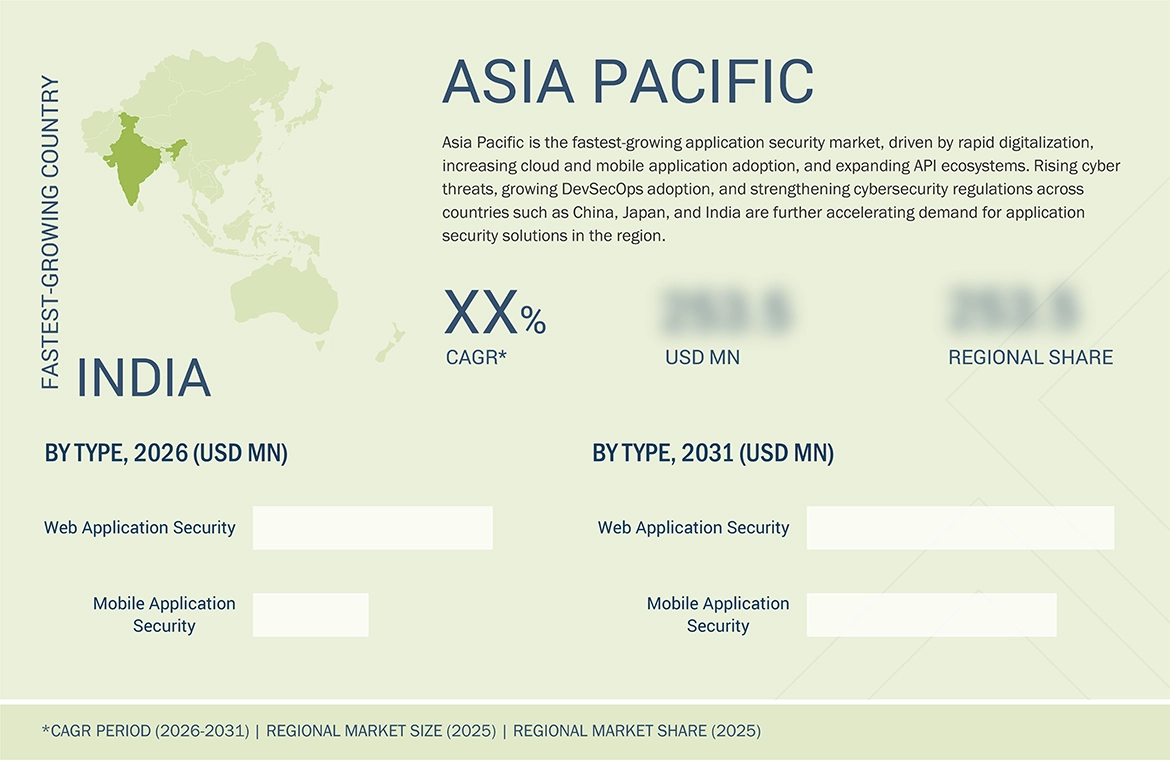
Asia Pacifc to be fastest-growing region in global application security market during forecast period.
Asia Pacific is expected to be the fastest-growing market for application security due to rapid Digital Transformation, increasing use of cloud services, and a rise in the development of mobile, web, and API-based applications. The increasing threats of cybercrime and stringent data protection laws are prompting organizations in the BFSI, government, healthcare, and e-commerce industries to invest in advanced application security systems to safeguard sensitive information and secure software development in the modern digital landscape.
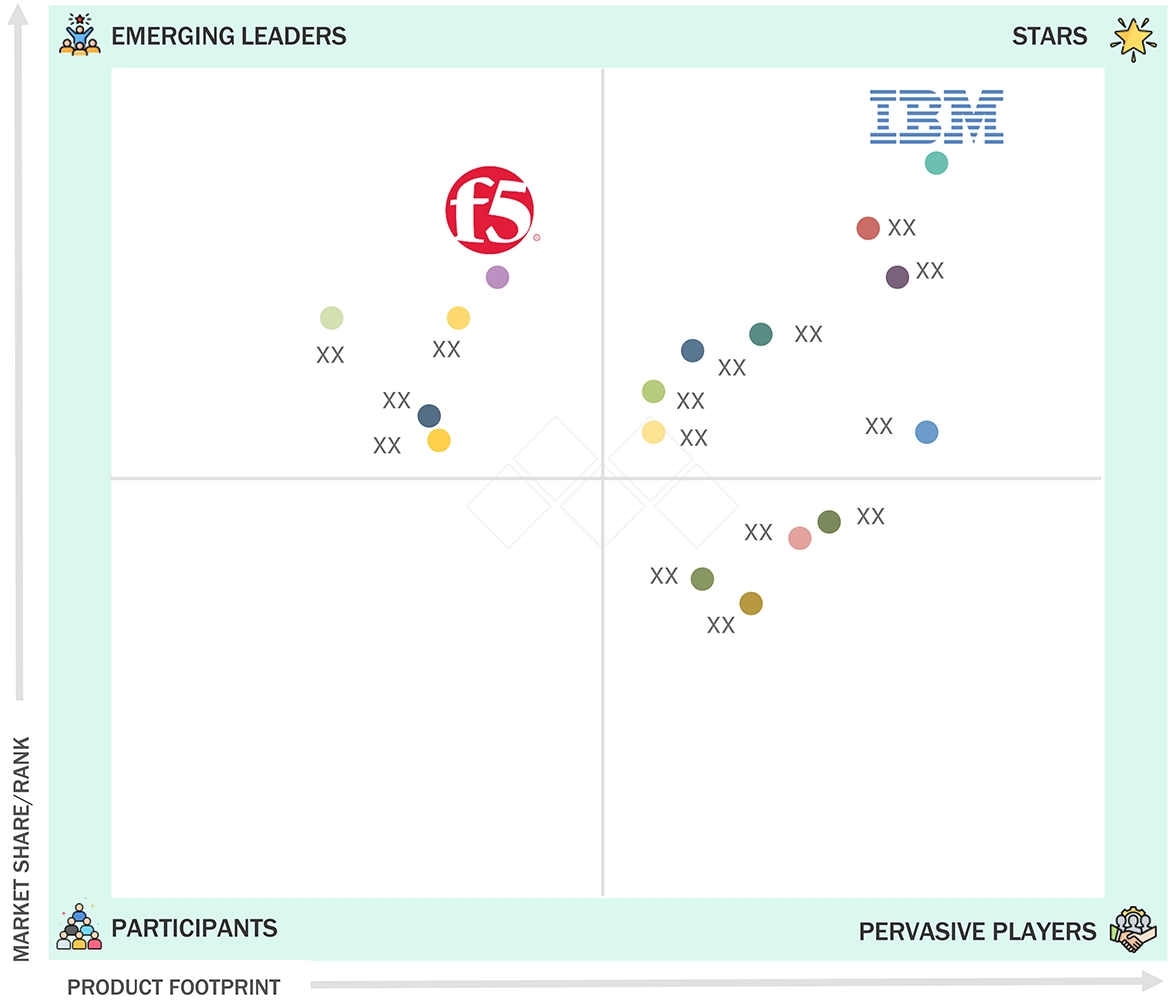
APPLICATION SECURITY MARKET: COMPANY EVALUATION MATRIX
In the application security market, IBM (Key Player) leads with a wide range of application security solutions, integrated with threat management, DevSecOps, and enterprise risk management environments. F5 Networks (Emerging Leader) is strengthening its position through advanced web application and API protection solutions designed to secure modern, cloud-native, and distributed application environments.
Source: Secondary Research, Interviews with Experts, MarketsandMarkets Analysis
KEY MARKET PLAYERS
- IBM (US)
- HCLTech (India)
- Cisco (US)
- Synopsys (US)
- Capgemini (France)
- VMware (US)
- F5 Networks (US)
- Trustwave (US)
- Rapid7 (US)
- Qualys (US)
- GitLab (US)
- OneSpan (US)
- Lookout (US)
- Imperva (US)
- Onapsis (US)
- Checkmarx (US)
MARKET SCOPE
| REPORT METRIC | DETAILS |
|---|---|
| Market Size in 2025 (Value) | USD 37.30 Billion |
| Market Forecast in 2026 (Value) | USD 41.16 Billion |
| Market Forecast in 2031 (Value) | USD 66.03 Billion |
| Growth Rate | CAGR of 9.9% from 2026 to 2031 |
| Years Considered | 2018-2031 |
| Base Year | 2025 |
| Forecast Period | 2026-2031 |
| Units Considered | Value (USD Billion) |
| Report Coverage | Revenue forecast, company ranking, competitive landscape, growth factors, and trends |
| Segments Covered |
|
| Regions Covered | North America, Europe, Asia Pacific, Middle East & Africa, Latin America |
WHAT IS IN IT FOR YOU: APPLICATION SECURITY MARKET REPORT CONTENT GUIDE
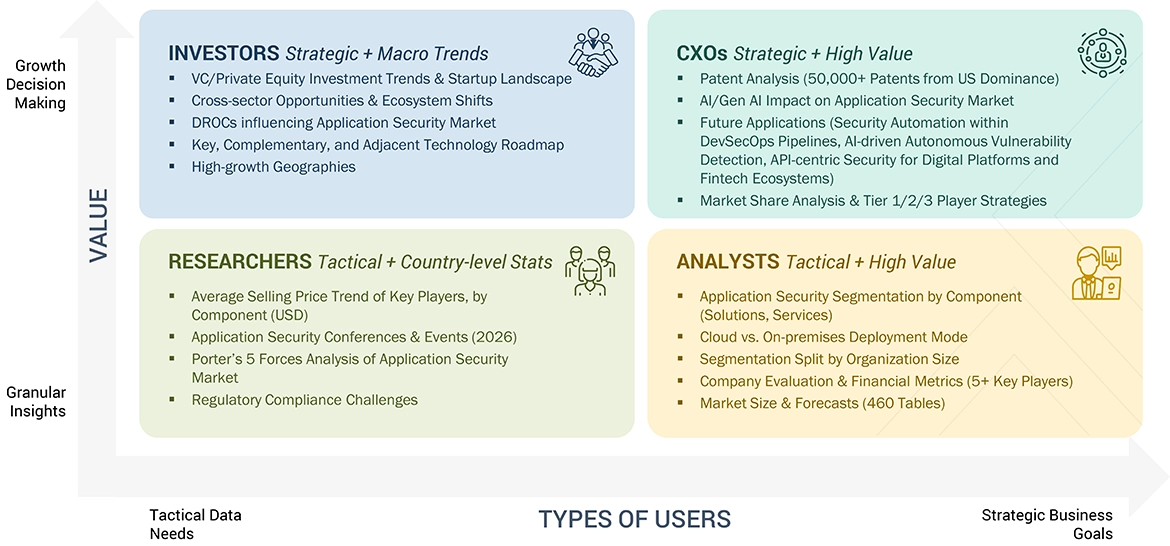
DELIVERED CUSTOMIZATIONS
We have successfully delivered the following deep-dive customizations:
| CLIENT REQUEST | CUSTOMIZATION DELIVERED | VALUE ADDS |
|---|---|---|
| Leading Solution Provider (US) | Product Analysis: Application Security Matrix, providing an in-depth comparison of leading vendors’ offerings, including web application security, API protection, runtime application self-protection, container and cloud application security, vulnerability management, DevSecOps integration, threat detection capabilities, compliance support, analytics and reporting features, and flexible deployment across cloud, hybrid, and on-premises environments. | Stronger understanding of competitive positioning in the application security market, product breadth across development and runtime environments, automation maturity, API and cloud-native protection capabilities, and platform integration strengths - supporting strategic technology investments, vendor selection, and long-term enterprise application protection strategies. |
| Leading Service Provider (EU) | Company Information: Detailed profiling and evaluation of additional application security vendors and service providers (up to 5), covering application protection technologies, API security capabilities, DevSecOps enablement, managed application security services, vulnerability management approaches, regulatory compliance support, global presence, and strategic partnerships across digital-first and highly regulated industries. | Comprehensive perspective of the evolving application security landscape, highlighting increasing adoption of API and cloud application protection, growing demand for integrated security platforms, rising reliance on managed security services, and vendor differentiation through automation, runtime protection, and secure application lifecycle management capabilities. |
RECENT DEVELOPMENTS
- February 2026 : Qualys released new TotalAppSec vulnerability detection updates, adding signatures to identify security flaws in widely used frameworks such as Laravel, WordPress, Apache, and Jenkins, strengthening automated application vulnerability detection across enterprise environments.
- September 2025 : Qualys expanded its Web Application Scanning capabilities by introducing new detection signatures for vulnerabilities across enterprise platforms, including GitHub Enterprise, Jenkins, SAP NetWeaver, and Oracle WebLogic applications.
- June 2025 : Checkmarx enhanced the Checkmarx One application security platform with improved software composition analysis and API security testing capabilities to help enterprises secure open-source dependencies and modern cloud-native applications.
- April 2025 : IBM strengthened its Application Security and DevSecOps portfolio by integrating AI-driven vulnerability detection capabilities into its security platforms to help enterprises secure applications across hybrid cloud environments.
- April 2025 : HCLTech introduced HCL AppScan API Security, an AI-infused platform designed to discover and secure APIs across development and runtime environments, helping enterprises detect shadow APIs and strengthen application security governance.
Table of Contents
 Exclusive indicates content/data unique to MarketsandMarkets and not available with any competitors.
Methodology
Secondary research was conducted to collect information useful for this technical, market-oriented, and commercial study of the application security market. The next step involved validating these findings, assumptions, and sizing with industry experts across the value chain using primary research. Different approaches, including top-down and bottom-up methods, were employed to estimate the total market size. After that, the market breakup and data triangulation procedures were used to estimate the size of segments and subsegments of the application security market.
Secondary Research
During the secondary research process, various secondary sources were consulted to identify and collect information relevant to the study. The secondary sources included annual reports, press releases, investor presentations of application security vendors, forums, certified publications, and whitepapers. The secondary research was mainly used to obtain key information about the industry’s supply chain, the total pool of key players, market classification and segmentation according to industry trends to the bottom-most level, regional markets, and key developments from both market- and technology-oriented perspectives, all of which were further validated by primary sources.
Primary Research
In the primary research process, various primary sources from both the supply and demand sides were interviewed to obtain qualitative and quantitative information for this report. The primary sources from the supply side included various industry experts, including chief executive officers (CEOs), vice presidents (VPs), marketing directors, technology and innovation directors, and related key executives from various key companies and organizations operating in the application security market.
In the market engineering process, top-down and bottom-up approaches were extensively used, along with several data triangulation methods, to perform market estimation and forecasting for the overall market segments and subsegments listed in this report. Extensive qualitative and quantitative analysis was performed on the complete market engineering process to list key information/insights throughout the report.
After the complete market engineering process (including calculations for market statistics, market breakups, market size estimations, market forecasts, and data triangulation), extensive primary research was conducted to gather information and verify & validate the critical numbers arrived at. The primary research was also conducted to identify the segmentation types, industry trends, competitive landscape of application security market players, and key market dynamics, such as drivers, restraints, opportunities, challenges, and key strategies.
The following is a breakdown of the primary respondents:
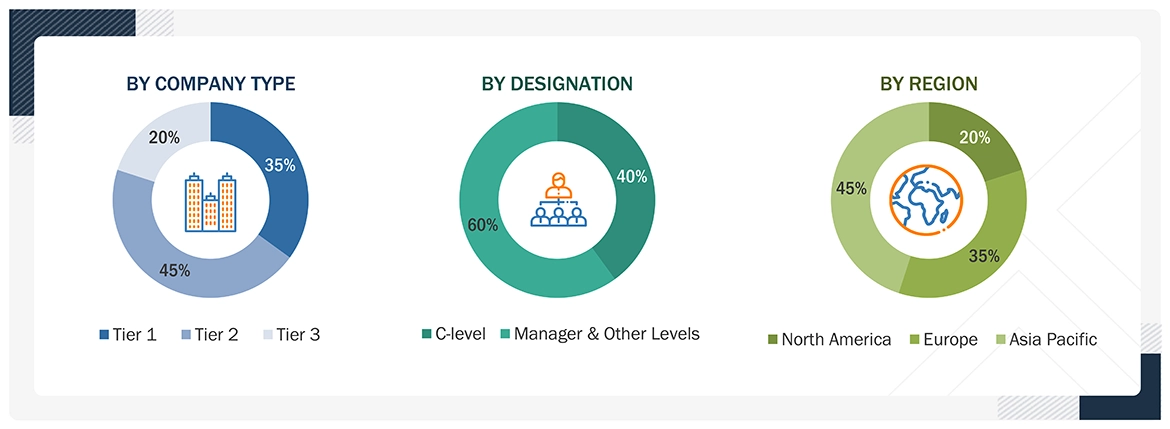
Note: Tier 1 companies receive revenues higher than USD 10 billion; Tier 2 companies' revenues range between USD 1 and 10 billion; and Tier 3 companies' revenues range between USD 500 million and USD 1 billion. Other designations include sales, marketing, and product managers.
To know about the assumptions considered for the study, download the pdf brochure
Market Size Estimation
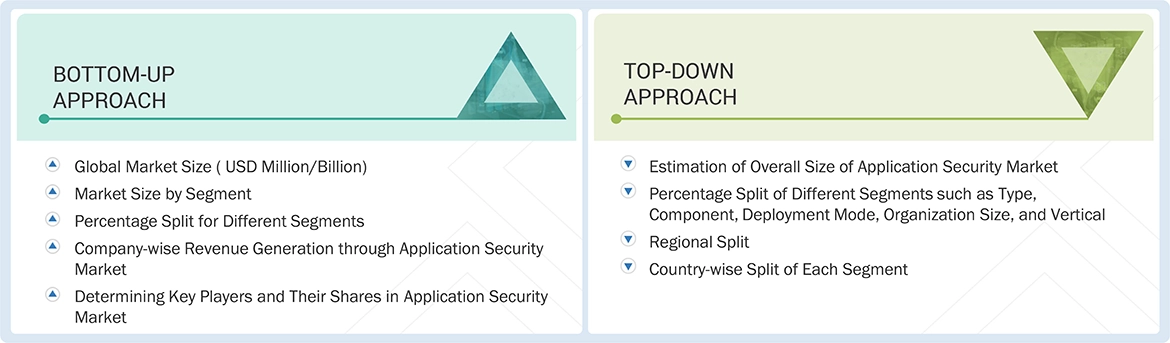
Top-down and bottom-up approaches were employed to estimate and validate the size of the application security market, as well as the size of various dependent sub-segments within the overall application security market. The research methodology used to estimate the market size includes the following details: critical players in the market were identified through secondary research, and their market shares in the respective regions were determined through primary and secondary research. This entire procedure involved studying the annual and financial reports of the top market players, and extensive interviews were conducted with key industry leaders, including CEOs, VPs, directors, and marketing executives, to gather valuable insights.
All percentage splits and breakdowns were determined using secondary sources and verified through primary sources. All possible parameters that affect the market covered in this research study were accounted for, viewed in extensive detail, verified through primary research, and analyzed to get the final quantitative and qualitative data. This data was consolidated and added to detailed inputs and analysis from MarketsandMarkets.
INFOGRAPHIC DEPICTING BOTTOM-UP AND TOP-DOWN APPROACHES
Data Triangulation
The market was split into several segments and subsegments after arriving at the overall market size using the market size estimation processes explained above. The data triangulation and market breakup procedures were employed, wherever applicable, to complete the overall market engineering process and arrive at the exact statistics of each market segment and subsegment. The data was triangulated by studying various factors and trends from both the demand and supply sides.
Market Definition
As per VMware, Inc., “application security is the process of developing, adding, and testing security features within applications to prevent security vulnerabilities against threats, such as unauthorized access and modification.”
As per MicroFocus, “application security is the discipline of processes, tools, and practices aiming to protect applications from threats throughout the entire application life cycle.”
MarketsandMarkets defined application security as “the process of finding a vulnerability and error in a web and mobile application during a Software Development Life Cycle (SDLC), including functional and non-functional aspects of application development in a lifecycle.”
Report Objectives
- To describe and forecast the application security market by type, component, deployment mode, organization size, vertical, and region from 2026 to 2031, and analyze the various macroeconomic and microeconomic factors that affect market growth
- To forecast the market size of five major regions: North America, Europe, Asia Pacific, the Middle East & Africa, and Latin America
- To analyze the subsegments of the market concerning individual growth trends, prospects, and contributions to the overall market
- To provide detailed information related to the primary factors (drivers, restraints, opportunities, and challenges) influencing the market growth
- To analyze opportunities in the market for stakeholders by identifying high-growth segments of the market
- To profile the key market players and comprehensively analyze their market size and core competencies
- To track and analyze competitive developments, such as new product launches, mergers and acquisitions, partnerships, agreements, and collaborations, in the application security market
Key Stakeholders
- Chief Technology and Data Officers
- Business Analysts
- Software Developers and Testers
- Information Technology (IT) Professionals
- Government Agencies
- Investors and Venture Capitalists
- Third-party Service Providers
- Consultants/Consultancies/Advisory Firms
- Managed and Professional Service Providers
Available customizations:
With the given market data, MarketsandMarkets offers customizations based on company-specific needs. The following customization options are available for the report:
GEOGRAPHIC ANALYSIS
- Further breakup of the Asia Pacific market into countries contributes to the rest of the regional market size.
- Further breakup of the North American market into countries contributes to the rest of the regional market size.
- Further breakup of the Latin American market into countries contributing to the rest of the regional market size
- Further breakup of the Middle East & African market into countries contributing to the rest of the regional market size
- Further breakup of the European market into countries contributes to the rest of the regional market size
Company information
- Detailed analysis and profiling of additional market players (up to 5)
Need a Tailored Report?
Customize this report to your needs
Get 10% FREE Customization
Customize This ReportPersonalize This Research
- Triangulate with your Own Data
- Get Data as per your Format and Definition
- Gain a Deeper Dive on a Specific Application, Geography, Customer or Competitor
- Any level of Personalization
Let Us Help You
- What are the Known and Unknown Adjacencies Impacting the Application Security Market
- What will your New Revenue Sources be?
- Who will be your Top Customer; what will make them switch?
- Defend your Market Share or Win Competitors
- Get a Scorecard for Target Partners

Custom Market Research Services
We Will Customise The Research For You, In Case The Report Listed Above Does Not Meet With Your Requirements
Get 10% Free CustomisationTESTIMONIALS






Growth opportunities and latent adjacency in Application Security Market