
Physical AI Market Size, Share & Growth

Physical AI Market by Offering (GPU, SoC, Memory, Sensors, Actuators, Software, Services), Robot Type (Industrial Robots, Professional Service Robots, Personal & Household Service Robots), Level of Autonomy, Vertical, and Region - Global Forecast to 2032




OVERVIEW
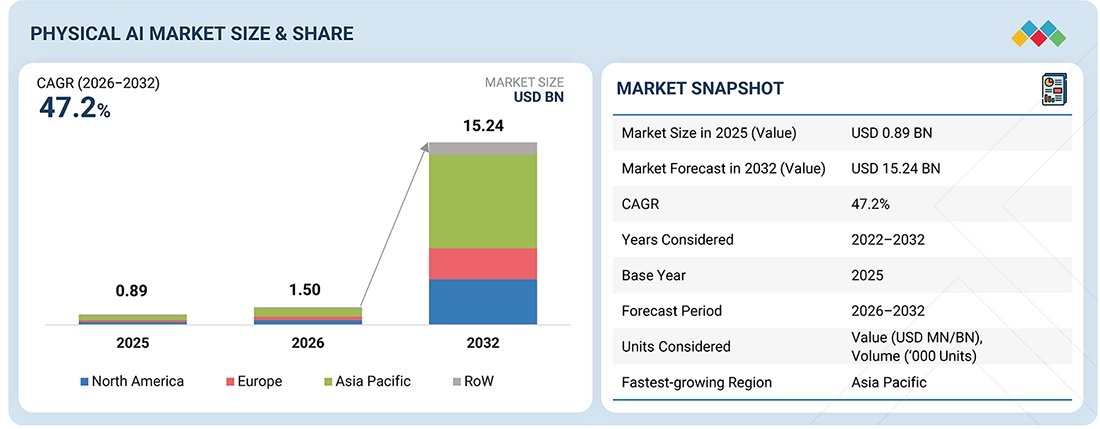
Source: Secondary Research, Interviews with Experts, MarketsandMarkets Analysis
The physical AI market is projected to reach USD 15.24 billion by 2032 from USD 1.50 billion in 2026, growing at a CAGR of 47.2% from 2026 to 2032. The market is driven by rapid advancements in edge AI computing, multimodal perception, and real-time decision-making capabilities in robots. Investments in humanoid robotics, AI-enabled autonomy, and simulation platforms are enabling scalable deployment. Additionally, rising labor shortages and increasing demand for automation across industries are accelerating adoption.
KEY TAKEAWAYS
-
BY REGIONAsia Pacific is expected to dominate the physical AI market with a 50.4% share in 2026.
-
BY OFFERINGBy offering, the hardware segment held largest market share in 2025.
-
BY ROBOT TYPEBy robot type, the industrial robots segment is expected to grow at a CAGR of 56.7% in the physical AI market from 2026 to 2032.
-
BY LEVEL OF AUTONOMYBy level of autonomy, the level 3: advanced segment is likely to record a CAGR of 60.8% during the forecast period.
-
BY VERTICALBy vertical, the logistics & supply chain segment is anticipated to hold the largest market share in 2026.
-
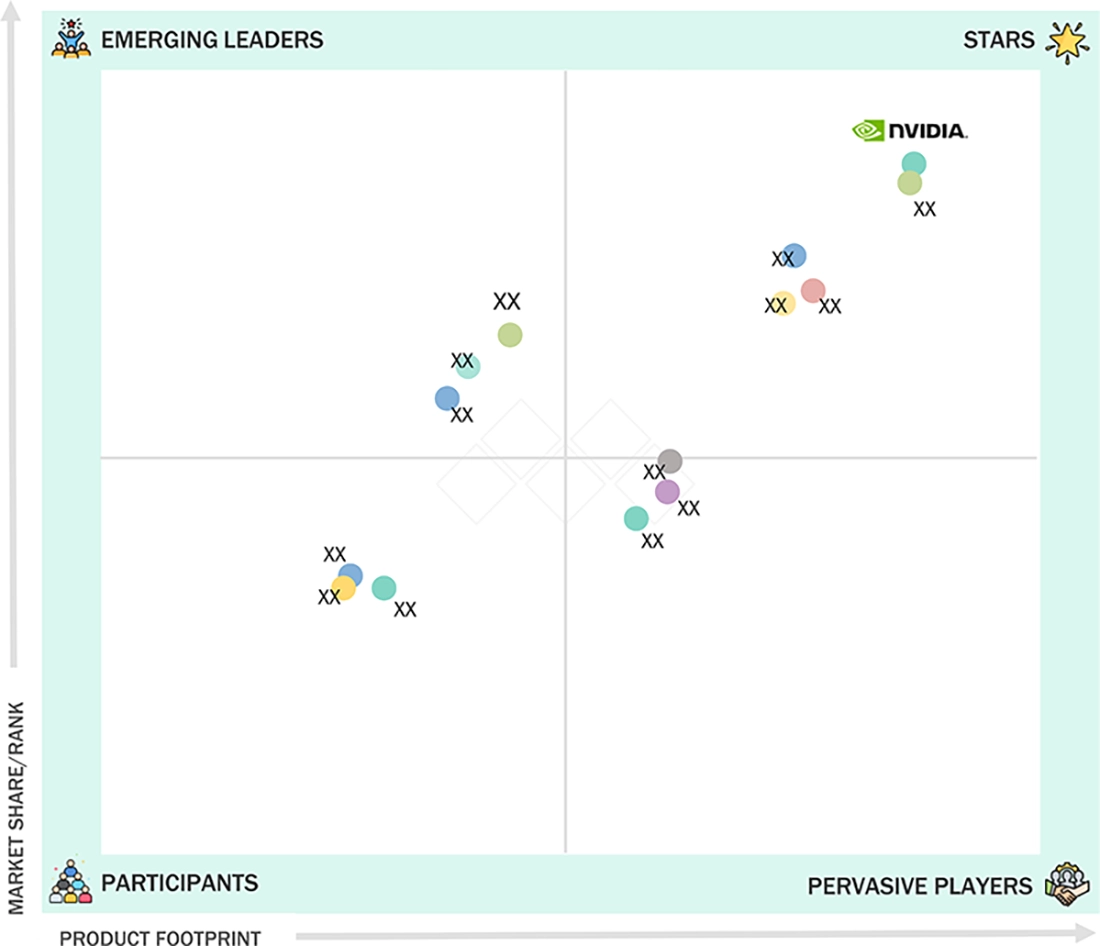
Competitive Landscape - KEY PLAYERSNVIDIA Corporation, ABB, and Qualcomm Technologies, Inc. were identified as some of the star players in the physical AI market, given their strong market share and product footprint.
-
Competitive Landscape - STARTUPS/SMESFigure AI, Agility Robotics, and Physical Intelligence, among others, have distinguished themselves among startups and SMEs by securing strong footholds in specialized niche areas, underscoring their potential as emerging market leaders.
The physical AI market is witnessing strong growth due to the convergence of advanced AI models and robotics, enabling real-time perception, learning, and autonomous decision-making. Rising labor shortages and increasing demand for automation across manufacturing, logistics, and healthcare are accelerating adoption. Continuous advancements in sensors, processors, and energy-efficient systems are improving performance and cost efficiency. Additionally, growing investments in humanoid robotics, AI-enabled autonomy, and simulation technologies are enabling scalable deployment, while enhanced safety and human-robot collaboration are expanding applications across diverse environments.
TRENDS & DISRUPTIONS IMPACTING CUSTOMERS' CUSTOMERS
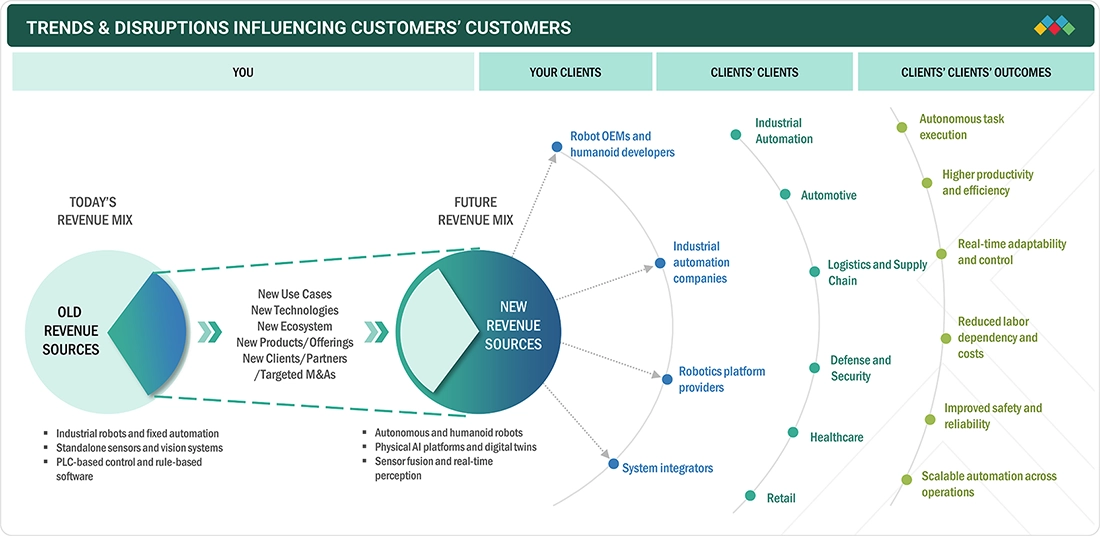
The physical AI market is undergoing a shift from traditional automation toward intelligent, autonomous systems driven by advancements in AI, sensor fusion, and real-time perception. Emerging technologies, such as humanoid robots, digital twins, and AI platforms, are enabling new use cases and revenue streams. This evolution is reshaping customer ecosystems, where robot OEMs and integrators serve diverse industries, including manufacturing, logistics, and healthcare. As a result, end users are achieving higher productivity, improved safety, reduced labor dependency, and scalable, adaptive operations across increasingly complex environments.
Source: Secondary Research, Interviews with Experts, MarketsandMarkets Analysis
MARKET DYNAMICS

Level
-
Rising adoption of autonomous robotics across industrial and logistics sectors

-
Advancements in edge AI compute, sensor fusion, and real-time processing capabilities


Level
-
High upfront investment requirements and extended hardware replacement cycles

-
Complex and unpredictable real-world environments


Level
-
Integration of physical AI into defense modernization and autonomous security infrastructure

-
Expansion of physical AI robotics in healthcare and medical assistance


Level
-
Lack of interoperability and standardization across multi-vendor robotics ecosystems

-
Complexity in real-time multimodal perception and decision-making

Source: Secondary Research, Interviews with Experts, MarketsandMarkets Analysis
Driver: Rising adoption of autonomous robotics across industrial and logistics sectors
The physical AI market is propelled by the accelerated adoption of autonomous robotics to enhance operational efficiency and throughput. Enterprises across manufacturing and logistics are leveraging AI-enabled robots to address labor gaps and optimize end-to-end workflows. Advancements in perception, navigation, and real-time decision-making are further enabling scalable and reliable deployments.
Restraint: High upfront investment requirements and extended hardware replacement cycles
Significant capital expenditure associated with advanced robotic systems and AI infrastructure continues to constrain market adoption. Organizations often face extended ROI timelines, impacting investment decisions. Moreover, long hardware replacement cycles reduce the pace of technology upgrades and limit agility in adopting next-generation solutions.
Opportunity: Integration of physical AI into defense modernization and autonomous security infrastructure
Rising investments in defense modernization are creating substantial opportunities for physical AI-enabled systems. Governments are increasingly deploying autonomous platforms for surveillance, reconnaissance, and mission-critical operations. The shift toward intelligent and unmanned security infrastructure is expected to unlock sustained growth potential.
Challenge: Lack of interoperability and standardization across multi-vendor robotics ecosystems
Fragmented standards across robotics hardware and software ecosystems present a critical challenge for seamless integration. Enterprises operating in multi-vendor environments face compatibility and data exchange limitations. This lack of standardization increases system complexity and hinders large-scale, interoperable deployments.
PHYSICAL AI MARKET SIZE, SHARE & GROWTH: COMMERCIAL USE CASES ACROSS INDUSTRIES
| COMPANY | USE CASE DESCRIPTION | BENEFITS |
|---|---|---|
 |
Deployment of Figure 02 humanoid robots for sheet-metal handling in BMW’s Spartanburg plant, performing precision pick-and-place tasks within automotive assembly lines; the robots operated in real production environments, integrating with existing workflows and industrial systems while meeting strict cycle time and accuracy requirements. | Validated humanoid deployment in high-volume manufacturing, contributing to production of 30,000+ vehicles | Achieved high precision within tight tolerances and sustained daily operations with minimal intervention | Demonstrated scalability and reliability of humanoid automation in complex industrial settings |
 |
Deployment of Digit humanoid robots in logistics facilities for autonomous tote handling, including picking, transferring, and stacking across workflows; the robots operate in human-centric environments and integrate with existing warehouse infrastructure without requiring major modifications | Handled over 100,000 totes, demonstrating high-throughput and operational reliability | Enabled workforce optimization by shifting human labor to higher-value tasks | Established clear ROI potential through scalable, multi-task automation in dynamic logistics environments |
 |
Deployment of Moxi humanoid robots in hospitals to autonomously transport medical supplies, lab samples, and medications across departments; the robots integrate into existing hospital workflows and utilize AI-driven navigation, task management, and real-time coordination | Completed over 1 million deliveries, significantly improving operational efficiency | Reduced workload on clinical staff, saving over 575,000 hours and enabling greater focus on patient care | Enhanced hospital productivity and streamlined internal logistics |
 |
Deployment of Spot quadruped robots for autonomous inspection, monitoring, and safety operations across industrial sites, energy facilities, and defense applications; the robots use AI-enabled sensing and mobility to operate in hazardous and complex environments | Improved safety by reducing human exposure to dangerous conditions | Enabled predictive maintenance and minimized downtime through continuous monitoring | Delivered operational efficiency and ROI across multiple industries and global deployments |
Logos and trademarks shown above are the property of their respective owners. Their use here is for informational and illustrative purposes only.
MARKET ECOSYSTEM
The physical AI ecosystem comprises interconnected layers spanning intelligent compute, sensing hardware, robotics manufacturing, and end-user industries. AI compute & software providers enable real-time perception, decision-making, and control, while hardware & sensing providers deliver critical components, such as actuators, sensors, and power systems. Robotics OEMs integrate these technologies into autonomous and humanoid systems. These solutions are deployed across end users, such as manufacturing, logistics, retail, and healthcare, enabling improved productivity, operational efficiency, and scalable automation.
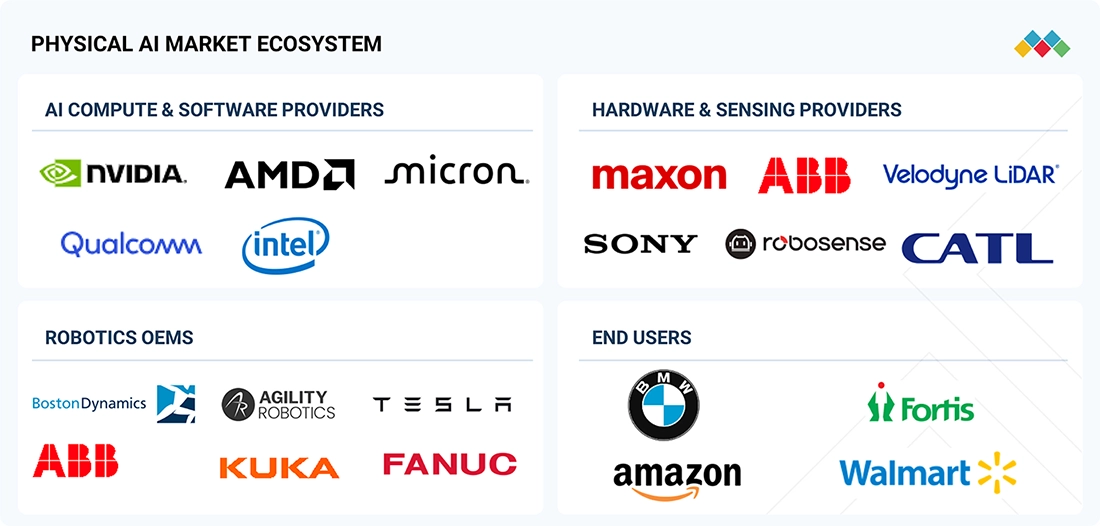
Logos and trademarks shown above are the property of their respective owners. Their use here is for informational and illustrative purposes only.
MARKET SEGMENTS
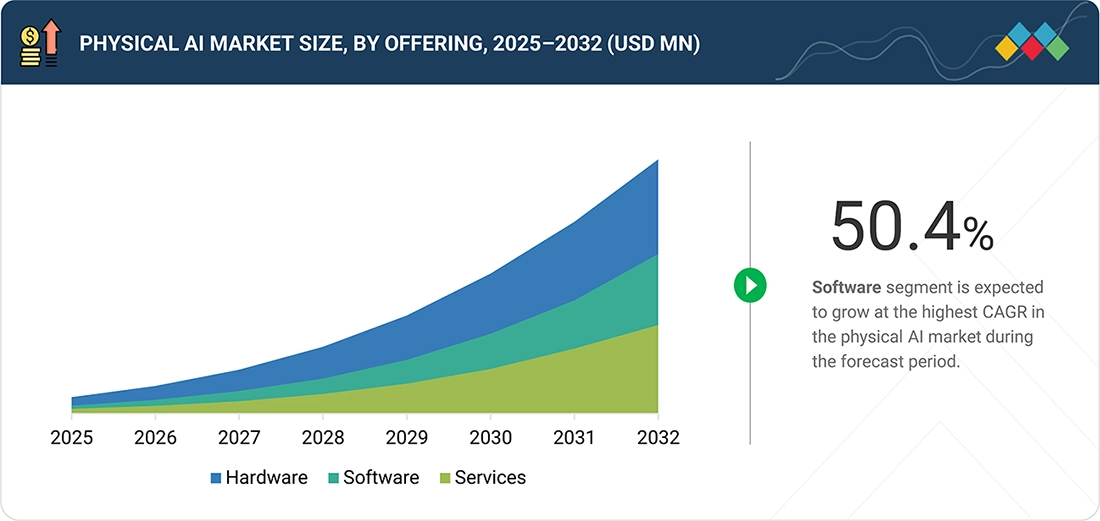
Source: Secondary Research, Interviews with Experts, MarketsandMarkets Analysis
Physical AI Market, By Offering
The software segment is expected to witness the highest CAGR due to increasing demand for AI-driven perception, decision-making, and orchestration platforms. Growing adoption of digital twins, simulation environments, and real-time analytics is accelerating software integration across robotics systems. Additionally, the shift toward platform-based and Robotics-as-a-Service models is further driving software-led value creation.
Physical AI Market, By Robot Type
Professional service robots are expected to dominate in 2026, driven by increasing adoption across healthcare, logistics, retail, and hospitality sectors. These robots are widely used for tasks such as delivery, inspection, cleaning, and customer assistance, improving efficiency and reducing labor dependency. Advancements in AI, mobility, and human-robot interaction are further enabling their deployment in dynamic, real-world environments.
Physical AI Market, By Level of Autonomy
Level 3: advanced autonomy is expected to grow at the highest CAGR during the forecast period, driven by the increasing demand for adaptive and intelligent robotic systems. These robots leverage AI for real-time decision-making, dynamic task execution, and minimal human intervention. Advancements in sensor fusion, edge computing, and machine learning are accelerating the transition toward higher autonomy levels.
Physical AI Market, By Vertical
The logistics and supply chain segment is expected to hold largest market share in 2032 due to the rising demand for automation in warehousing and fulfillment operations. Growth in e-commerce and the need for faster, more efficient delivery systems are driving the adoption of AI-enabled robots. Additionally, labor shortages and the need for scalable operations are further strengthening demand in this vertical.
REGION
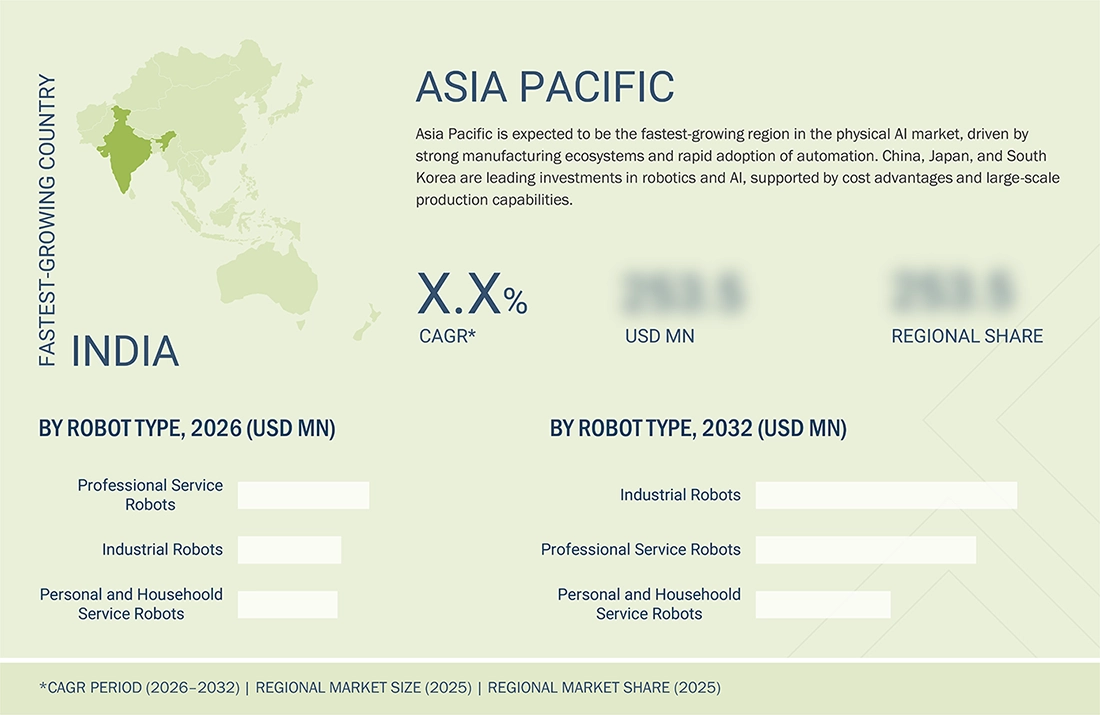
Asia Pacific to be fastest-growing region in global physical AI market during forecast period
Asia Pacific is expected to be the fastest-growing region in the physical AI market, driven by strong manufacturing ecosystems and rapid industrial automation. China, Japan, and South Korea are leading investments in robotics, AI hardware, and humanoid development. The region benefits from cost advantages, large-scale production capabilities, and a robust electronics supply chain. Additionally, supportive government initiatives and rising demand across logistics, healthcare, and industrial sectors are accelerating market growth.
PHYSICAL AI MARKET SIZE, SHARE & GROWTH: COMPANY EVALUATION MATRIX
In the physical AI market matrix, NVIDIA Corporation emerges as the Star player, supported by its dominant market presence and comprehensive, vertically integrated AI hardware and software ecosystem. NVIDIA leads with its full-stack physical AI platform, spanning high-performance GPUs, CUDA frameworks, and robotics-focused platforms, such as Isaac and Omniverse. This enables seamless development, simulation, and deployment of intelligent autonomous systems. Its solutions empower enterprises to build highly capable physical AI robots with real-time perception, advanced decision-making, and scalable deployment across industrial automation, logistics, healthcare, and humanoid robotics applications.
Source: Secondary Research, Interviews with Experts, MarketsandMarkets Analysis
KEY MARKET PLAYERS
- NVIDIA Corporation (US)
- ABB (Switzerland)
- Qualcomm Technologies, Inc. (US)
- Moog (US)
- Festo (Germany)
- Advanced Micro Devices, Inc. (US)
- STMicroelectronics (Switzerland)
- Texas Instruments Incorporated (US)
- SK HYNIX INC. (South Korea)
- Infineon Technologies AG
- Bosch Sensortec GmbH (Germany)
MARKET SCOPE
| REPORT METRIC | DETAILS |
|---|---|
| Market Size in 2025 (Value) | USD 0.89 Billion |
| Market Forecast in 2032 (Value) | USD 15.24 Billion |
| Growth Rate | CAGR of 47.2% from 2026-2032 |
| Years Considered | 2022-2032 |
| Base Year | 2025 |
| Forecast Period | 2026-2032 |
| Units Considered | Value (USD Million/Billion), Volume (Thousand Units) |
| Report Coverage | Revenue forecast, company ranking, competitive landscape, growth factors, and trends |
| Segments Covered |
|
| Regions Covered | North America, Asia Pacific, Europe, RoW |
WHAT IS IN IT FOR YOU: PHYSICAL AI MARKET SIZE, SHARE & GROWTH REPORT CONTENT GUIDE
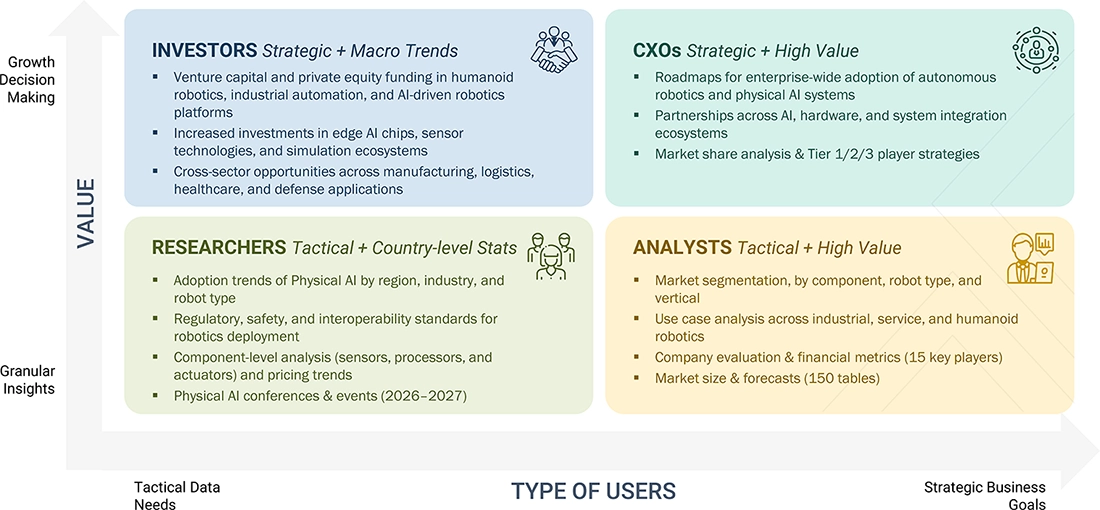
DELIVERED CUSTOMIZATIONS
We have successfully delivered the following deep-dive customizations:
| CLIENT REQUEST | CUSTOMIZATION DELIVERED | VALUE ADDS |
|---|---|---|
| Comprehensive Ecosystem Mapping of Physical AI | Conducted detailed mapping of the Physical AI ecosystem covering AI compute providers, sensor manufacturers, actuator suppliers, robotics OEMs, software platforms, and system integrators across key industries | Provides end-to-end visibility into ecosystem structure, value chain dynamics, and key stakeholders, enabling informed partnership, investment, and market entry strategies |
| Competitive Benchmarking of Physical AI Solution Providers | Evaluated leading robotics and Physical AI vendors based on product portfolio, autonomy capabilities, AI integration, scalability, deployment models, and industry focus | Enables strategic vendor comparison, strengthens competitive intelligence, and supports partnership, investment, and acquisition decision-making |
| Application-Level and Industry-Specific Opportunity Assessment | Analyzed high-impact use cases across manufacturing, logistics, healthcare, retail, and defense, including automation, inspection, material handling, and service robotics | Identifies high-growth revenue pockets, prioritizes key applications and industries, and sharpens go-to-market strategies |
| Technology Roadmap and Innovation Assessment | Assessed evolution of key technologies including AI processors, sensor fusion, humanoid robotics, edge AI, and digital twin platforms across development stages | Supports long-term technology investment planning and aligns Physical AI strategies with future innovation and automation trends |
| Cost Structure, Pricing, and Deployment Analysis | Evaluated cost components including hardware (sensors, processors, actuators), software platforms, integration costs, and deployment models such as Robotics-as-a-Service | Enables optimized pricing strategies, improved cost planning, and better understanding of ROI and scalability for Physical AI deployments |
RECENT DEVELOPMENTS
- February 2026 : Agility Robotics partnered with Toyota Motor Manufacturing Canada to deploy Digit humanoid robots following a successful pilot. The deployment focuses on improving operational efficiency and workforce productivity in manufacturing environments. This marks a significant step toward commercial-scale adoption of humanoid robots in industrial operations.
- February 2026 : BMW Group initiated deployment of humanoid robots in its Leipzig plant, marking the introduction of Physical AI in European production. The initiative builds on prior successful pilots and aims to integrate AI-driven robotics into core manufacturing processes. It also supports broader adoption across vehicle, battery, and component production.
- January 2026 : NVIDIA launched new Physical AI models, frameworks, and compute infrastructure, including Cosmos world models, GR00T humanoid models, and the Blackwell-powered Jetson platform. These innovations enhance robot learning, reasoning, and simulation, enabling faster development of general-purpose robots. Global partners introduced next-generation robots built on this stack, accelerating adoption across industries.
- January 2026 : Boston Dynamics unveiled the production-ready Atlas humanoid robot, designed for industrial applications such as material handling and order fulfillment. The robot features advanced autonomy, adaptability, and seamless integration with enterprise systems. Large-scale deployments are scheduled, highlighting strong commercial demand for next-generation humanoid robots.
Table of Contents
 Exclusive indicates content/data unique to MarketsandMarkets and not available with any competitors.
Methodology
The study involved four major activities in estimating the current size of the physical AI market. Exhaustive secondary research collected information on the market, peer, and parent markets. The next step was to validate these findings, assumptions, and sizing with industry experts across the value chain through primary research. Both top-down and bottom-up approaches were employed to estimate the complete market size. After that, market breakdown and data triangulation techniques were used to estimate the market size of segments and subsegments.
Secondary Research
The secondary research process has referred to various secondary sources to identify and collect necessary information for this study. The secondary sources include annual reports, press releases, and investor presentations of companies; white papers; journals and certified publications; and articles from recognized authors, websites, directories, and databases. Secondary research was mainly used to obtain key information about the supply chain of the industry, the total pool of market players, classification of the market according to industry trends to the bottom-most level, regional markets, and key developments from the market and technology-oriented perspectives. Secondary data was collected and analyzed to determine the overall market size, which was further validated through primary research.
Primary Research
Extensive primary research was conducted after gaining knowledge about the current scenario of the physical AI market through secondary research. Several primary interviews were conducted with experts from the demand and supply sides across four major regions: North America, Europe, Asia Pacific, and RoW. This primary data was collected through questionnaires, emails, and telephone interviews.
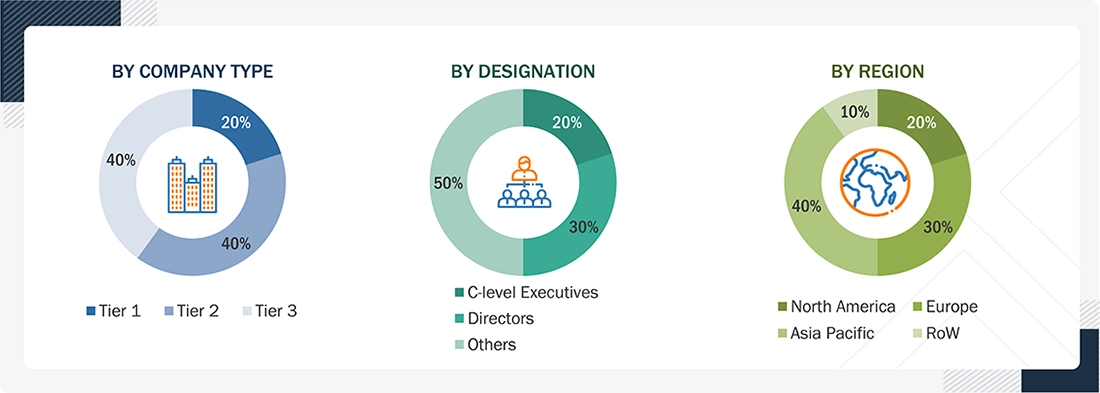
Notes: Other designations include technology heads, media analysts, sales managers, marketing managers, and product managers.
The three tiers of the companies are based on their total revenues as of 2024; Tier 1: >USD 1 billion, Tier 2: USD 500 million–1 billion, and Tier 3: <USD 500 million.
To know about the assumptions considered for the study, download the pdf brochure
Market Size Estimation
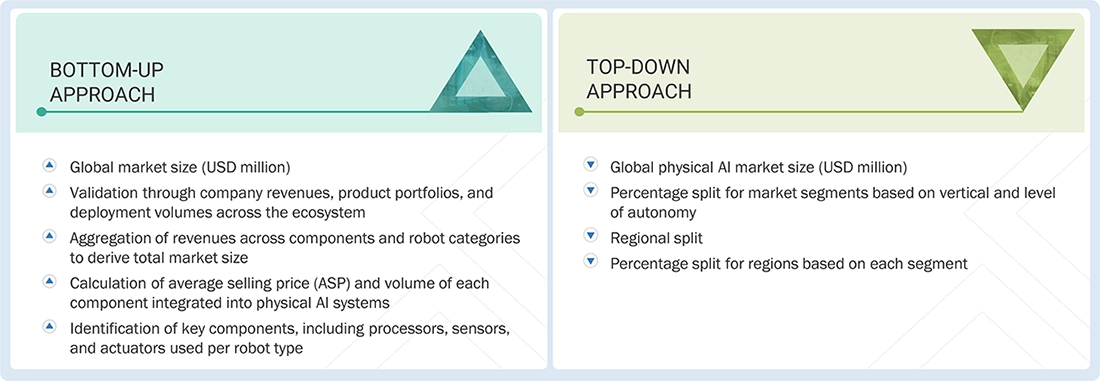
In the complete market engineering process, top-down and bottom-up approaches and several data triangulation methods were used to estimate and forecast the overall market segments and subsegments listed in this report. Key players in the market were identified through secondary research, and their market shares in the respective regions were determined through primary and secondary research. This entire procedure includes the study of annual and financial reports of the top market players and extensive interviews for key insights (quantitative and qualitative) with industry experts (CEOs, VPs, directors, and marketing executives).
All percentage shares, splits, and breakdowns were determined using secondary sources and verified through primary sources. All the parameters affecting the markets covered in this research study were accounted for, viewed in detail, verified through primary research, and analyzed to obtain the final quantitative and qualitative data. This data was consolidated and supplemented with detailed inputs and analysis from MarketsandMarkets and presented in this report.
Physical AI Market : Top-Down and Bottom-Up Approach
Data Triangulation
After arriving at the overall market size, the market was split into several segments and subsegments using the market size estimation processes explained above. Data triangulation and market breakdown procedures were employed to complete the entire market engineering process and determine the exact statistics of each market segment and subsegment. The data was triangulated by studying various factors and trends from the demand and supply sides in the physical AI market.
Market Definition
Physical AI refers to artificial intelligence embedded within robots and autonomous machines that enables them to perceive, interpret, and interact with the physical world through real-time on-device processing. These systems integrate hardware components, such as edge AI processors, sensors, and actuation systems, with intelligent software platforms that enable perception, navigation, manipulation, and decision making. Physical AI systems operate across different levels of autonomy, ranging from reactive automation to advanced reasoning capabilities. They are implemented in robotic platforms, including industrial robots, professional service robots, and personal and household robots, supporting applications across sectors such as healthcare, industrial automation, automotive, logistics and supply chain, defense and security, retail, and education.
Key Stakeholders
- Government bodies and policymakers
- Robotics and AI industry associations
- Robotics manufacturers
- Semiconductor and AI chip companies
- Sensor technology providers
- Actuator and motor manufacturers
- Robotics software platform providers
- Edge computing providers
- Original equipment manufacturers (OEMs)
- System integrators
- Technology and solution providers
- Simulation and digital twin providers
- Research institutes and universities
- Defense and security organizations
- Enterprise end users
- Venture capital and technology investors
- Intellectual property providers
- Market research and consulting firms
- Industry analysts and strategists
- Forums, alliances, and associations
Report Objectives
- To define, describe, and forecast the size of the physical AI market, by offering, robot type, level of autonomy, and vertical, in terms of value
- To forecast the size of market segments with respect to four regions, namely North America, Europe, Asia Pacific, and RoW, in terms of value
- To identify and analyze key drivers, restraints, opportunities, and challenges influencing the growth of the market
- To offer an ecosystem analysis, value chain analysis, case study analysis, patent analysis, technology analysis, pricing analysis, Porter’s five forces analysis, and regulations pertaining to the market
- To strategically analyze micromarkets with respect to individual growth trends, prospects, and contributions to the total market
- To strategically profile key players and comprehensively analyze their market shares and core competencies
- To analyze the opportunities in the market for stakeholders and describe the competitive landscape of the market
- To study competitive developments, such as collaborations, partnerships, product launches/developments, and acquisitions, in the market
Available customizations:
With the given market data, MarketsandMarkets offers customizations according to the specific requirements of companies. The following customization options are available for the report:
Regional Analysis
- Additional country-wise breakdown for North America, Europe, the Asia Pacific, and the Rest of the World
Company Information
- Detailed analysis and profiling of additional market players (up to five)
Need a Tailored Report?
Customize this report to your needs
Get 10% FREE Customization
Customize This ReportPersonalize This Research
- Triangulate with your Own Data
- Get Data as per your Format and Definition
- Gain a Deeper Dive on a Specific Application, Geography, Customer or Competitor
- Any level of Personalization
Let Us Help You
- What are the Known and Unknown Adjacencies Impacting the Physical AI Market
- What will your New Revenue Sources be?
- Who will be your Top Customer; what will make them switch?
- Defend your Market Share or Win Competitors
- Get a Scorecard for Target Partners

Custom Market Research Services
We Will Customise The Research For You, In Case The Report Listed Above Does Not Meet With Your Requirements
Get 10% Free Customisation





Growth opportunities and latent adjacency in Physical AI Market