
Mobile Hydraulic Cranes Market

Mobile Hydraulic Cranes Market in North America by Crane Type (Rough Terrain Cranes, All-Terrain Cranes, Hydraulic Truck Cranes, Boom Truck Cranes, Lattice Boom Crawler Cranes, Telescoping Boom Crawler Cranes) and Country – Forecast to 2029




OVERVIEW
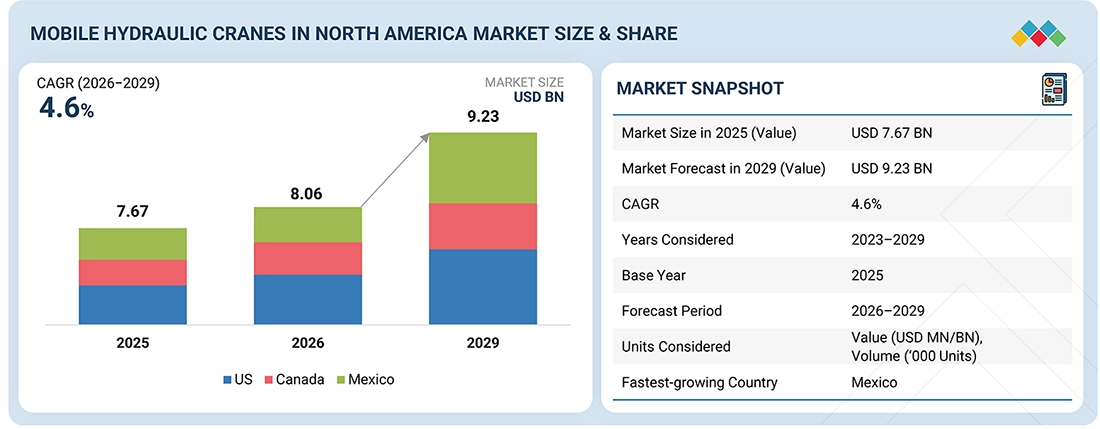
Source: Secondary Research, Interviews with Experts, MarketsandMarkets Analysis
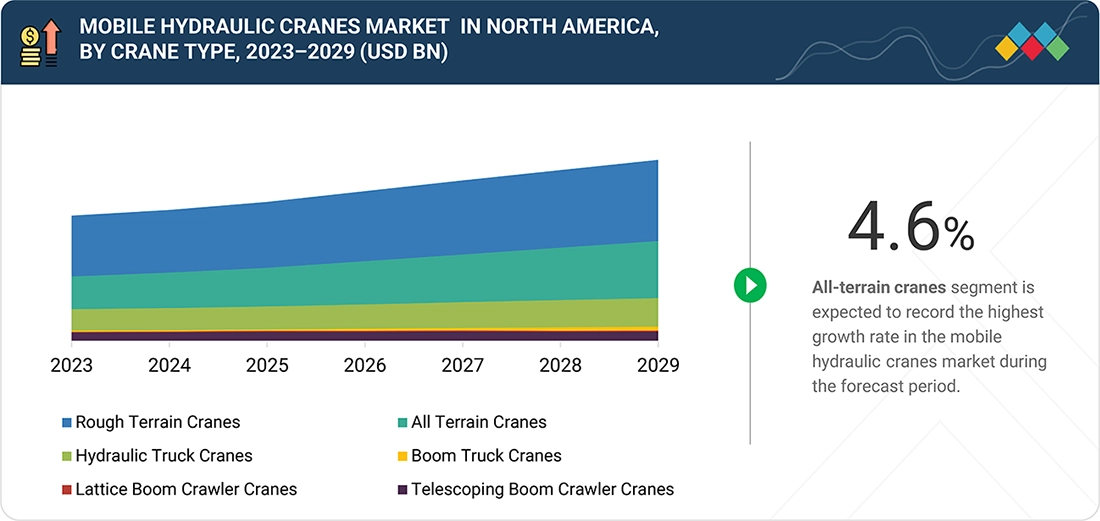
The mobile hydraulic cranes market is projected to grow from USD 8.06 billion in 2026 to USD 9.23 billion by 2029, at a CAGR of 4.6%. Market is driven by the increasing demand for infrastructure development, industrial expansion, and efficient material handling solutions across construction, oil & gas, and renewable energy sectors. Large-scale investments in transportation networks, including highways, bridges, and urban development projects are significantly boosting the demand for mobile hydraulic cranes in the region. Additionally, the expansion of renewable energy projects, particularly wind energy installations, is increasing the need for high-capacity cranes for turbine installation and maintenance.
KEY TAKEAWAYS
-
BY CRANE TYPEBy crane type, the lattice boom crawler cranes segment hold the largest share of the mobile hydraulic cranes market in North America due to superior lifting capacity and other benefits.
-
BY COUNTRYThe US dominates the mobile hydraulic cranes market in North America due to massive infrastructure investments, strong construction and energy sectors, high equipment demand, presence of major OEMs, and a well-established rental market driving continuous crane utilization and replacement demand.
-
COMPETITIVE LANDSCAPE - KEY PLAYERSLiebherr, The Manitowoc Company (Grove), Tadano (Demag), Terex Corporation, and Link-Belt Cranes were identified as the star players in the North America mobile hydraulic cranes market, given their strong market share, broad lifting-capacity portfolios, and established dealer/rental networks across the US and Canada.
-
COMPETITIVE LANDSCAPE - STARTUPS/SMESBroderson Manufacturing and Shuttlelift have distinguished themselves among SMEs by securing strong footholds in specialized niche segments—industrial carry-deck and rubber-tired gantry cranes respectively underscoring their potential as emerging market leaders in underserved application areas.
Mobile hydraulic cranes are advanced lifting solutions used to lift, move, and position heavy loads efficiently across construction, infrastructure, energy, and industrial applications in North America. These cranes utilize hydraulic systems to generate high lifting force, enabling precise and controlled operations while maintaining mobility across job sites. Unlike fixed lifting equipment, mobile hydraulic cranes are designed for easy transportation, quick setup, and flexible deployment, making them essential for projects requiring dynamic and time-sensitive operations. Mobile hydraulic cranes include a range of equipment such as boom truck cranes, rough terrain cranes, all-terrain cranes, hydraulic truck cranes, and crawler cranes, each designed for specific load capacities, terrain conditions, and operational requirements. These cranes support critical applications such as bridge construction, high-rise building development, wind turbine installation, industrial plant setup, and equipment maintenance.
TRENDS & DISRUPTIONS IMPACTING CUSTOMERS' CUSTOMERS
The impact on the mobile hydraulic cranes market in North America is shaped by the increasing emphasis on project efficiency, safety compliance, and cost optimization across construction, energy, and industrial sectors. Over the next 4 to 5 years, product and service portfolios are expected to evolve from conventional lifting equipment toward digitally integrated, automated, and high-performance crane ecosystems with telematics, real-time monitoring, and predictive maintenance capabilities. Two key trends driving this transition include the growing adoption of advanced telematics and fleet management systems for real-time tracking, utilization optimization, and remote diagnostics, along with the increasing use of automation and smart load monitoring technologies to enhance lifting precision and safety. These innovations are enabling improved operational efficiency, reduced downtime, enhanced operator safety, and better decision-making across project sites.
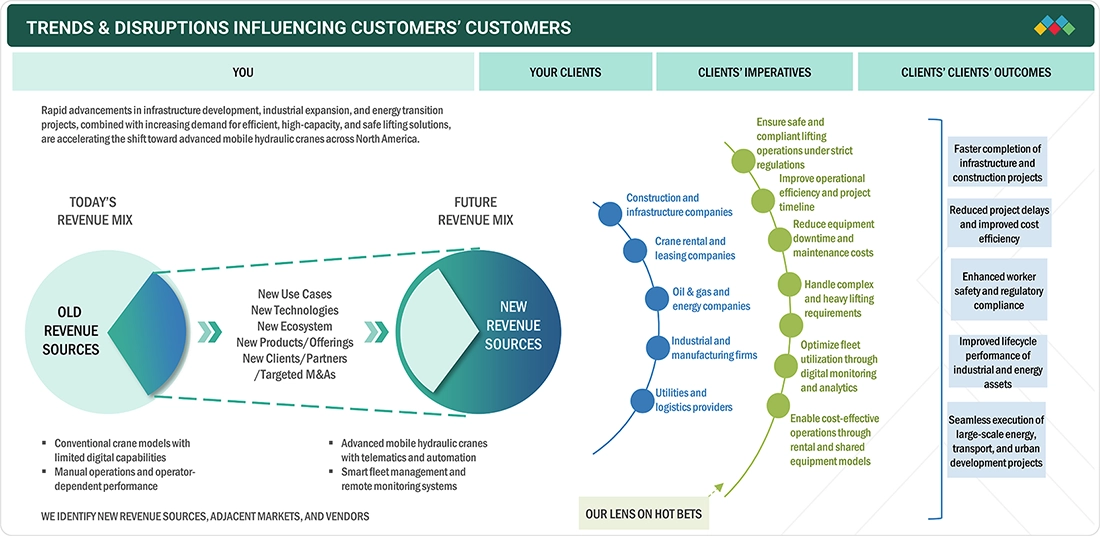
Source: Secondary Research, Interviews with Experts, MarketsandMarkets Analysis
MARKET DYNAMICS

Level
-
Rising infrastructure development and urbanization

-
Increasing investment in renewable energy and industrial projects


Level
-
High initial cost of mobile hydraulic cranes

-
Stringent safety regulations and compliance requirements


Level
-
Integration of telematics, automation and digital fleet management systems

-
Mounting adoption of fuel-efficient and low-emission cranes


Level
-
Supply chain disruptions

-
Maintenance complexities associated with advanced crane systems

Source: Secondary Research, Interviews with Experts, MarketsandMarkets Analysis
Driver: Rising infrastructure development and urbanization
Rapid infrastructure development and urbanization across North America are significantly driving demand for mobile hydraulic cranes. Large-scale projects such as highways, bridges, rail networks, and urban construction require efficient lifting solutions for timely execution. Government investments in infrastructure modernization, along with expansion of residential and commercial construction, are further accelerating crane adoption. Additionally, growing renewable energy projects, particularly wind farms, require high-capacity cranes for installation and maintenance, strengthening demand for mobile hydraulic cranes across diverse applications.
Restraint: High initial cost of mobile hydraulic cranes
The high initial cost of mobile hydraulic cranes acts as a major restraint for market growth, particularly for small and mid-sized contractors. These cranes involve substantial capital investment, including procurement, transportation, and installation costs. Additionally, expenses related to operator training, maintenance, and compliance with safety regulations further increase the total cost of ownership. This financial burden often discourages direct purchases, leading end users to rely on rental services instead. As a result, high costs limit widespread adoption, especially in cost-sensitive segments.
Opportunity: Integration of telematics, automation and digital fleet management systems
The integration of telematics, automation, and digital fleet management systems presents significant growth opportunities in the mobile hydraulic cranes market in North America. These technologies enable real-time monitoring of crane performance, location tracking, predictive maintenance, and improved fleet utilization. Automation and smart control systems enhance lifting precision, reduce human error, and improve safety compliance. Additionally, data-driven insights help operators optimize operations, reduce downtime, and lower operational costs. As digital transformation accelerates across industries, demand for technologically advanced cranes is expected to increase.
Challenge: Maintenance complexities associated with advanced crane systems
Maintenance complexities associated with advanced mobile hydraulic crane systems present a key challenge to the market growth. Modern cranes incorporate sophisticated technologies such as telematics, automation, and electronic control systems, which require specialized skills and tools for maintenance and repair. The need for trained technicians, availability of spare parts, and higher servicing costs can increase operational downtime if not managed effectively. Additionally, ensuring regular maintenance while minimizing project delays becomes difficult, especially for rental fleets operating across multiple job sites.
MOBILE HYDRAULIC CRANES MARKET: COMMERCIAL USE CASES ACROSS INDUSTRIES
| COMPANY | USE CASE DESCRIPTION | BENEFITS |
|---|---|---|
 |
Provides a wide range of mobile hydraulic cranes, including crawler and boom truck cranes, used across infrastructure, construction, and energy projects for heavy lifting and material handling operations | High lifting capacity | Advanced crane control systems | Strong product reliability | Enhanced operational efficiency | Wide service network |
 |
Offers versatile mobile hydraulic cranes such as rough terrain and boom truck cranes, widely used in construction, utilities, and industrial applications requiring mobility and quick deployment | High mobility and flexibility | Cost-effective solutions | Easy maintenance | Improved job site productivity | Strong rental market presence |
 |
Delivers advanced all-terrain and rough terrain cranes designed for complex lifting operations across infrastructure, energy, and industrial sectors with strong focus on safety and performance | Superior lifting performance | Advanced safety features | Fuel-efficient designs | High durability | Reliable performance in harsh environments |
 |
Provides high-capacity mobile hydraulic cranes, including crawler and all-terrain cranes, used in large-scale infrastructure, wind energy, and industrial projects requiring precision lifting | High precision and control | Advanced load management systems | Strong engineering capabilities | Efficient heavy lifting | Long equipment lifecycle |
 |
Offers a range of mobile hydraulic cranes, particularly rough terrain and crawler cranes, widely used in construction and infrastructure projects across North America | User-friendly operation | Reliable performance | Strong dealer support | Efficient lifting solutions | High equipment uptime |
Logos and trademarks shown above are the property of their respective owners. Their use here is for informational and illustrative purposes only.
MARKET ECOSYSTEM
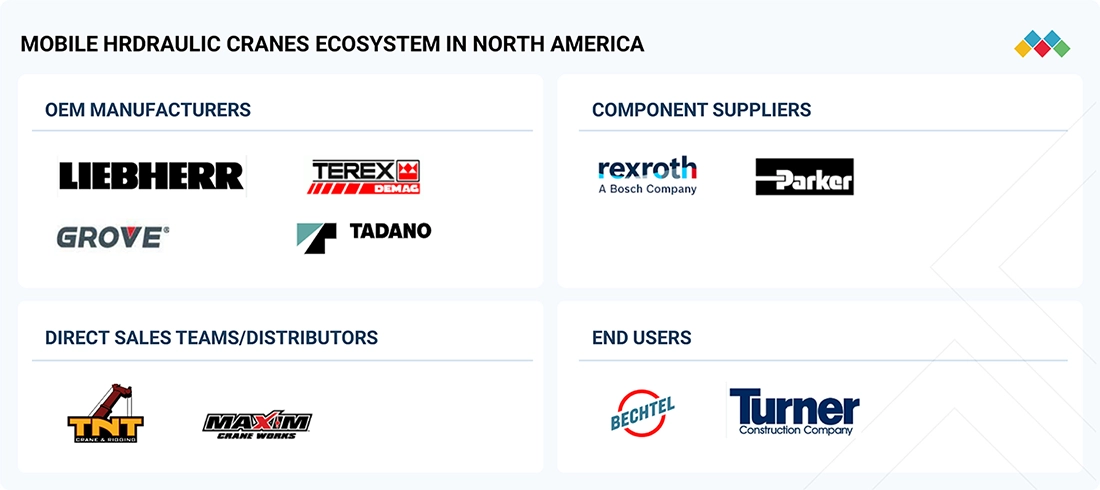
The mobile hydraulic cranes ecosystem in North America includes OEMs such as The Manitowoc Company, Inc., Terex Corporation, Tadano Ltd., and Liebherr Group that design and manufacture cranes for construction, energy, and industrial use. Component suppliers provide hydraulics, engines, and control systems. Rental companies play a crucial role by offering cost-effective access to equipment. Direct sales teams/distributors ensure availability and aftersales support. Technology providers integrate telematics, automation, and fleet management systems for efficiency. End users including construction, energy, and industrial firms utilize cranes to enhance productivity, safety, and project execution efficiency across diverse applications.
Logos and trademarks shown above are the property of their respective owners. Their use here is for informational and illustrative purposes only.
MARKET SEGMENTS
Source: Secondary Research, Interviews with Experts, MarketsandMarkets Analysis
BY CRANE TYPE
Lattice boom crawler cranes segment hold the largest share of the mobile hydraulic cranes market in North America due to superior lifting capacity, stability for heavy loads, suitability for large infrastructure and wind projects, and strong demand in energy, construction, and industrial applications.
BY COUNTRY
The US dominates the mobile hydraulic cranes market in North America due to massive infrastructure investments, strong construction and energy sectors, high equipment demand, presence of major OEMs, and a well-established rental market driving continuous crane utilization and replacement demand.
REGION
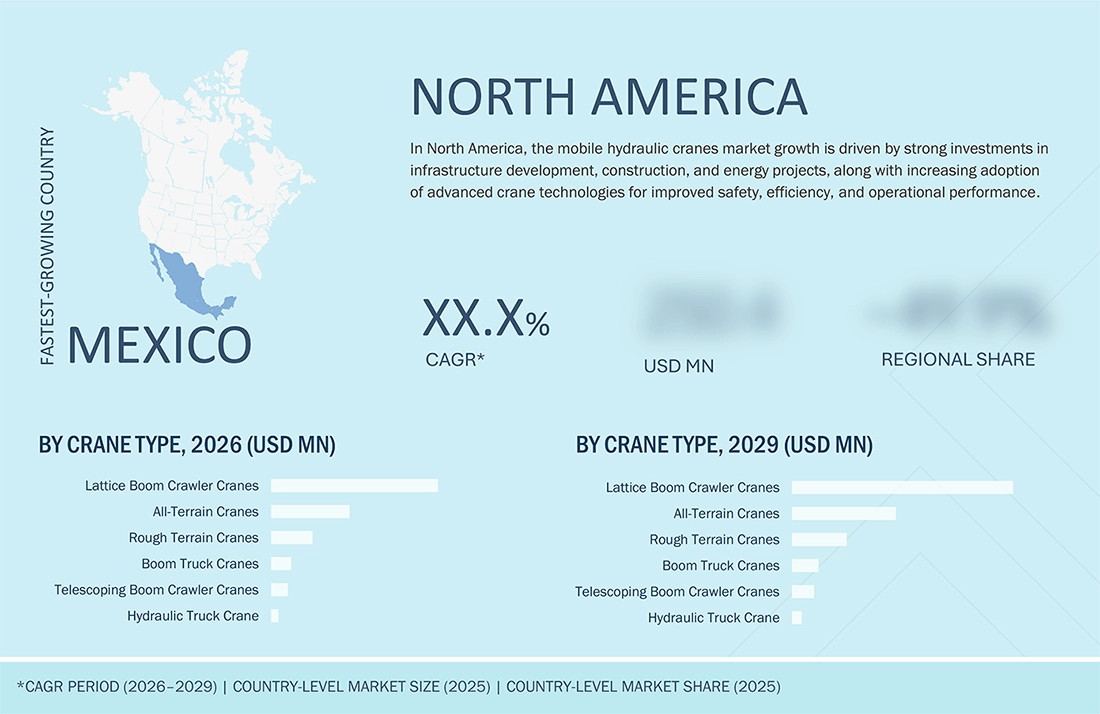
Mexico to be fastest-growing country in mobile hydraulic cranes market in North America during forecast period
Mexico is expected to witness the highest CAGR in the mobile hydraulic cranes market in North America due to its rapid industrialization and infrastructure expansion. The country is benefiting from strong nearshoring trends, attracting manufacturing investments in automotive, electronics, and heavy industries, which increases the demand for construction and material handling equipment. Additionally, increasing investments in transportation infrastructure, logistics hubs, and energy projects are driving crane deployment. Compared with the US and Canada, Mexico has a lower market base, enabling faster percentage growth. Increasing adoption of rental models and modernization of construction practices further support accelerated demand for mobile hydraulic cranes.
MOBILE HYDRAULIC CRANES MARKET: COMPANY EVALUATION MATRIX
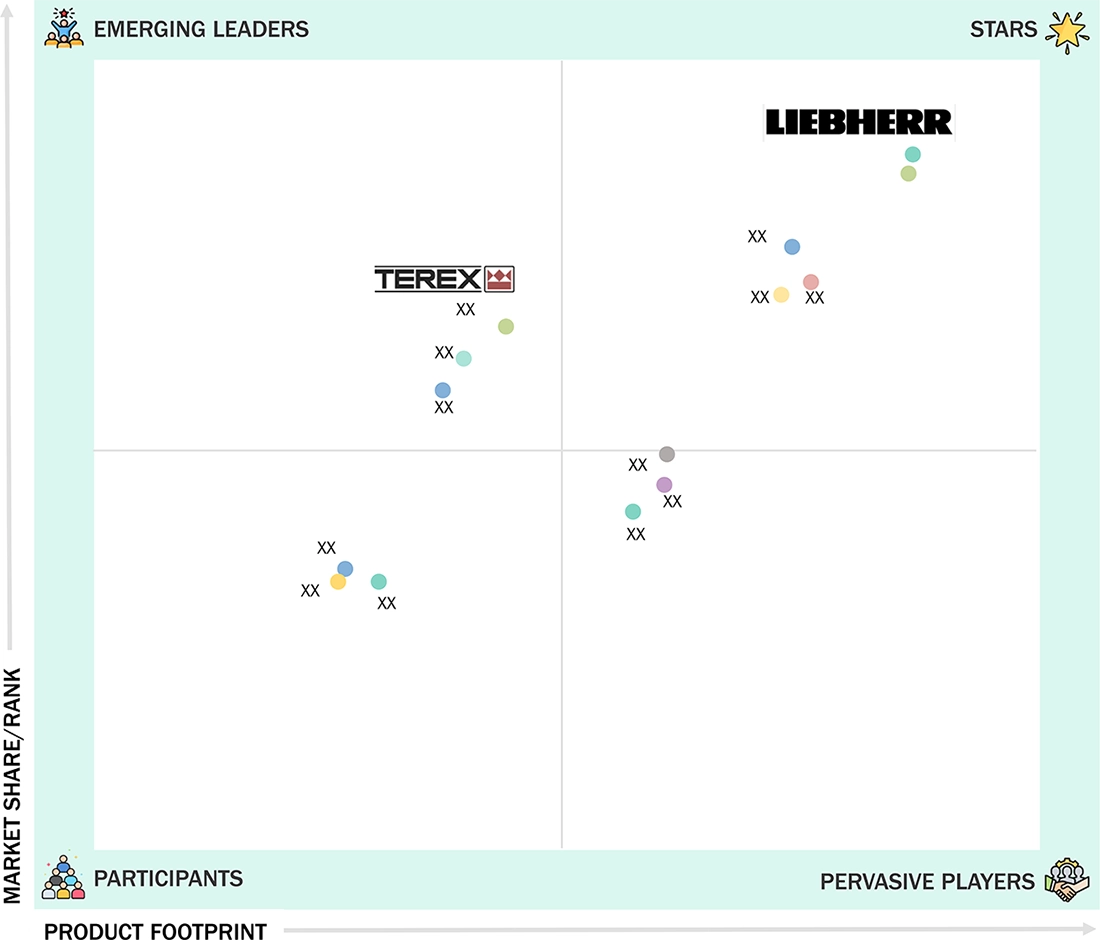
In the mobile hydraulic cranes market in North America, Liebherr Group (Star) leads with a strong regional footprint and a comprehensive portfolio of all-terrain, crawler, and truck-mounted hydraulic cranes. Its advanced lifting technologies, telematics integration, and focus on safety and efficiency strengthen its dominance across construction, energy, and infrastructure sectors. Continuous investments in automation, digital monitoring, and eco-efficient solutions further reinforce its leadership position. Terex (Emerging Leader) is gaining strong traction through its expanding presence in North America and its focus on innovative crane solutions. The company is reinforcing its market position by leveraging advanced hydraulic systems, forming strategic partnerships, and emphasizing operational efficiency, which is driving higher adoption across infrastructure development and industrial applications.
Source: Secondary Research, Interviews with Experts, MarketsandMarkets Analysis
KEY MARKET PLAYERS
- Liebherr Group (Switzerland)
- Terex Corporation (US)
- The Manitowoc Company (US)
- Tadano Ltd. (Japan)
- Konecranes Plc (Finland)
- Cargotec Corporation (Finland)
- Palfinger AG (Austria)
- Kobelco Construction Machinery Co., Ltd. (Japan)
- Sumitomo Heavy Industries Construction Cranes Co., Ltd. (Japan)
- Link-Belt Cranes (US)
MARKET SCOPE
| REPORT METRIC | DETAILS |
|---|---|
| Market Size in 2025 (Value) | USD 7.67 Billion |
| Market Forecast in 2029 (Value) | USD 9.23 Billion |
| CAGR | 4.6% |
| Years Considered | 2023–2029 |
| Base Year | 2025 |
| Forecast Period | 2026–2029 |
| Units Considered | Value (USD Million/Billion), Volume (Thousand Units) |
| Report Coverage | Revenue forecast, company ranking, competitive landscape, growth factors, and trends |
| Segments Covered | By Crane Type: Rough Terrain Cranes, All-Terrain Cranes, Hydraulic Truck Cranes, Boom Truck Cranes, Lattice Boom Crawler Cranes, and Telescoping Boom Crawler Cranes |
| Countries Covered | US, Canada, and Mexico |
WHAT IS IN IT FOR YOU: MOBILE HYDRAULIC CRANES MARKET REPORT CONTENT GUIDE
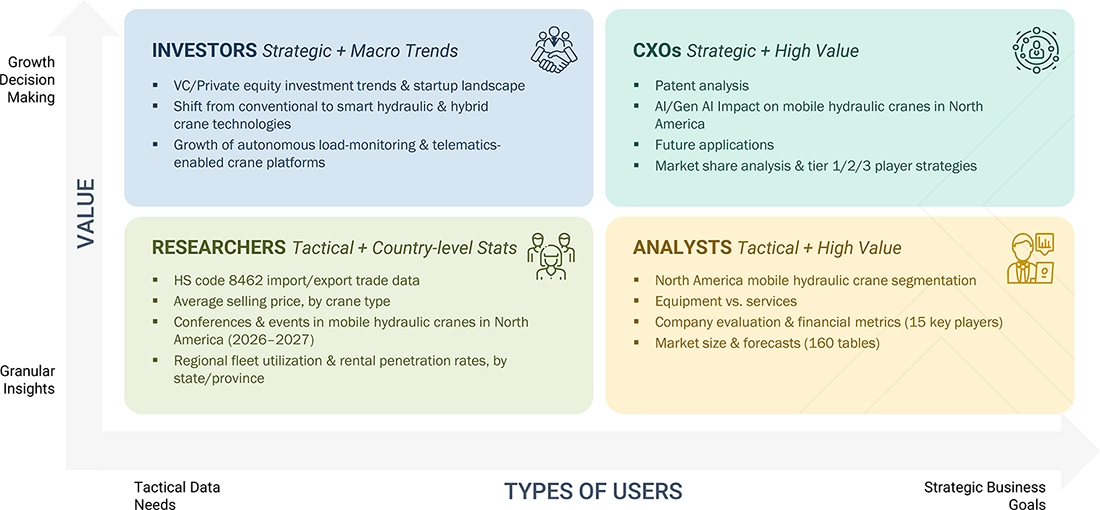
DELIVERED CUSTOMIZATIONS
We have successfully delivered the following deep-dive customizations:
| CLIENT REQUEST | CUSTOMIZATION DELIVERED | VALUE ADDS |
|---|---|---|
| Mobile Hydraulic Crane Manufacturer / OEM | Detailed benchmarking of North American mobile hydraulic crane manufacturers by crane category (all-terrain, rough-terrain, truck-mounted, crawler hydraulic cranes), lifting capacity class, hydraulic boom technology, telematics integration, load moment indicators, outrigger stabilization systems, and emission-compliant engine configurations. Assessment of OEM product engineering including hydraulic pumps, telescopic boom cylinders, slew drive systems, operator cabin ergonomics, and digital control interfaces for high-duty construction and utility applications. Competitive mapping of regional and global OEMs supplying the US and Canada with comparison across mobility, lifting precision, automation capability, and fleet ownership penetration. | Identify innovation white spaces in smart hydraulic lifting systems, remote crane diagnostics, AI-enabled anti-sway controls, and hybrid/electric powertrain opportunities. Track product certification pathways under OSHA/ANSI/CSA compliance frameworks influencing OEM product launches and dealer expansion. Support localization strategy for North American assembly, aftermarket parts stocking, and rental fleet partnerships. |
| Crane Rental Companies / Equipment Leasing Providers / Construction Fleet Operators | Mapping of North American crane rental and leasing providers operating across infrastructure construction, commercial building erection, utility transmission, oil & gas maintenance, and modular industrial installation projects. Evaluation of rental fleet composition by mobile hydraulic crane tonnage, rental utilization rates, project-based vs operated rentals, telematics-based fleet monitoring, and hydraulic maintenance service models. Benchmarking of operator certification requirements, preventative service intervals, fleet replacement cycles, and digital dispatch management platforms adopted by rental leaders. The region shows strong rental-led procurement behavior due to reduced ownership burden and high multi-site mobility requirements. | Gain visibility into rental penetration trends, crane uptime monetization models, AIoT-based fleet optimization, and operator productivity analytics. Understand ROI of telematics-enabled predictive maintenance, hydraulic failure reduction, and remote service scheduling. Track regional expansion plans of rental fleets in US transportation corridors, Canadian mining belts, and renewable energy construction zones to estimate replacement demand through 2030. |
| Regulatory Bodies / Safety Authorities / Standards Organizations | Assessment of North American regulatory and safety frameworks impacting mobile hydraulic crane manufacturing, deployment, and operator usage including OSHA lifting safety mandates, ANSI/ASME B30 mobile crane standards, CSA heavy lifting compliance requirements, Department of Transportation transport permitting, emissions mandates, and NCCCO operator certification protocols. | Support compliance roadmap planning for OEMs, rental providers, and contractors with evolving digital safety mandates, certified operator shortages, and emissions-driven fleet modernization. Benchmark how safety automation, overload monitoring, anti-two block systems, and operator assistance software are reducing accident exposure and insurance costs. Identify standards harmonization opportunities between US and Canada affecting cross-border fleet deployment. |
| Infrastructure Contractors / Utilities / Oil & Gas / Industrial End Users | Evaluation of ROI and cost-benefit analysis of deploying mobile hydraulic cranes across bridge construction, highway modernization, telecom tower erection, substation installation, refinery turnaround maintenance, wind turbine assembly, and prefabricated industrial module lifting applications. Performance comparison of crane classes across terrain adaptability, lifting cycle time, hydraulic responsiveness, setup speed, transportability, and operator dependency. | Improve project lifting productivity, reduce subcontracted heavy-lift costs, and optimize crane selection by tonnage/application fit. Identify economic benefits of telematics-based utilization tracking, automated lift planning, and low-emission hydraulic crane adoption for public tenders. Supply actionable insights into procurement timing linked with Infrastructure Investment programs, renewable power installation, and utility transmission upgrades driving mobile hydraulic crane demand through the forecast period. |
RECENT DEVELOPMENTS
- January 2026 : Manitowoc announced at CONEXPO-CON/AGG 2026 the North American introduction of new Grove and National Crane mobile hydraulic crane models alongside expanded aftermarket lifecycle solutions. The development includes deployment of the company’s new Mobile Training & Technology Center for dealer and customer technician upskilling, strengthening field maintenance responsiveness, operator training, and aftermarket productivity support for crane fleets across the US and Canada. This initiative enhances OEM customer retention and supports faster fleet serviceability in North America.
- December 2025 : Manitowoc entered a strategic distribution expansion agreement with Nors Machinery, granting Nors the rights to distribute Manitowoc mobile hydraulic cranes across major Canadian provinces including British Columbia, Alberta, Saskatchewan, Manitoba, Ontario, and Quebec. The agreement also includes expanded parts warehousing, service support, and a new Surrey facility to improve crane availability and aftermarket support for hydraulic crane customers. This deal significantly strengthens Manitowoc’s dealer penetration and service reach in the Canadian mobile crane market.
- January 2025 : Tadano introduced the EVOLT eGR-1000XLL-1, the first fully electric 100-ton rough-terrain mobile hydraulic crane launched for the North American market. The crane delivers battery-powered lifting operations, reduced onsite emissions, and lower noise performance while retaining high-capacity hydraulic lifting functionality for infrastructure, industrial, and urban utility applications. This marks a significant advancement toward electrified hydraulic crane deployment in the US and Canada, particularly for contractors pursuing sustainability-led public works projects.
Table of Contents
 Exclusive indicates content/data unique to MarketsandMarkets and not available with any competitors.
Methodology
The research study involved four major activities in estimating the size of the mobile hydraulic cranes market in North America. Exhaustive secondary research has been done to collect important information about the market and peer markets. The next step has been to validate these findings and assumptions and size them with the help of primary research with industry experts across the value chain. Both top-down and bottom-up approaches have been used to estimate the market size. The market breakdown and data triangulation have been adopted to estimate the market sizes of segments and sub-segments.
Secondary Research
In the secondary research process, various secondary sources were referred to identify and collect information required for this study. The secondary sources include annual reports, press releases, investor presentations of companies, white papers, and articles from recognized authors. Secondary research has been mainly done to obtain key information about the market’s value chain, the pool of key market players, market segmentation according to industry trends, regional outlook, and developments from both market and technology perspectives.
Primary Research
In primary research, various sources from the supply and demand sides have been interviewed to obtain the qualitative and quantitative insights required for this report. Primary sources from the supply side include experts such as CEOs, vice presidents, marketing directors, technology and innovation directors, and related executives from multiple key companies and organizations operating in the mobile hydraulic cranes ecosystem in North America. After interacting with industry experts, brief sessions have been conducted with highly experienced independent consultants to reinforce the findings from primary research. This, along with the in-house subject-matter experts’ opinions, has led us to the findings as described in the report. The breakdown of primary respondents is as follows:
BREAKDOWN OF PRIMARIES
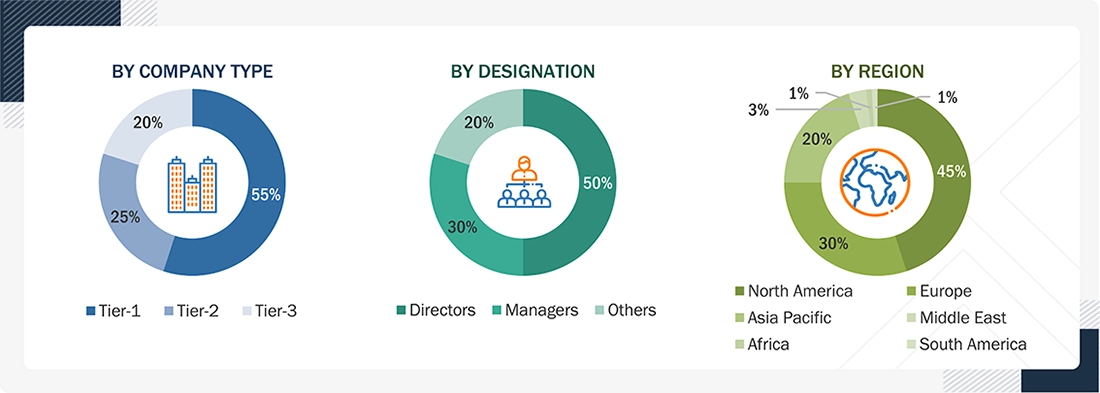
Note: Other designations include sales, marketing, and product managers.
To know about the assumptions considered for the study, download the pdf brochure
Market Size Estimation
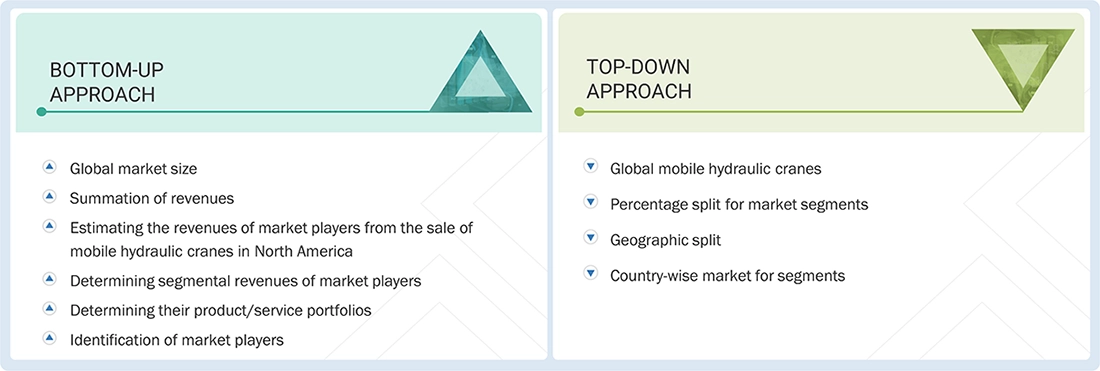
In the market engineering process, both top-down and bottom-up approaches and data triangulation methods have been used to estimate and validate the size of the mobile hydraulic cranes market in North America and other dependent submarkets. The research methodology used to estimate the market sizes includes the following:
- The bottom-up procedure has been employed to arrive at the overall size of the mobile hydraulic cranes market in North America.
- Major companies that provide mobile hydraulic cranes in North America have been identified. This included analyzing the company’s product and service offerings and its presence across various regions.
- The segment-specific revenues of the companies, particularly those related to mobile hydraulic cranes and services, have been determined.
- The product-specific and service-specific revenues of the companies, particularly those related to mobile hydraulic cranes in North America, have been determined.
- These individual revenue figures have been compiled to determine the total revenue generated across the identified companies within the sector.
- The global size of the mobile hydraulic cranes in North America has been obtained using this consolidated data.
- The top-down approach has been used to estimate and validate the total size of the mobile hydraulic cranes market in North America
- Identified top-line investments and spending in the ecosystem and major market developments to consider segment-level splits
- Estimated the overall size of the mobile hydraulic cranes market in North America, then segmented the global market by allocating shares based on the segments considered
- Distributed segment-level markets into regions and countries by aligning regional mobile hydraulic cranes activity with economic indicators, the presence of market players, and national development initiatives
Mobile Hydraulic Cranes Market : Top-Down and Bottom-Up Approach
Data Triangulation
After determining the overall market size through the previously explained estimation processes, we have divided the market into several segments and subsegments. Data triangulation and market breakdown procedures have been employed to complete the entire market engineering process and arrive at the exact statistics of each market segment and subsegment. The data has been triangulated by studying various factors and trends from the demand and supply sides of the mobile hydraulic cranes market in North America.
Market Definition
The mobile hydraulic cranes market in North America comprises equipment and integrated lifting solutions used to lift, move, and position heavy materials and equipment across construction, infrastructure, energy, and industrial applications, along with related services, such as maintenance, rental, and aftermarket support. These cranes utilize hydraulic systems to generate lifting force, enabling efficient and controlled handling of loads in diverse operating environments. Mobile hydraulic cranes are designed for mobility, flexibility, and quick deployment, allowing them to operate across urban construction sites, rough terrains, and large-scale project locations. The market includes various crane types, such as boom truck cranes, rough terrain cranes, all-terrain cranes, hydraulic truck cranes, and crawler cranes (lattice boom and telescopic), each suited for specific lifting capacities and operational conditions. These solutions are critical in ensuring safe and efficient material handling, supporting applications such as infrastructure construction (bridges and highways), energy projects (wind turbines and oil & gas facilities), industrial installations, and utility services. Advanced features such as load monitoring systems, telematics, automation, and safety controls are increasingly integrated to improve operational efficiency, precision, and compliance with stringent safety regulations.
Key Stakeholders
- Crane Manufacturers (OEMs)
- Component and System Suppliers
- Construction and Infrastructure Companies
- Energy and Utilities Companies
- Industrial and Manufacturing Companies
- Distributors and Dealers
- Regulatory and Safety Authorities
- Logistics and Transportation Companies
Report Objectives
- To describe, segment, and forecast the size of the mobile hydraulic cranes market in North America, by crane type, in terms of value
- To describe and forecast the size of the mobile hydraulic cranes market in North America in three key countries, namely the US, Canada, and Mexico, in terms of value
- To provide detailed information regarding the key factors such as drivers, restraints, opportunities, and challenges influencing the growth of the market
- To analyze the value chain and ecosystem, along with the average selling price for cranes and country segments, in the mobile hydraulic cranes market in North America
- To strategically study the regulatory landscape, tariffs, standards, patents, Porter’s five forces, import and export scenarios, trade values, and case studies pertaining to the market under study
- To understand micromarkets with regard to individual growth trends, prospects, and contributions to the overall market
- To offer the impact of AI/Gen AI on the mobile hydraulic cranes in North America
- To outline the macroeconomic outlook for the regions under study
- To analyze strategies such as product launches, collaborations, acquisitions, and partnerships adopted by players in the mobile hydraulic cranes in North America
- To profile key market players and comprehensively analyze their ranking based on their revenue, market share, and core competencies
Available customizations:
With the given market data, MarketsandMarkets offers customizations according to the specific requirements of companies. The following customization options are available for the report:
Country-wise Information:
- Country-wise breakdown for North America
Company Information
- Detailed analysis and profiling of additional market players (up to five)
Need a Tailored Report?
Customize this report to your needs
Get 10% FREE Customization
Customize This ReportPersonalize This Research
- Triangulate with your Own Data
- Get Data as per your Format and Definition
- Gain a Deeper Dive on a Specific Application, Geography, Customer or Competitor
- Any level of Personalization
Let Us Help You
- What are the Known and Unknown Adjacencies Impacting the Mobile Hydraulic Cranes Market
- What will your New Revenue Sources be?
- Who will be your Top Customer; what will make them switch?
- Defend your Market Share or Win Competitors
- Get a Scorecard for Target Partners

Custom Market Research Services
We Will Customise The Research For You, In Case The Report Listed Above Does Not Meet With Your Requirements
Get 10% Free CustomisationTESTIMONIALS

Tetsuya Ohhira
Business Development Manager-Technology Business
Nikon Corporation,
Leading Japanese MNC specializing in optics and imaging productswww.nikon.com
MarketsandMarkets™ response
is quick. Their attitude is flexible and positive. Analyst Insights are globally considered and
significant. Client Services quickly respond to our inquiry and demand. Their wide range of global
surveys help us make our strategic plan.
We hope Knowledge Store will be easier to search
for a report.
VP - Marketing & Business Development
Leading Provider of Process Control Solutions
We engaged with MarketsandMarkets on a study to perform an analysis and recommend a Go-To-Market strategy for metrology and process control in the semiconductor market. The study was tailored to our targets and needs with well-defined milestones. Our overall experience with the MarketsandMarkets team was very good throughout the project in all aspects including the analysis methodologies used, the quality and depth of primary and secondary data sets, the professionalism and flexibility of the team and the ability to meet the target schedule and milestones. We want to thank MarketsandMarkets team for a job well done.

Still Researching the
Mobile Hydraulic Cranes Ecosystem?
See the competitors, opportunity evaluation, and growth signals shaping it - Instantly!
Generate 15+ consulting-grade strategic intelligence outputs - from competitor analysis to board-ready strategy decks, tailored to your Mobile Hydraulic Cranes growth question.






Growth opportunities and latent adjacency in Mobile Hydraulic Cranes Market